Embedded Linux and Qt HMI Development | Obeita
This configuration is proposed for assessment. Confirm interfaces, components and performance for your specific project.
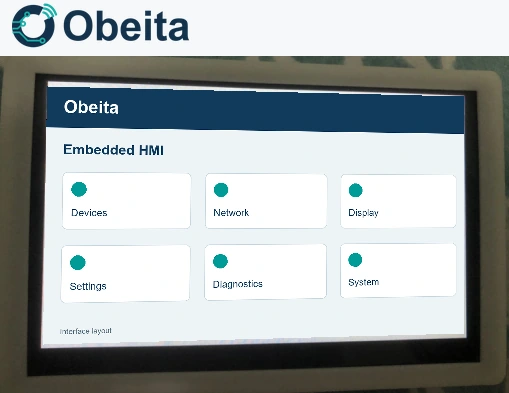
Create a compact Linux/Qt operator terminal using an Allwinner V3S core board and a separate peripheral carrier. The design combines a 5-inch 800 × 480 capacitive-touch display with local audio, Wi-Fi/Bluetooth, an RTC and sensors, making it useful for equipment status, settings and service interfaces.
Core board and carrier architecture
A 30 × 50 mm four-layer core board contains V3S, clock/reset circuitry and an EA3036 three-output power stage. The processor integrates 64 MB DDR2. A 76 × 100 mm two-layer carrier holds the product peripherals. A Mini PCIe-shaped connector is used as a board-to-board signal connection; its mechanical format does not mean that the pins implement standard PCIe.
Display, touch and power sequence
The RGB666 interface carries 18 colour data lines, plus timing/control signals; the panel pinout and voltage must match the actual board. A PT4103 backlight driver and one-button power circuit support the user-facing hardware. EA3036 rails are 1.2 V, 1.8 V and 3.3 V in this design. Panel timing, backlight current and touch interrupts are checked together before enclosure assembly.
Useful peripherals for an operator terminal
RTL8723BS uses SDIO for Wi-Fi and UART for Bluetooth. DS3231 provides an RTC, SHT30 measures temperature/humidity and MPU6050 supplies motion data. The audio path includes a microphone, headphone output and an 8002B speaker amplifier, with jack switching to be validated. These functions can support a service panel, local alarm interface or portable monitoring application rather than a generic tablet launcher.
Boot stack, storage and Qt application
Software work spans U-Boot, kernel configuration, device-tree/drivers, the root filesystem and Qt 5. The application must fit the 64 MB memory budget. An optional W25N01GV NAND position offers a possible storage path, but population, boot support and recovery must be agreed; the footprint alone does not confirm flash boot. Settings, audio and sensor views should be designed around the equipment workflow.
Mechanical layout and acceptance
The display covers the carrier face, so FPC routing, connector cut-outs and button positions affect serviceability. Keep copper away from the radio antenna region and allocate space for speaker, battery and cabling. Acceptance should measure boot time, touch response, application recovery and simultaneous peripheral operation, with the proposed screen artwork kept separate from runtime evidence.
Proposed design configuration
These are configuration inputs for development; the final assembly, firmware and acceptance tests define the delivered specification.
| Item | Configuration |
|---|---|
| Processor / RAM | Allwinner V3S; integrated 64 MB DDR2 |
| Display | 5-inch 800 × 480; capacitive touch; RGB666 |
| Software | U-Boot + Linux + rootfs + Qt 5 |
| Board sizes | Core 30 × 50 mm; carrier 76 × 100 mm |
| Peripherals | RTL8723BS, DS3231, SHT30, MPU6050 |
| Audio / power | Microphone, headphone, 8002B amplifier; one-button power |
Project questions
Can a standard Mini PCIe card be inserted into the carrier connector?
Do not assume compatibility. Here the connector shape is reused for board-to-board signals; compare every pin and voltage before connecting anything.
Can an existing desktop Qt application run unchanged?
Its memory use, graphics backend, libraries and input assumptions must be reviewed against the V3S platform and 64 MB RAM budget.
Plan this project
Send the intended operator screens, panel timing, required sensors and boot-time target for a Linux/Qt terminal scope.