SLE Wireless RS485 DTU Adaptation | Obeita
Project status: proposed configuration. Final specifications and delivery scope require project validation.
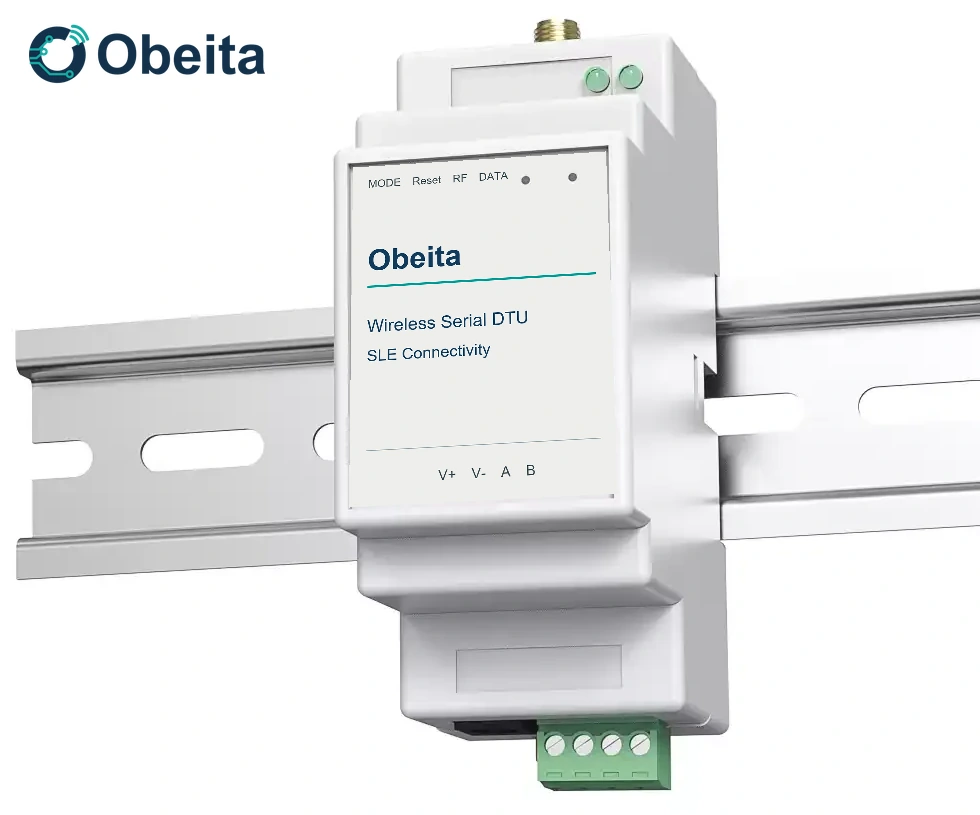
Bridge selected RS485 device connections over an SLE wireless network using DIN-rail DTU nodes. A master-side DTU connects to the PLC or host, while remote nodes connect to field instruments, reducing selected cable runs without discarding the existing device protocol.
Master and remote-node topology
The development direction is a one-master/multiple-node arrangement, with an illustrated target of up to eight remote nodes. Device addressing, message length and polling interval determine useful capacity. Pressure, level, temperature/humidity and energy instruments may share the system only when their timing and address rules are compatible.
Configuration and role assignment
The intended configuration workflow covers master/node role, serial settings, target identity and communication mode. Host and mobile configuration concepts appear in the material, but an export-facing tool should use an English interface and a maintainable provisioning route. Any wireless propagation of settings needs confirmation and a recovery procedure for nodes that fail to apply the change.
Antenna, rail mounting and installation
A 35 mm DIN-rail enclosure and external antenna suit cabinet installations. Stub and remote-mounted antennas create different clearance and cable-routing needs; test them in the actual site rather than assigning a guaranteed distance from a promotional comparison. Keep power specifications separate from the small radio module: the listing mixes module-sized values with a finished DTU faceplate.
Proposed design configuration
These are configuration inputs for development; the final assembly, firmware and acceptance tests define the delivered specification.
| Item | Configuration |
|---|---|
| Wireless direction | Hi3863 / SLE 1.0 |
| Field interface | RS485 |
| Topology target | One master; up to 8 nodes to be evaluated |
| Mounting | 35 mm DIN rail |
| Configuration scope | Role, serial parameters, node identity and mode |
| Power / range | Final assembly rating and site performance to confirm |
Project questions
Will a wireless bridge preserve every RS485 protocol automatically?
Not necessarily. Inter-frame timing, turnaround, broadcast behaviour and host timeouts must be checked with the actual devices.
How should an eight-node pilot be tested?
Use the intended packet sizes and poll intervals, include missing/offline nodes, then measure response time, loss and recovery after power cycling.
Plan this project
Send the PLC protocol, RS485 timing, node locations and antenna mounting options for an SLE bridge pilot.