BLE L2CAP CoC or GATT for Bulk Data: Framing, Credits and Platform Support
Choose a bearer from compatibility and flow control
For transferring a log or firmware image, the useful question is not whether L2CAP is “faster than Bluetooth.” Both GATT traffic and an LE connection-oriented channel use the Bluetooth stack and share radio constraints. Decide whether the supported phones and embedded stack offer the required channel API, whether the application can handle its backpressure, and whether GATT remains necessary for discovery and control. This guide compares GATT with LE Credit Based Flow Control channels using Bluetooth Core 6.0 and Zephyr 3.7.0 as explicit baselines. It does not assume Enhanced Credit Based Flow Control or claim any measured throughput advantage. For qualification, consult the SIG’s Core 6.0 page and mandatory updates; this engineering guide is not a compliance checklist.
Compare abstractions rather than packet-size slogans
GATT exposes services and characteristic operations; Nordic’s services-and-characteristics guide is a useful primary introduction to that model. A bulk protocol can use those operations, but it must respect the chosen operation’s limits and flow-control signals. An LE CoC offers a separate connection-oriented data channel. Core 6.0 L2CAP distinguishes the receive MTU, which bounds an SDU, from MPS, which bounds a protocol data payload. Neither is the radio PHY rate or a guarantee about application chunk size. Avoid comparing a minimal GATT configuration against a tuned CoC and calling the result inherent to the bearer. Compare equivalent security, radio settings and application workloads.
Verify both roles on every supported platform
Android’s createL2capChannel API was introduced at API level 29 and creates a secure outgoing LE CoC socket using the remote PSM. That does not establish support on every older phone or firmware. Apple’s WWDC2017 Core Bluetooth API introduction documents CBL2CAPChannel from iOS 11 and macOS 10.13 with input and output streams; check current SDK availability and lifecycle behavior for the actual deployment. On the embedded side, verify listener and initiator support, security policy, buffer configuration and the shipped stack release. A compile-time symbol alone is not a completed interoperation test. Keep a matrix of role, OS version, SDK, and observed channel-open outcome.
Discover the endpoint and negotiate the application contract
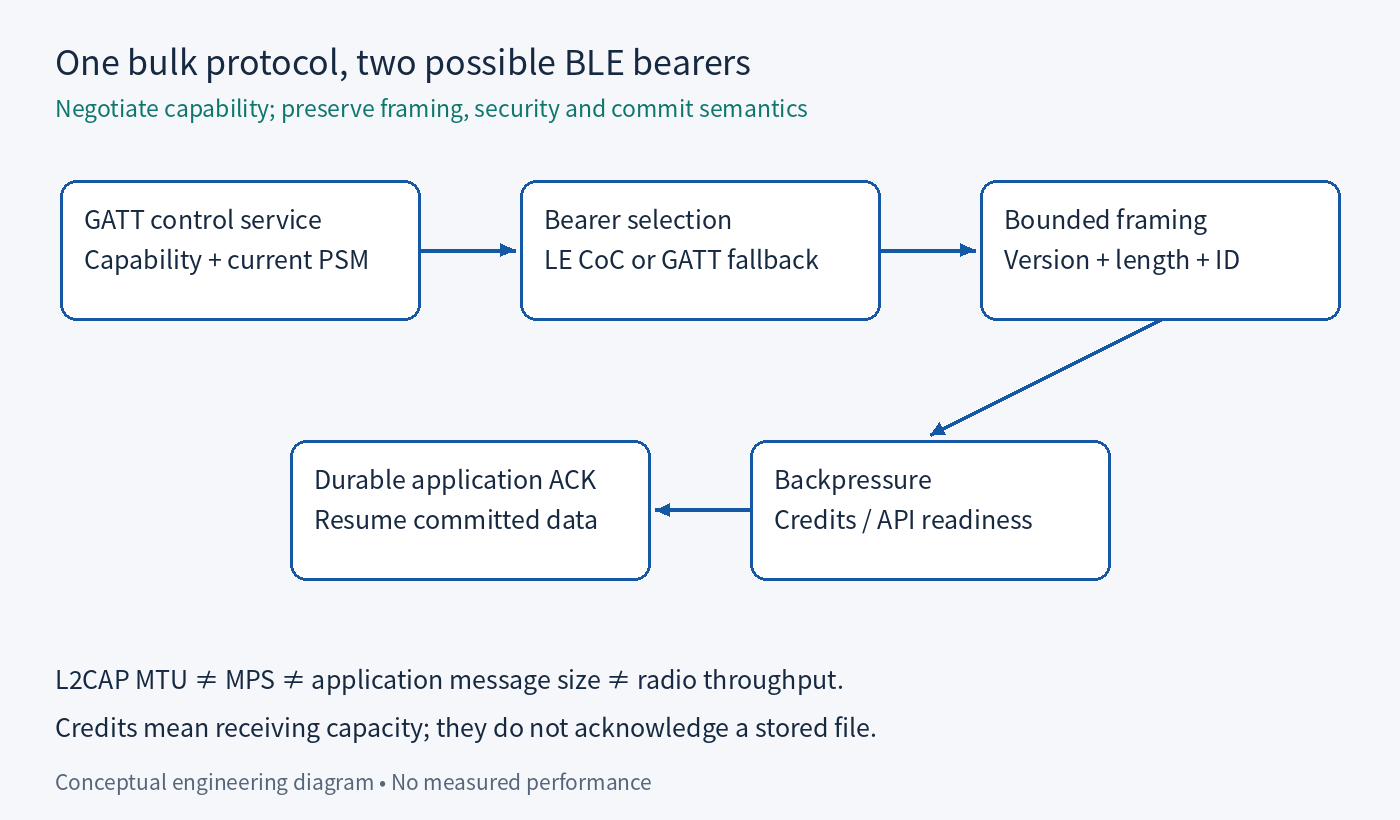
The client needs the correct service endpoint identifier, commonly a PSM, and must not treat a previously observed dynamic value as permanent. A small GATT control service can advertise capability and supply the current endpoint under the product’s access policy. Negotiate a bulk-protocol version, maximum application message, transfer identifier and required security before sending content. If the peer lacks CoC, choose a documented GATT fallback that preserves the same authorization and integrity requirements. A failed secure open must not silently retry through an insecure path. Decide when capability is re-read after reboot or reconnect so an old endpoint does not produce an unexplained transfer failure.
Do not confuse SDUs with mobile stream reads
L2CAP has SDU boundaries, but a platform can expose a stream abstraction above them. The mobile application must not assume that one read returns one complete message or that one write is consumed in a single callback. Use an explicit application frame such as a version, type, bounded payload length, transfer identifier and payload. Parse incrementally, validate the length before allocating memory, and handle partial headers and multiple frames in one input buffer. Define byte order and reject unsupported frame versions. For an image or log, add an application integrity check suited to the threat model and an explicit completion acknowledgment. Link encryption does not by itself prove that the intended file was fully stored.
Treat credits as receiving capacity, not completion
Core 6.0’s LE credit scheme consumes one credit per transmitted K-frame, not per application message or byte. The receiver grants further credits as capacity becomes available. Zero credits therefore require backpressure, not a busy retry loop or unlimited queued copies. Zephyr 3.7.0’s L2CAP API notes that its send can block while credits are unavailable and that its receive callback executes in the RX thread, where long blocking work is discouraged. Follow that version’s buffer-ownership and asynchronous-completion rules. Never block the thread required to release receive resources while waiting for a send that depends on those resources. A returned credit is still not an application commit acknowledgment.
Define interruption and fallback without duplicate commits
Track transfer identity and the receiver’s durable progress separately from bytes submitted to the local socket. After a disconnect, cancel old asynchronous work and establish which chunks the receiver actually committed before resuming. If the design falls back from CoC to GATT, retain the same logical transfer identifier and idempotent chunk semantics, or restart through an explicit discard procedure. Do not run both bearers as competing writers to one file. A receiver should reject inconsistent offsets, lengths or content identity. Put a bound on temporary storage and expired transfers, and ensure cancellation releases channel buffers. These are application protocol requirements that neither CoC credits nor ATT responses supply automatically.
Use an equivalent-workload acceptance matrix
Test both bearers with the same payload, security state, connection conditions and device pair. Include minimum supported OS versions, unsupported CoC, rejected security, a slow consumer, a full receive queue, disconnect during a partial frame, stale PSM, cancellation and restart. Report useful bytes committed, elapsed time, memory high-water mark and energy if actually measured; include failed transfers in the results. This article provides the proposed matrix and no performance numbers. Choose CoC when its compatibility and backpressure model serve the product, and retain GATT where its reach and operational simplicity are preferable. The release decision should be based on complete, recoverable transfers, not on a headline MTU or a successful channel-open callback.