Buildroot Package Patches: Ordering, Global Patch Directories and Refreshable Diffs
Treat the patch stack as an ordered input
A package update can fail even when every individual patch looks reasonable. A board-specific change may depend on an earlier Buildroot fix, an upstream release may already contain a backport, or two global directories may apply competing edits. The useful unit of review is the complete ordered transformation from the selected source archive to the source actually compiled.
This guide uses Buildroot 2025.02. It focuses on package patch ordering and refreshable changes, not on deciding a kernel maintenance strategy. The example package name, meter-agent, is illustrative. No patch was applied or product built for this article. Use a disposable source workspace and a separate Buildroot output directory when carrying out the proposed checks.
Inventory all patch inputs before editing one
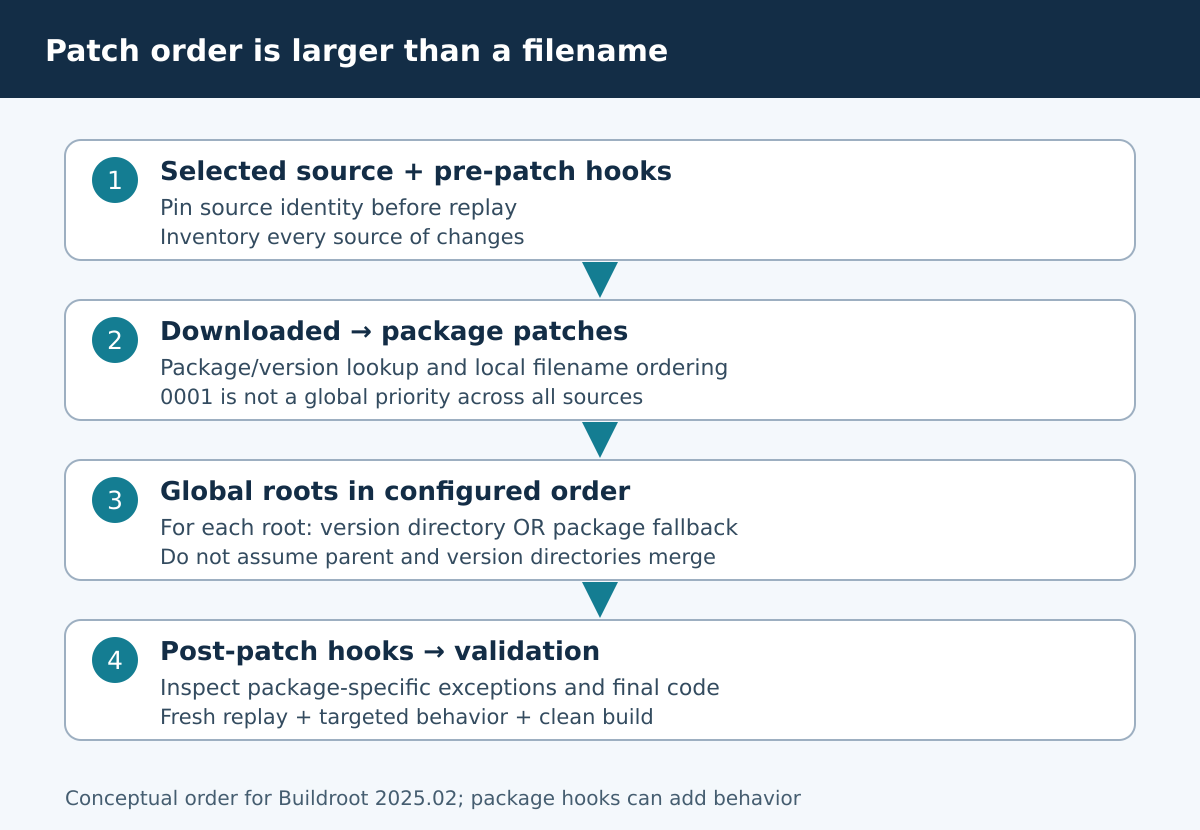
List the package version, downloaded patch entries, patches shipped inside its Buildroot package directory, every BR2_GLOBAL_PATCH_DIR entry and any pre/post-patch hooks. Record the exact ordering of global directories in the product configuration. A filename containing 0001 only orders a patch within its selected patch set; it does not make that patch precede every other patch source.
For the ordinary package flow, the 2025.02 patch policy places pre-patch hooks first, downloaded patches before package-directory patches, global directories afterward in their configured order, and post-patch hooks last. Package-specific hooks can add behavior, so inspect the actual recipe rather than treating this summary as a universal override of package logic.
Choose version-specific directories deliberately
For each global directory, Buildroot checks for a package/version subdirectory first; when that exists, it uses that directory rather than also treating the parent package directory as an additional common layer. Otherwise it can use the package directory itself. The 2025.02 customization reference defines this lookup.
board/acme/common-patches/meter-agent/
  0001-fix-cross-compile-probe.patch
board/acme/product-patches/meter-agent/2.4.0/
  0001-add-board-calibration-path.patch
The fictional layout shows two separately configured roots. It does not claim that a parent directory and its version child are merged. Document which root supplies reusable policy and which supplies a product-specific change. When the package version changes, verify the selected directory again: an old version-specific directory may stop matching and expose a different fallback patch set.
Make order visible and each change reviewable
Use zero-padded numeric filenames followed by a useful description. Within a selected directory, alphabetical ordering is predictable. Buildroot 2025.02 still describes legacy series-file handling, but its patch policy discourages introducing new series files. Avoid maintaining two competing ordering mechanisms in a new patch set.
Keep one coherent purpose per patch. Include the problem, why the product needs the change, an upstream reference or clearly explained upstream status, and any adaptation from the original fix. Preserve original authorship and sign-off information when refreshing a patch. Never invent a Signed-off-by line for someone else. A patch header should let a future maintainer decide whether to keep, revise or remove the change without reconstructing its history from guesswork.
Refresh against the complete predecessor stack
When a patch no longer applies, recreate its intended change on top of the exact source plus all earlier patches. Do not refresh it against pristine upstream if the product build applies several prerequisites first. Conversely, avoid including unrelated edits from the working directory in the replacement diff. Review the patch text as carefully as the resulting source.
First check whether the new upstream version already contains the fix. An “already applied” message is a reason to investigate, not a reason to force reversal or suppress the error. Compare behavior and the upstream change, then remove an obsolete local patch only after confirming that its intended effect is retained. A textual match alone can miss follow-up fixes or a product-specific adaptation.
Replay from fresh extraction and preserve the log
A previously patched build directory is poor evidence for the new stack. Configure a separate output directory with the candidate patch set and run the relevant patch/build stages there, preserving the original output. Capture source identity, selected patch paths, application order and any offsets or fuzz reported by the patch tool.
Even a successful application with offsets deserves review when surrounding code changed. A patch can land in a similar-looking but unintended location. Inspect the modified functions and run a focused test of the behavior the patch is intended to change. The 2025.02 generic package implementation is the authority for the actual patch stage and hooks when a project’s logs are ambiguous.
Recognize cases outside the normal patch flow
Local-source and override-source development paths can differ from archive extraction and patching. In particular, the 2025.02 generic-package documentation states that the local site method does not apply the normal patch set; it offers post-rsync hooks for that workflow. Do not conclude that a release patch works because a developer’s already-edited local tree compiled.
The Linux package also has a documented ordering exception: BR2_LINUX_KERNEL_PATCH is applied through a post-patch hook after global patches. If the package under review is Linux, include that extra source in the inventory. Keep the normal package policy and package-specific behavior distinct, and trace the exact selected tag rather than borrowing an ordering claim from a newer manual.
Acceptance and a maintainable patch ledger
Accept the stack when a fresh extraction selects the intended directories, applies every required patch once in the expected order, and produces the intended source changes. Require a focused behavioral test for each important fix, plus a clean build under the product configuration. These are proposed acceptance steps; this article provides no executed-build result.
Maintain a compact ledger with patch filename, purpose, origin, upstream status, predecessor assumptions and removal condition. Record both the package version and Buildroot tag. This makes an update review about the continued need for each change, rather than about keeping a collection of diffs applying indefinitely. The ledger is also the place to note unsupported configurations and tests still awaiting hardware.