Flash Program Alignment Errors: Distinguish Driver Rejection from Filesystem Corruption
Before calling a failed flash write “filesystem corruption,” capture the exact request at each layer: device, offset, length, buffer, return code, and whether any physical command was issued. A driver rejecting an invalid request is a different event from a chip accepting a command and storing unexpected bytes.
This diagnostic method uses the Zephyr v4.2.0 flash API and its generic SPI NOR driver, with SST26VF064B/SST26VF064BA datasheet DS20005119K as a device-boundary example. It does not establish that every board uses that driver or device. The goal is a runtime request matrix and an error-origin map, rather than a filesystem configuration tutorial.
1. Identify the violated contract
The v4.2.0 flash API requires write offset and length to be multiples of the minimum write-block size supported by the driver. It separately says source-buffer alignment is unrestricted for this public API. Do not confuse a misaligned flash offset with an unaligned RAM pointer or assume that a private controller interface has the same contract.
Read flash_get_write_block_size() for the actual device and inspect the selected driver. The API notes that a driver’s exposed write size can differ from the memory’s physical write unit. Record partition-relative and device-relative offsets together; an aligned local offset can become invalid after an incorrect base translation.
Also check range, protection, erased-state requirements, and completion. An invalid-argument result is not uniquely an alignment diagnosis. A timeout or I/O error may originate after some activity has already occurred. Preserve the first error instead of replacing it with a later generic mount failure.
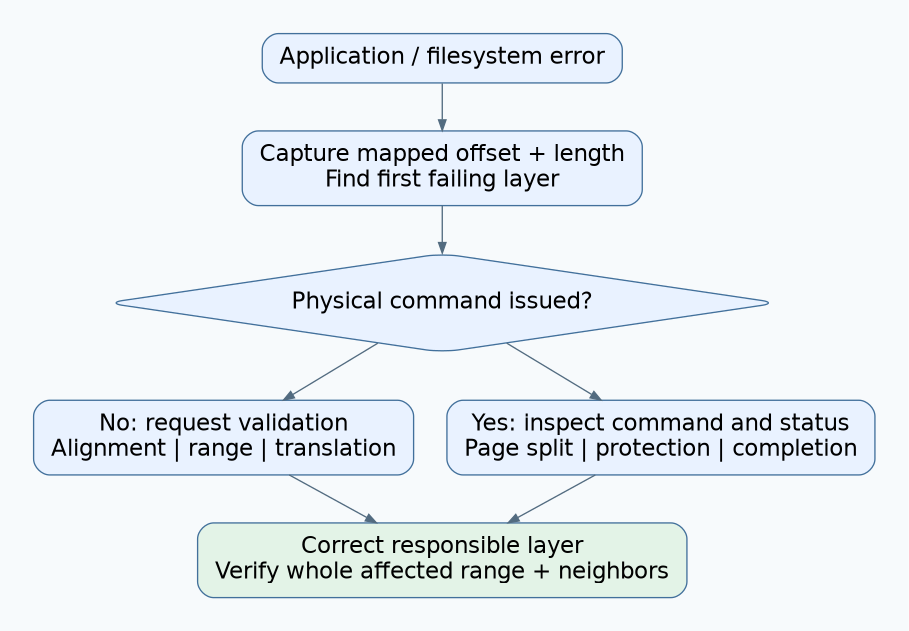
2. Trace the smallest reproducing request
At the filesystem adapter boundary, record logical block, block offset, requested length, and the mapped flash address. At the driver boundary, record the actual offset and length, driver-reported write unit, return value, and relevant status. Where necessary, capture a nonintrusive bus trace or narrowly instrument command submission.
Keep the trace outside the failing storage region. Avoid logging full application payloads when addresses, lengths, and a test-pattern identifier are enough. Preserve an image of valuable data before experiments, and stop background writers so that unrelated traffic does not obscure the sequence.
A useful record says “driver rejected offset X and length Y before command submission,” rather than “write failed.” If the integration cannot prove whether a command occurred, mark that uncertainty and verify the affected range instead of assuming it is unchanged.
3. Use an alignment boundary matrix
Let W be the actual minimum write-block size and A a legal, in-range aligned address. Perform non-writing validation first. Physical write tests require an authorized disposable region, known erase state, and neighboring sentinels. Do not probe intentionally invalid writes against production settings or boot firmware.
| Case | Request or observation | Expected interpretation |
|---|---|---|
| Aligned control | Offset A, length W, all other prerequisites valid. | Establishes the basic supported path. |
| Offset violation | Offset A+1, length W, when W is greater than one. | The integration should reject the unsupported offset without expanding the target. |
| Length violation | Offset A, length W−1, when W is greater than one. | Checks size validation independently of address validation. |
| Region end | Last legal unit, then a request extending beyond the owned region. | Checks range and partition translation, not just alignment. |
| Physical page crossing | A legal API request spanning a chip program-page boundary. | Checks driver splitting even though API alignment is valid. |
| Source-pointer variation | Equivalent source bytes at different RAM alignments through the public API. | Checks the documented buffer contract and any wrapper deviation. |
Where W equals one, there is no byte-offset or byte-length misalignment of this kind. The Zephyr v4.2.0 generic SPI NOR driver exposes a one-byte write-block size. Imposing an unexplained four- or eight-byte rule would misdiagnose that interface.
4. Separate API alignment from chip page wrapping
The cited Microchip chip accepts Page Program data in whole-byte increments, up to 256 bytes, but data crossing the 256-byte page boundary wraps within that page. See DS20005119K section 5.20. This is a physical command rule, distinct from a public driver’s minimum write alignment.
The pinned generic SPI NOR driver limits each command to the current page boundary. For an illustrative 256-byte configured page size, a 48-byte request beginning at device offset 0x1F0 needs a 16-byte chunk followed by a 32-byte chunk. The arithmetic predicts the boundary split; it is not a captured hardware trace or proof of a particular board’s configuration.
If the bus shows one wrapping command instead, inspect the active driver, page-size discovery, and any custom adapter. Do not “repair” filesystem metadata to compensate for a lower-layer command error.
5. Fix the owner of the invalid request
- Wrong mapping: correct base translation or overflow handling and verify the entire partition boundary.
- Unsupported offset or length: make the caller honor the driver’s contract or provide a deliberately designed adapter.
- Wrong physical split: fix command construction and page-size information.
- Legal request with device failure: investigate protection, power, status, erase prerequisites, and hardware behavior.
- Valid lower layers but bad stored structures: preserve the image and investigate filesystem-level consistency separately.
Blindly rounding an address down or padding a length upward can overwrite neighboring data. A read-modify-write adapter needs ownership of the whole affected unit, concurrency control, correct erase behavior, and a power-loss design. It is not a harmless arithmetic patch. Never issue a broader erase merely to make one rejected write succeed.
Hypothetical diagnosis
A new port reports a storage error only for short records. Its trace shows the filesystem adapter forwarding a four-byte request to a hypothetical driver requiring eight-byte write units. The driver rejects it before programming. The correct investigation is the adapter contract and its data-preserving implementation, not an assumption that the existing filesystem is damaged.
After the correction, rerun the boundary matrix, verify neighboring bytes, and exercise remount and interrupted-operation tests on disposable media. Keep the exact failing request as a regression fixture. A successful retry alone does not establish that the integration now preserves every adjacent byte.