Cross-Build Linker Maps: Attribute Duplicate Implementations Before Removing Libraries
Use the linker map to identify which object owns each suspected duplicate implementation and which reference caused it to enter the executable. Then replace or remove one implementation at a time and rerun the same functional checks. A large library name or two similar symbols is not enough evidence to delete a dependency.
This guide pins GNU Binutils 2.44 and reports an executed GCC 14.2.0 x86-64 fixture. It uses two deliberately equivalent teaching loops, not production cryptography or a customer algorithm. No target flash footprint, runtime speed or real product saving was measured.
Distinguish duplicate meaning from duplicate symbols
Two libraries can contain the same algorithm under different symbol names without producing a multiple-definition error. Conversely, similarly named functions may implement different formats, boundary behavior or error contracts. Linker information locates code; semantic equivalence still requires source review and tests.
Begin with a narrow hypothesis, such as “these two private checksum wrappers contain equivalent loops.” Record the two API entry points, callers, expected input domain and ownership constraints. Do not turn a rough size report into a broad library-removal campaign.
Capture the exact link invocation, object and archive identities, linker script and optimization settings. A map from a debug build does not automatically explain a production build using different LTO or section-selection options.
Generate an attribution map and cross-reference table
The GNU ld 2.44 options reference documents map output, including archive members selected and the symbols that caused their inclusion. Its –cref option adds a symbol cross-reference table to the map when one is generated.
# Proposed pattern for the product's existing link invocation:
cc objects... libraries... -Wl,-Map=application.map,--cref   -o application
Use the actual target compiler driver in a cross build; the generic cc spelling above is not a replacement toolchain selection. Give the output and map explicit owned paths, and preserve the complete successful link command.
For each candidate, copy the archive member, input section, symbol, contribution size and referring file into a worksheet. In the cross-reference table, the defining file appears before referencing files for a defined symbol. Follow references far enough to explain why both implementations remain reachable.
Read the executed two-library example
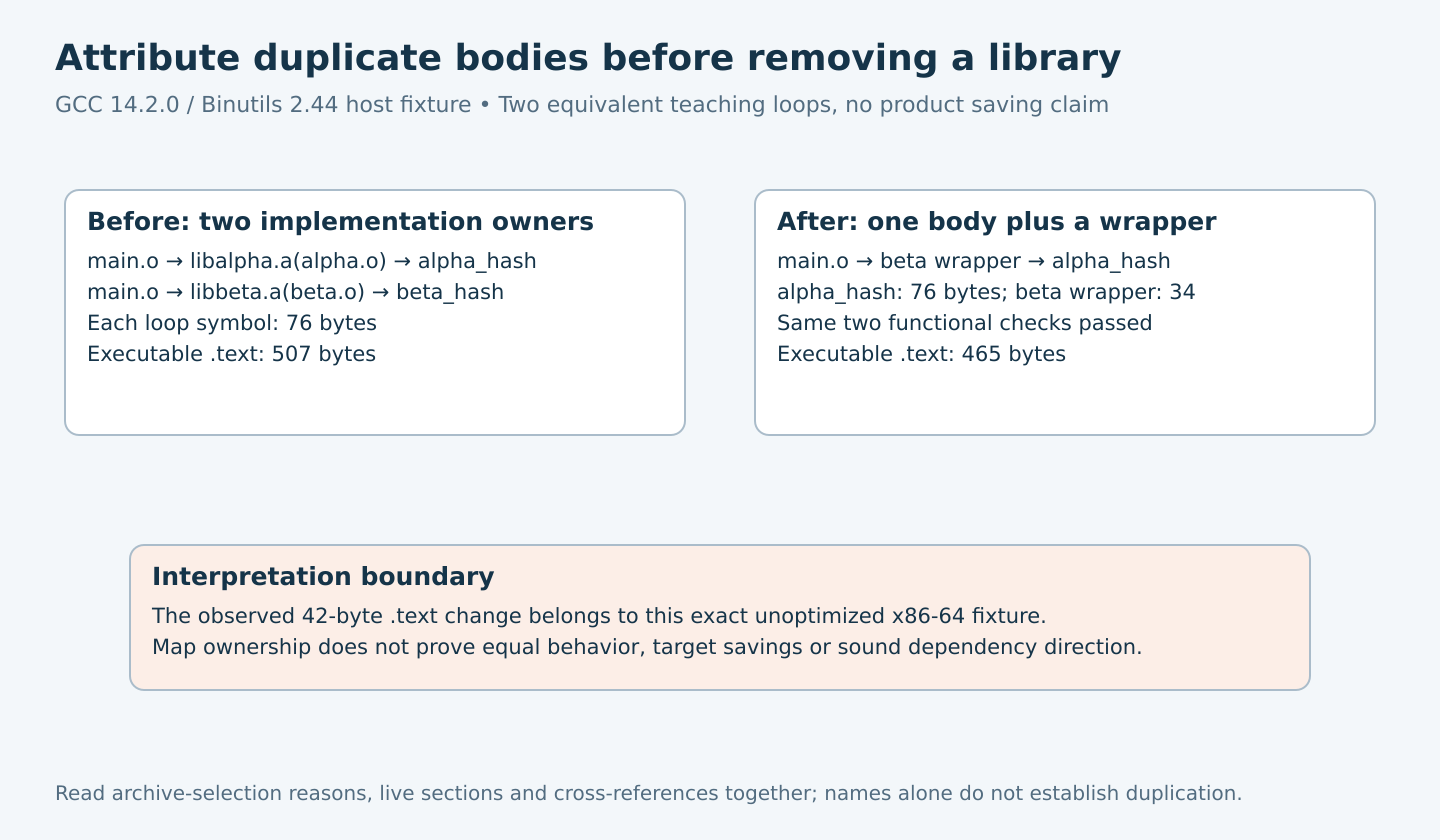
The fixture compiled alpha_hash and beta_hash into separate archives. Both implemented the same unsigned recurrence over a byte array: multiply the accumulator by thirty-three, then add the next byte. Distinct names made both definitions legal.
The original map identified libalpha.a(alpha.o) as selected for main.o’s alpha_hash reference and libbeta.a(beta.o) for its beta_hash reference. Both loops were genuinely linked; this was not a count of source files that the linker had discarded.
| Worksheet field | First implementation | Second implementation |
|---|---|---|
| Public fixture entry | alpha_hash | beta_hash |
| Owning archive member | libalpha.a(alpha.o) | libbeta.a(beta.o) |
| Initial reference root | main.o | main.o |
| Observed symbol size | 76 bytes | 76 bytes |
The test required both functions to return 1,158 for the three bytes one, two and three, and zero for an empty input. Those are executed assertions for the teaching code, not a comprehensive equivalence proof for arbitrary libraries.
Replace one body while retaining the intended API
The revised fixture preserved beta_hash as a wrapper but delegated its implementation to alpha_hash. It linked libbeta_wrap.a instead of libbeta.a, keeping existing caller names intact. The resulting map showed the wrapper member and the surviving alpha implementation.
Both functional checks still passed. Symbol-size inspection reported alpha_hash at 76 bytes and beta_hash at 34 bytes. The executable’s .text section changed from 507 to 465 bytes, a forty-two-byte reduction in this exact unoptimized host fixture.
The Binutils inspection reference supplies the nm and size views used for those observations. Symbol size and aggregate section size answer different questions. Whole-file size can also include alignment, notes, debug information and headers, so do not extrapolate the forty-two bytes into an image or flash saving.
Check the replacement’s semantic and ownership cost
Before consolidating real code, compare byte order, overflow behavior, accepted lengths, error returns, allocation ownership and thread safety. An implementation that is equivalent for a happy-path vector may differ on malformed or empty input.
Also review dependency direction. Making library B call library A introduces a relationship that can affect installation, initialization or future upgrades. In the fixture that relationship is deliberate and simple; in a product it might create an undesirable dependency cycle or cross-component ownership burden.
Retain the original failure or size hypothesis and the exact change. If removing one archive breaks an unrelated feature, the map has exposed an additional owner or reference to investigate. Do not hide that failure by indiscriminately adding other libraries until linking succeeds.
Account for optimization and discarded sections
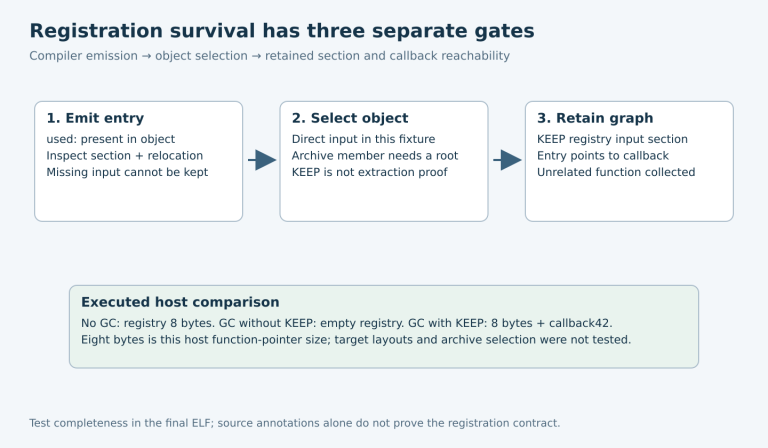
The fixture used -O0, disabled inlining and did not enable LTO, garbage collection or identical-code folding. That made ownership easy to observe. A production build may inline, merge or discard code, so repeating the attribution under its actual options is necessary.
Read the discarded-section area separately from live output sections. A symbol mentioned somewhere in the map is not automatically consuming executable space. Likewise, a library named on the command line may contribute no archive members at all.
Use section-address and size evidence to support the claim that both implementations survive. When optimization obscures attribution, preserve intermediate reports and use the compiler/linker facilities appropriate to that exact toolchain rather than inferring ownership from source filenames.
Release a small, reviewable comparison
Keep before/after maps, symbol inventories, section sizes, artifact hashes and identical functional-test results. State the tested input domain and the new dependency relationship. Separate a measured host code-size difference from unmeasured target effects.
The useful outcome is an explained ownership change with preserved behavior, not merely a smaller number. Here one redundant teaching loop became a wrapper and the scoped checks passed. A real consolidation still needs its own semantic review and target qualification.