Buildroot Package Build Parallelism: Find Upstream Races Hidden by Serial Builds
If an upstream package succeeds serially but fails in parallel, identify the missing dependency between its own outputs and consumers. A generated header and an object listed as siblings under all are not automatically ordered. Fix the producer-to-consumer edge instead of relying on the order that a serial build happened to choose.
This guide pins GNU Make 4.4.1 and Buildroot 2025.02’s autotools-package guidance. An executed host fixture used GCC 14.2.0 and a controlled generator gate to expose one missing edge. It did not run a complete Buildroot image build or measure the frequency of a naturally occurring race.
Locate the ordering boundary inside the package
First establish that the host generator and external libraries are already available before this package builds. Then inspect the package’s own rules: which target produces the header, which command reads it and what prerequisite connects them?
This is a different problem from a missing Buildroot dependency on another package. Adding an unrelated package dependency cannot correct an upstream Makefile that starts a consumer before its own generated header exists.
Preserve the exact failing command and the first missing input. Parallel logs can interleave unrelated output, so identify the working directory and rule owner rather than treating the last make error as the cause. Keep a successful serial log as a comparison, not as acceptance evidence.
Make the missing edge visible
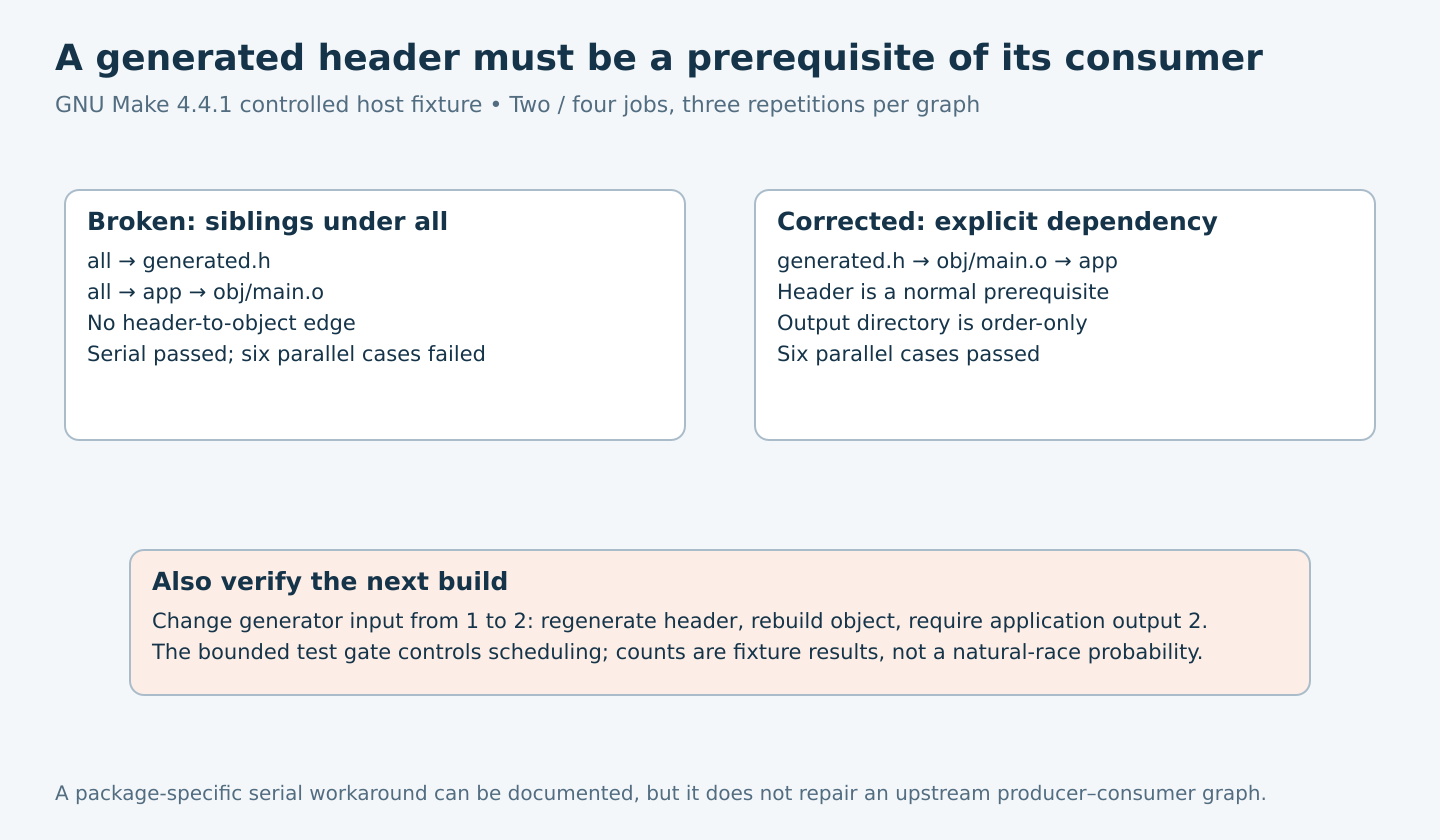
The teaching defect gave all two prerequisites: generated.h and app. The application depended on its object, but that object’s rule omitted generated.h. A serial make happened to generate the header first and the executable printed one.
In a parallel invocation, Make was free to start the generator and consumer together. The GNU Make 4.4.1 manual defines parallel job slots and prerequisite ordering; sibling order is not a substitute for a dependency between those siblings.
The fixture made this observation deterministic with a test-only gate. The generator announced readiness and waited for a bounded release signal. A consumer wrapper recorded its start and rejected a missing header before invoking GCC. The harness released the generator only after that missing-header observation in the broken case.
This schedule deliberately exposed the permitted ordering. It was not a timed sleep presented as a field-race measurement, and it did not claim that GCC itself produced the controlled rejection. The wrapper’s missing-input check was the failure detector.
Use normal and order-only prerequisites correctly
The corrected graph made the generated header a normal prerequisite of the consuming object and the output directory an order-only prerequisite:
generated.h: value.txt gen.py
	python gen.py

obj:
	mkdir -p obj

obj/main.o: main.c generated.h | obj
	$(CC) -c main.c -o obj/main.o

app: obj/main.o
	$(CC) obj/main.o -o app
This is a focused rule fragment; the executed harness additionally used its consumer-check wrapper and gate markers. Both variants express the same required header-to-object edge.
A normal prerequisite imposes ordering and makes a newer input trigger rebuilding. An order-only prerequisite imposes ordering without treating its timestamp as a reason to rebuild the target. That distinction is useful for directories, whose timestamps change when entries are added or removed.
Do not put generated.h only after the pipe. That can establish initial ordering while failing to rebuild the object when the header later changes. The dependency must describe both first-build readiness and incremental invalidation.
Read the controlled test results
| Executed case | Result | What it establishes |
|---|---|---|
| Broken graph, serial | Build passed; application printed 1. | Incidental serial order can hide the defect. |
| Broken graph, gated parallel | Six cases rejected the missing header. | The consumer could start before its producer completed. |
| Corrected graph, gated parallel | Six cases passed; application printed 1. | The declared edge kept the consumer behind generation. |
| Generator input changed | Object rebuilt; application printed 2. | The normal prerequisite preserved incremental invalidation. |
The parallel cases used two and four job slots, with three fresh-directory repetitions of each graph at each setting. Each generator wait had a bounded timeout. The corrected case released the generator after its readiness marker; the consumer could proceed only after the generated target completed.
The input-change check modified value.txt after the successful corrected build. The generator produced a new header, the object’s timestamp advanced and the program printed two. A fix that passed only clean builds but missed this update would be incomplete.
Review output ownership as well as ordering
A complete graph also needs one owner for each generated output. If multiple rules write the same header concurrently, adding a consumer prerequisite may not prevent producer-producer corruption. Trace all rules that can update the file and make their relationship explicit.
The fixture wrote a temporary header and replaced the final file after completing its contents. That construction avoids exposing a partially written fixture header, but it does not substitute for correct Make dependencies or prove atomic multi-file generation.
Keep generated output in the package’s build directory rather than mutating a shared source tree. If one invocation produces several files, use the build system’s supported multi-output rule model and test its incremental behavior separately.
Use serial fallback as a bounded workaround
The Buildroot 2025.02 autotools guidance documents a package-specific LIBFOO_MAKE=$(MAKE1) choice when parallel building is unsupported. Apply the real package prefix and infrastructure rules; this is not a universal variable for every Buildroot package type.
Serializing the affected package can be a documented temporary workaround. It is not evidence that the upstream graph is correct, and it should not silently disable parallelism across unrelated packages. Retain the reproducer and the reason for any workaround.
Release the minimal missing-edge case, corrected graph, controlled schedule and input-change regression together. The host results establish one upstream ordering repair. The real package still needs clean and incremental builds under its actual Buildroot toolchain and configuration.