Buildroot Git Bug Reports: Share a Reproducible Case Without Exposing the Product
A useful Buildroot Git bug report lets another engineer recreate the same failure from a stated revision and configuration. It should also avoid exposing customer repositories, credentials or unrelated product details. The goal is a small, faithful reproduction with enough context to investigate, not the largest possible log archive.
This article focuses on preparing that report. It does not describe a completed customer incident or promise that maintainers will diagnose an issue from any particular checklist. The proposed method separates observed facts, reduction experiments and unresolved assumptions so the recipient can judge the evidence.
Start with the observed failure
Write the expected behavior and the actual result before proposing a cause. Name the failing stage, such as source retrieval, patch application, configuration, compilation or image creation. Include the command and a useful section of output around the first meaningful error.
A final build-system error often reports that an earlier command failed without explaining why. Preserve enough preceding context to expose the original diagnostic. If multiple errors appear, say which one is reproducible and avoid combining unrelated failures into a single report.
The Buildroot reporting guidance asks for version, host, target, failing package and command information, together with configuration. Use that as the factual foundation, then explain what is specific about the Git checkout being investigated.
Identify the tree that actually failed
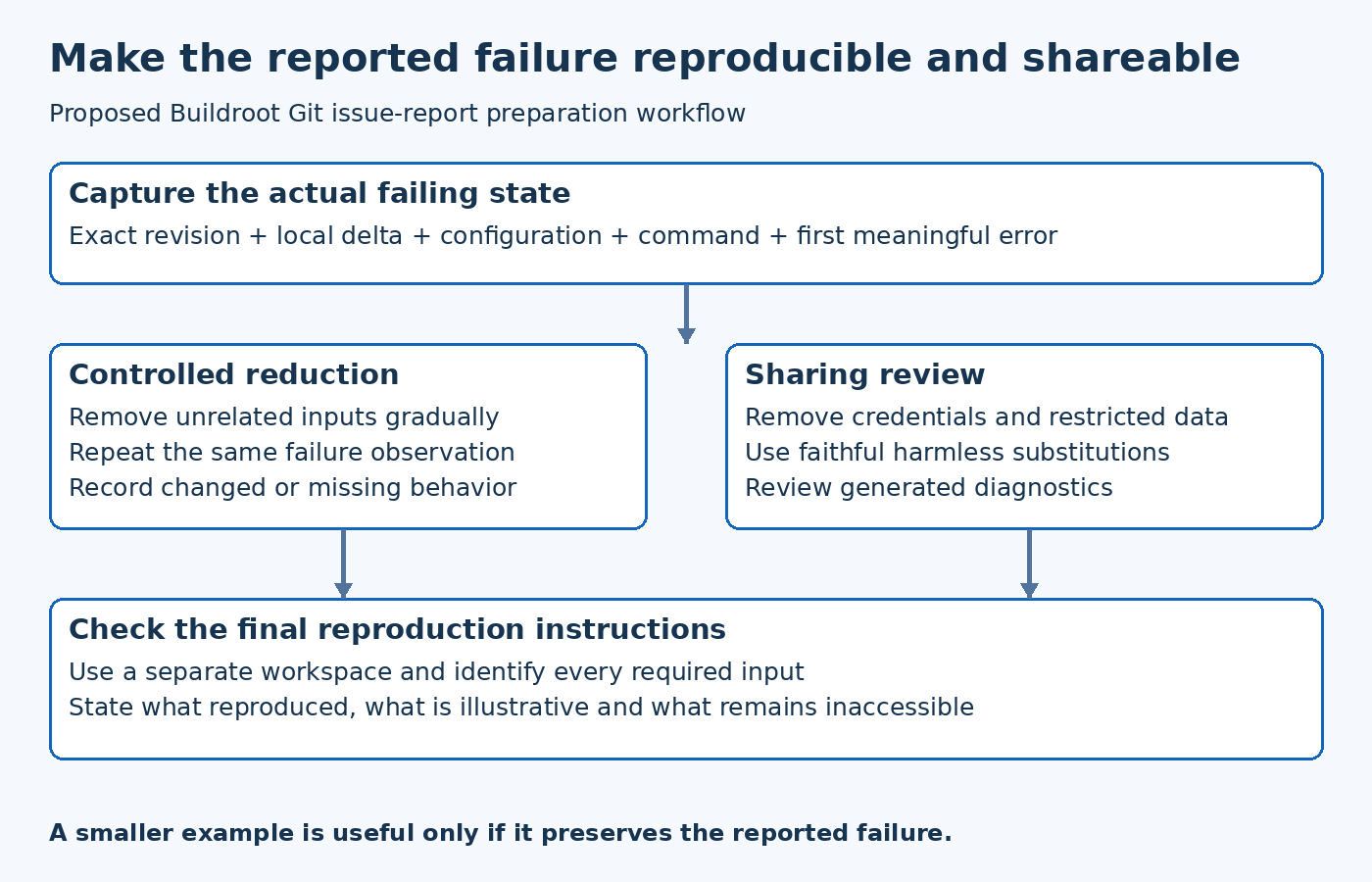
Provide the exact Buildroot commit rather than only a branch label that may move. Describe local modifications and external product trees that affect the reproduction. If the failure occurs only with an uncommitted patch, a clean upstream commit identifier alone is an incomplete description.
Separate the public upstream base from the product-specific delta. An authorized minimal patch can sometimes reproduce the issue without exposing the complete product tree. If no shareable reduction exists, state the limitation rather than implying that maintainers can rebuild an inaccessible configuration.
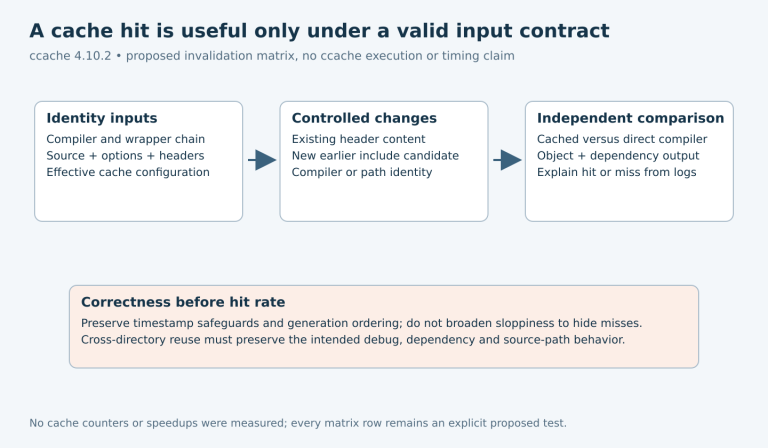
Keep the effective failing configuration as evidence before simplifying it. A compact defconfig is convenient, but its interpretation depends on the Buildroot revision and available external configuration definitions. Check that the recipient can resolve every required input.
Reduce the case one change at a time
Remove unrelated packages or board customizations in a controlled copy of the configuration. After each meaningful reduction, repeat the observation that identifies the failure. If the problem disappears, restore the relevant difference and investigate the boundary rather than presenting the reduced success as equivalent evidence.
A hypothetical package may fail only when an optional dependency is enabled. Removing that dependency makes the configuration smaller but also removes the bug. The useful report preserves the option and explains why it remains in the minimal case.
Record the reduced case separately from the original. It should be clear whether the report demonstrates the same diagnostic, a similar symptom or only a suspected relationship. Minimization is an experiment, and a partial reduction is still useful when its limits are explicit.
Control hidden build-state dependencies
Note whether the reproduction uses a fresh output directory or an existing incremental build. If the failure depends on earlier configuration changes, record that sequence. A recipe that fails after an upgrade but succeeds from a fresh output needs a different investigation from a clean-build failure.
Include the relevant host and toolchain information without assuming a container name fully describes the environment. If a source download depends on a private mirror or a local override, either provide an authorized substitute that reproduces the issue or state that the reproduction is not independently complete.
A report should identify prerequisites, not silently rely on the sender's caches. Testing the instructions from a separate disposable workspace is a useful way to discover omissions before asking another engineer to repeat them.
Distinguish Git diagnostics from Buildroot diagnostics
Sometimes the failure is genuinely in a Git operation, while other failures occur later in Buildroot's package flow. Do not assume a Git repository problem merely because the project is stored in Git. Identify the command that failed and its inputs.
The official Git bugreport documentation describes collecting Git, machine and repository information along with reproduction details. That tool can help a Git-specific report, but it does not collect the whole Buildroot configuration and product dependency context automatically.
Review any generated diagnostic file before sharing it. Automated collection is a convenience, not a privacy review. Explain which portions are relevant to the failure instead of attaching an unexplained bundle and expecting the recipient to infer the problem.
Redact carefully and test the redacted case
Inspect logs, URLs, configuration fragments and patch headers for credentials, internal hostnames, customer identities and proprietary paths. Remove secrets entirely. Do not leave a live token embedded in an otherwise public source URL.
When replacing a private value with a placeholder, distinguish a cosmetic redaction from a functional substitution. Changing a path's characters, length or quoting can affect a path-related failure. If that matters, create a harmless public value with the required properties and verify the issue again.
Do not claim that a sanitized example reproduces the defect until it has actually been checked. Where checking is impossible, label the example as illustrative and retain the original diagnostic description without disclosing restricted material.
Finish with a bounded investigation request
Summarize what was tested, which revisions were involved and what remains unknown. Link an existing public report if relevant, and avoid declaring a root cause solely from timing or a nearby commit. A suspected regression boundary can guide investigation without being presented as proof.
The final report should allow a reader to answer four questions: what failed, which inputs produced it, how to repeat it and what cannot yet be shared or verified. That is a stronger handoff than an unfiltered product archive. It also preserves a reusable internal record when the eventual fix needs to be checked against the original failure.