Buildroot Git Mirrors: Preserve Access to the Commits Your Release Needs
A pinned Git commit identifies source content, but it does not guarantee that a future build can retrieve that content. A Buildroot release needs both an exact source identity and a retention plan for the repositories and downloaded artifacts behind it. Treat a successful checkout today as the start of that plan, not proof of long-term recoverability.
The problem is especially visible when a vendor rewrites a development branch, removes a repository or changes access arrangements. The build description can remain unchanged while its source becomes unavailable. The following workflow is a proposed preservation review; it does not claim that any particular mirror or release has been recovery-tested.
Separate identity from availability
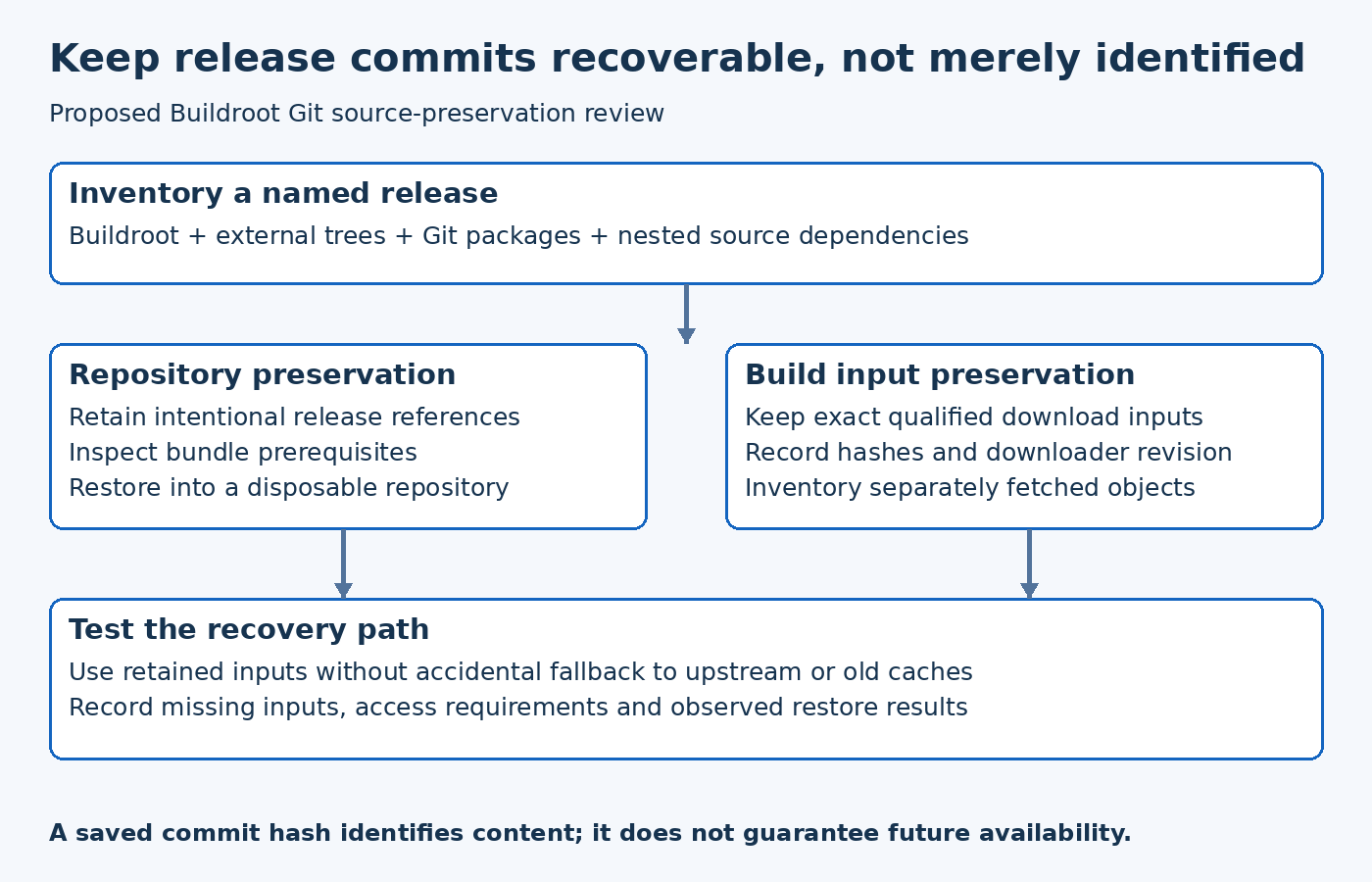
List the Git repositories involved in the release: the Buildroot tree, external product trees and packages retrieved from Git. Associate each with its selected commit and the release configuration that uses it. Include nested repositories when the package requires them, rather than assuming the parent repository contains every dependency.
For each entry, ask two questions. Can the commit be identified unambiguously? Can its necessary objects be recovered without relying on an individual developer's machine? A spreadsheet of hashes answers the first question only. An undocumented disk cache may answer neither reliably once its owner leaves the project.
Keep the preservation record tied to a release, not merely to the current development branch. Older supported products may depend on revisions no longer present in active development references.
Understand what a live mirror protects
A mirror that follows an upstream repository is useful for availability, but its update and deletion policy matters. If it reproduces removed references, it may stop providing the convenient names that previously retained release history. Establish a deliberate policy for release references instead of assuming that synchronization is equivalent to archival retention.
The official Git garbage-collection reference explains that maintenance can remove unreachable objects and expire reflog information. Do not rely on an object remaining forever just because it once existed in a clone. Retention depends on the repository's actual references, policies and maintenance behavior.
This is not a recommendation to disable maintenance everywhere. It is a reason to make supported release objects intentionally reachable and to test the chosen preservation method. Avoid changing production repository retention settings casually during an incident.
Preserve a recoverable repository artifact
The Git bundle documentation describes an offline transport for Git objects and references. A bundle can be self-contained or depend on objects already available elsewhere. That distinction matters when selecting an archival artifact for a recovery environment that starts empty.
Record which references the artifact contains and whether it has prerequisites. Verify it with the appropriate Git tooling and perform a trial restoration into a separate disposable repository. A file existing on storage is weaker evidence than a demonstrated recovery of the required commit from that file.
Treat each separate dependency repository deliberately. A parent repository record should not be interpreted as an archive of all external source repositories, large-file storage or unrelated build inputs. Inventory those dependencies according to the actual package retrieval path.
Keep downloaded Buildroot inputs as a separate layer
Repository preservation and Buildroot download-artifact preservation serve related but different purposes. A repository can support source history inspection and recreation of a checkout. The exact downloaded archive used by a qualified build can provide a more direct input for repeating that build's retrieval stage.
Keep the artifact identity, relevant hash records, downloader version and package metadata together. Do not silently substitute a newly generated archive for an older qualified artifact just because both originate from the same commit. Archive-generation behavior can itself change across build-system revisions.
Conversely, retaining only the downloaded archive may leave maintainers without useful history for future debugging or patch preparation. Choose the layers required by the product's maintenance obligations and document their purpose. Storage policy should follow the recovery requirement rather than a single convenient tool.
Test with the original source unavailable
Design a controlled recovery exercise that does not accidentally fall back to the developer's existing cache or the original upstream service. Use a disposable environment, approved retained inputs and the recorded release configuration. Observe which dependencies still require an unexpected external fetch.
Record the exact failed request if the exercise stops. A missing submodule, toolchain component or source archive is actionable information. A vague statement that the mirror is complete is not. Resolve each gap against the inventory, then repeat the affected portion of the exercise.
For example, a hypothetical product may preserve its application repository successfully while forgetting a separately fetched library. The application commit remains recoverable, yet the release build cannot proceed. The useful correction is to preserve the library input and its identity, not to change the application's pinned revision.
Define ownership and retention evidence
Assign responsibility for checking restore results, storage integrity and the supported-release inventory. Record where authorized maintainers can obtain the artifacts, which access is required and how that access is recovered when staff or infrastructure changes. Do not put secrets into the release manifest.
Retention also has legal and contractual boundaries. Keep license notices and review redistribution obligations before providing source archives to another party. Internal preservation does not automatically authorize public redistribution of every dependency.
The practical acceptance criterion is specific: an authorized maintainer can restore the required source and retrieval inputs for a named release using the documented artifacts. Pinning, mirroring and archiving are useful components of that outcome, but none alone proves it. Repeat the recovery check when repository policy or release dependencies change, and retain the observed results alongside the release record.