STM32CubeMX Migration: Check What Was Dropped Before Accepting a Successful Import
A successful STM32CubeMX import establishes that the selected configuration could be accepted. It does not establish that every original product function survived the choices made during import. Review the requirements that were removed or remapped while resolving conflicts before using the new project as a firmware-port baseline.
This guide follows the STM32CubeMX 6.18.1 documentation for MCU projects. The example is hypothetical, and no CubeMX session or target migration was executed. The separate MPU-specific import rules are outside its scope.
Carry the application's requirements into the import
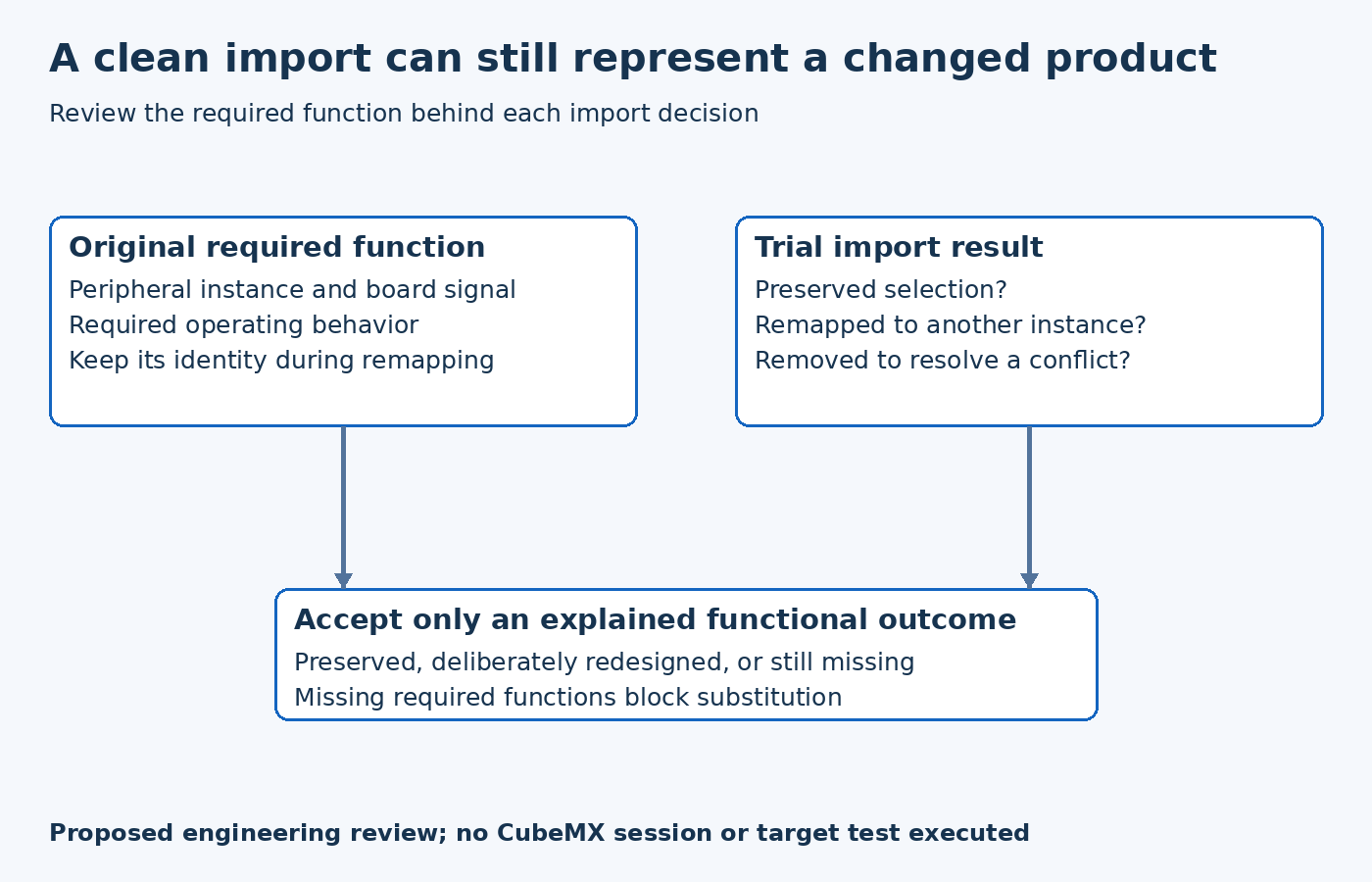
Before selecting a target, identify each externally meaningful function: its peripheral instance, connected board signal and required behavior. Give that function an identity independent of a generated handle name. Otherwise moving a connection from one UART instance to another can appear harmless in a code diff while changing the physical connector or interrupt route.
For example, a hypothetical controller uses two serial channels: one for service access and one for a field device. A migration that keeps only the service channel is not equivalent merely because the resulting configuration is valid. The missing field connection needs an explicit redesign or a rejected migration decision.
Interpret compatibility labels at their stated scope
The official compatible-MCU tutorial distinguishes exact matches from partial matches with or without hardware compatibility. A partial match without hardware compatibility requires signal remapping. Search options can also ignore selected pinning, power-pin or system-pin constraints.
Record which constraints were relaxed to obtain a candidate. A broader search result is useful for exploring a board redesign, but it should not silently become evidence that the existing board can remain unchanged. Confirm the resulting signal locations against the actual schematic and the proposed ordering code.
The label belongs to the tool's current configuration comparison. Treat application memory, analog behavior and operating requirements as additional engineering checks, rather than reading a configuration match as a complete device-substitution certificate.
Review the trial before accepting the result
The Import Project description requires an empty target configuration. Manual import can select a subset of peripherals and resolve instance choices. Try Import reports conflicts, while Show View exposes the prospective configuration before acceptance.
Use that preview to compare the original function list with the imported one. For each removed selection, decide whether its function is intentionally absent, implemented differently or still unresolved. A green result after deselecting a required peripheral is a changed design, not a completed fix.
For remapped instances, inspect the associated pins, clocks and peripheral settings together. Then identify application references that need review. A consistent generated initialization function cannot determine whether an external cable still reaches the intended signal or whether hand-written application code selects the new instance.
Accept a functional baseline, not only a clean dialog
The proposed review ends with three explicit sets: functions preserved, functions intentionally redesigned and functions still missing. Do not merge the third set into a general list of future improvements. It defines what prevents the migrated project from replacing the old one.
Generate and build only after accepting those design choices, then qualify the affected board interfaces with actual equipment. A compile result can find stale names and missing interfaces, but it cannot demonstrate communication with the real field device or verify a remapped connector.
Preserve the original configuration while evaluating the candidate. The practical value of the import tool is exposing and reducing porting work. Its successful completion becomes useful evidence when the engineer can also explain what changed and why the product still has every function it requires.