Industrial Data Commissioning: Connect SiteWise Streams to the Right Asset Measurements
Receiving industrial telemetry in the cloud does not establish that it is attached to the intended equipment model. In AWS IoT SiteWise, a data stream can exist before an asset measurement is assigned to it. Plan the association step explicitly so an integration team can prove where the collected values belong.
This guide concerns commissioning data into an asset model. It does not propose changing a production site's mappings automatically, deleting history to clear an error, or treating a plausible trend line as evidence of correct physical attribution.
Choose whether collection or modeling happens first
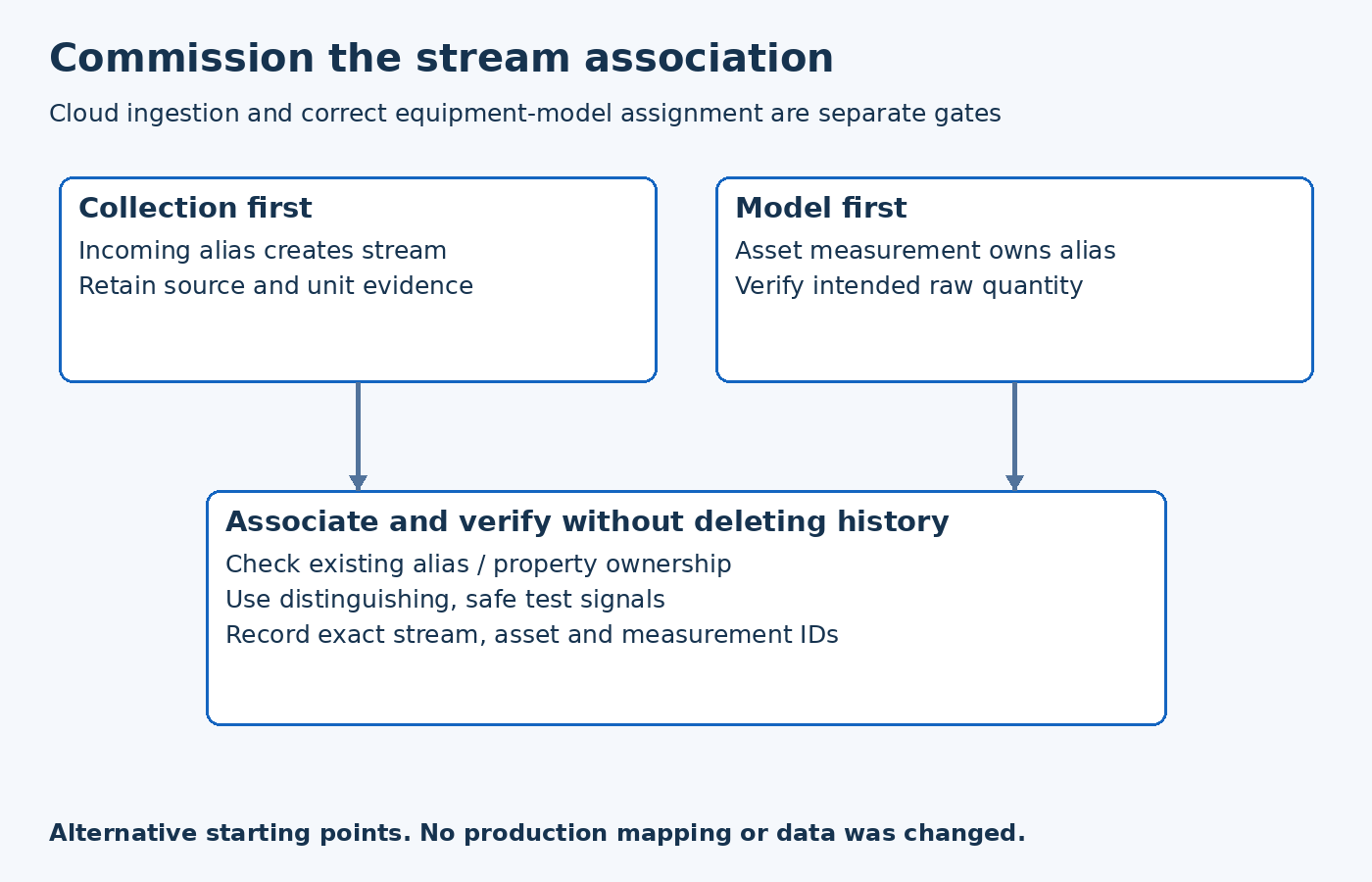
SiteWise data-stream documentation describes two supported starting points. Data arriving under a previously unused alias can create a stream before an asset exists. Alternatively, a team can assign an alias to an asset property first and have later data populate the associated stream. Streams can be associated with measurement properties, with one stream linked to a property at a time.
The project decision is who supplies the approved mapping and when. A collector team may start gathering data while the asset team finishes the model. That can be useful, but “collected” and “modeled correctly” must remain separate commissioning states.
For a hypothetical pump skid, record the collector's stream alias, the physical measurement location, its units, and the intended asset and measurement identifiers. Avoid letting a dashboard label become the only link between those identities.
Review the model independently of the incoming tag name
SiteWise asset models standardize properties across assets of a type. They can include transformations and relationships used for aggregate calculations. A tag called Temperature is therefore insufficient by itself: the model still needs the correct quantity, location and interpretation.
Consider two artificial signals named inlet temperature, one supplied in degrees Celsius and the other in tenths of a degree. If both appear numerically reasonable during a short trial, a mistaken mapping may survive a visual check. Record the source representation and the transformation that belongs at the selected boundary.
Also distinguish a raw measurement from a derived result. Associating a pressure signal to a property used as temperature can corrupt downstream calculations even if the upload path has no transport error. Verify the semantic assignment before enabling those calculations for operational use.
Treat an alias conflict as an investigation signal
The SiteWise common-scenarios guide explains that assigning an already-used alias can fail because an existing stream or property owns it. When collection has already created the stream, association may be the appropriate operation rather than trying to assign that alias again as if nothing existed.
First identify the existing owner and whether it contains useful history. Do not respond to the error by deleting a stream merely to make the next command succeed. Any destructive change needs the project's approved retention and recovery process.
Likewise, a measurement already linked to a stream is not an empty destination. A proposed reassociation should describe what happens to the current stream and its history, which ingestion paths are active, and how the change will be verified. Avoid improvising that sequence while live data continues to arrive.
Use evidence that distinguishes neighboring signals
The documented association workflow identifies a stream by alias and its destination by asset and property identifiers. Retain those exact identifiers in the commissioning record rather than only screenshots of friendly names.
A proposed test should use an approved, harmless stimulus that distinguishes the target signal from nearby channels. For example, a synthetic commissioning source can emit different known patterns for two test measurements. Verify which asset properties receive each pattern and whether units and transformations agree with the mapping sheet.
Do not introduce a physical disturbance to operating machinery merely to create an identifiable trace. When a safe stimulus is unavailable, record that the mapping remains partially verified and use an approved alternative observation method.
Close collection and modeling separately
No SiteWise account or equipment was changed for this article. The desired deliverable is a mapping record that names source, alias, measurement destination, transformation and actual verification evidence. It lets the next engineer distinguish successful ingestion from a correctly commissioned industrial data model without sacrificing existing history to resolve an ambiguous configuration error.