Industrial Asset Model Changes: Assess Every Dependent Machine Before Updating SiteWise
A shared industrial asset model is an operational dependency, not just a reusable drawing. In AWS IoT SiteWise, changing it can affect every asset created from it; a shared component model can extend that impact through multiple asset models. Review the affected machines and historical data before treating a model edit as a local correction.
This article proposes a change-review method based on official SiteWise documentation checked on October 19, 2026. It does not perform model updates or claim that a particular customer environment is safe to migrate.
Identify what the change would affect
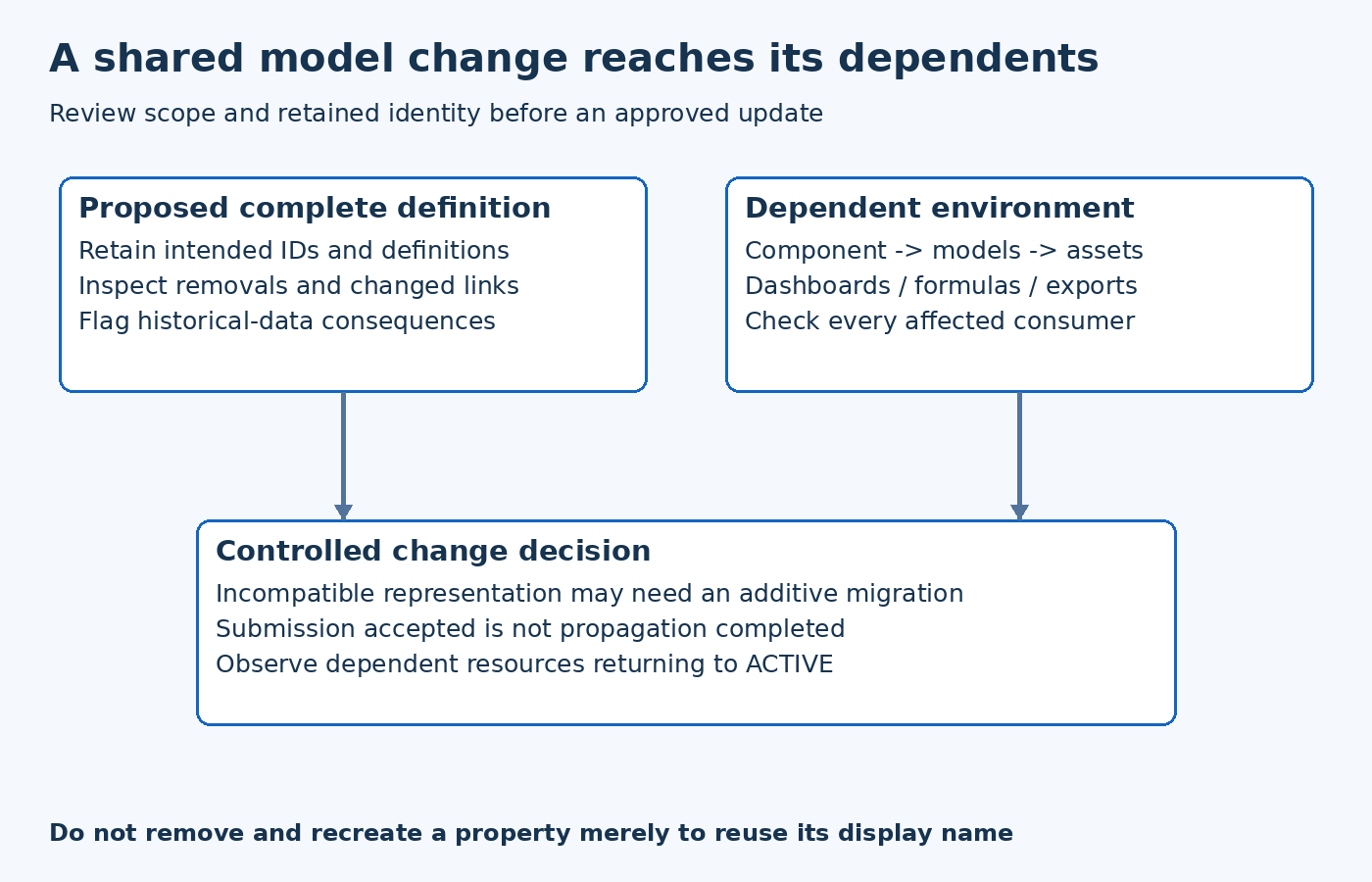
Start with the intended outcome: adding a measurement, changing a description, altering a calculation, or replacing an incompatible data definition. Then identify the concrete model, its component-model references, dependent assets, and applications that consume those properties. A dashboard that displays the same label is not sufficient evidence that it follows the same property identity.
Consider a hypothetical factory using one compressor model across three production areas. A request concerning one area's new sensor should not automatically become a change to all compressors. Determine whether the requirement belongs to the shared model or to a separately managed design. Reuse is valuable only when the shared definition remains accurate for all its dependents.
Treat omission as a possible deletion
The SiteWise model-update guide warns that the update payload replaces the existing definition. Retained properties and hierarchies therefore need their IDs and definitions included. Sending only the newly desired property is not a safe partial-update assumption.
The guide also states that removing a property deletes its previous data, while removing a hierarchy definition disassociates its assets. Existing property types and data types, and existing metric windows, cannot simply be changed in place. These constraints make “remove it and add it back with the same name” an unsafe default repair.
Prepare a complete proposed-definition comparison without submitting it. Flag every removed identifier, changed reference, and expanded set of dependent assets. Separate changes that preserve existing data from changes that require an explicit historical-data decision. Do not rely on a familiar display name to hide a newly created identity.
Plan incompatible changes as migrations
The UpdateAssetModel API reference defines the operation as updating the model and its created assets. That scope should shape the maintenance decision before an engineer chooses a console or API client.
For an incompatible measurement representation, consider an additive migration design where feasible: retain the existing property, introduce a separately identified replacement, and adapt ingestion and consumers deliberately. This is a proposed design approach, not a guarantee that every model can be migrated this way. Dependencies, quotas, authorization, naming restrictions, and the application's historical-query requirements must be evaluated in the actual environment.
Keep old and new values distinguishable during any approved comparison period. A successful write to the replacement property does not prove that dashboards, formulas, exports, or downstream applications have switched to it. Require evidence from the consumers that matter before considering retirement of the old definition.
Separate request acceptance from completed propagation
SiteWise documents asynchronous asset and model states. An update can pass through UPDATING and PROPAGATING; dependent resources must return to ACTIVE before normal interaction. A successful submission is therefore not the end of the change.
Plan status observation and failure handling as part of the authorized maintenance window. Record affected resource identities and errors, rather than retrying the same update blindly when a dependent resource is temporarily unavailable. Concurrent editors should use the documented conditional-update facilities instead of overwriting each other's changes.
Before production approval, evaluate the proposed definition in an isolated representative model and inspect its dependent assets. The change review should answer three questions clearly: what propagates, what history could be lost, and what observable state establishes completion. That is the difference between useful model reuse and an unexpectedly plant-wide modification.