RISC-V CSR Helpers: Distinguish x0 Operands from Registers That Contain Zero
A helper intended to read a CSR with a zero mask unexpectedly attempts a write. The C expression evaluates to zero, so the source looks harmless. At the instruction level, however, RISC-V distinguishes the architectural zero register from another register whose current value happens to be zero.
That distinction affects read-only CSR access and custom side effects. Review the emitted CSR opcode and operand fields, not only the numerical mask passed to a wrapper.
A zero value is not always a no-write request
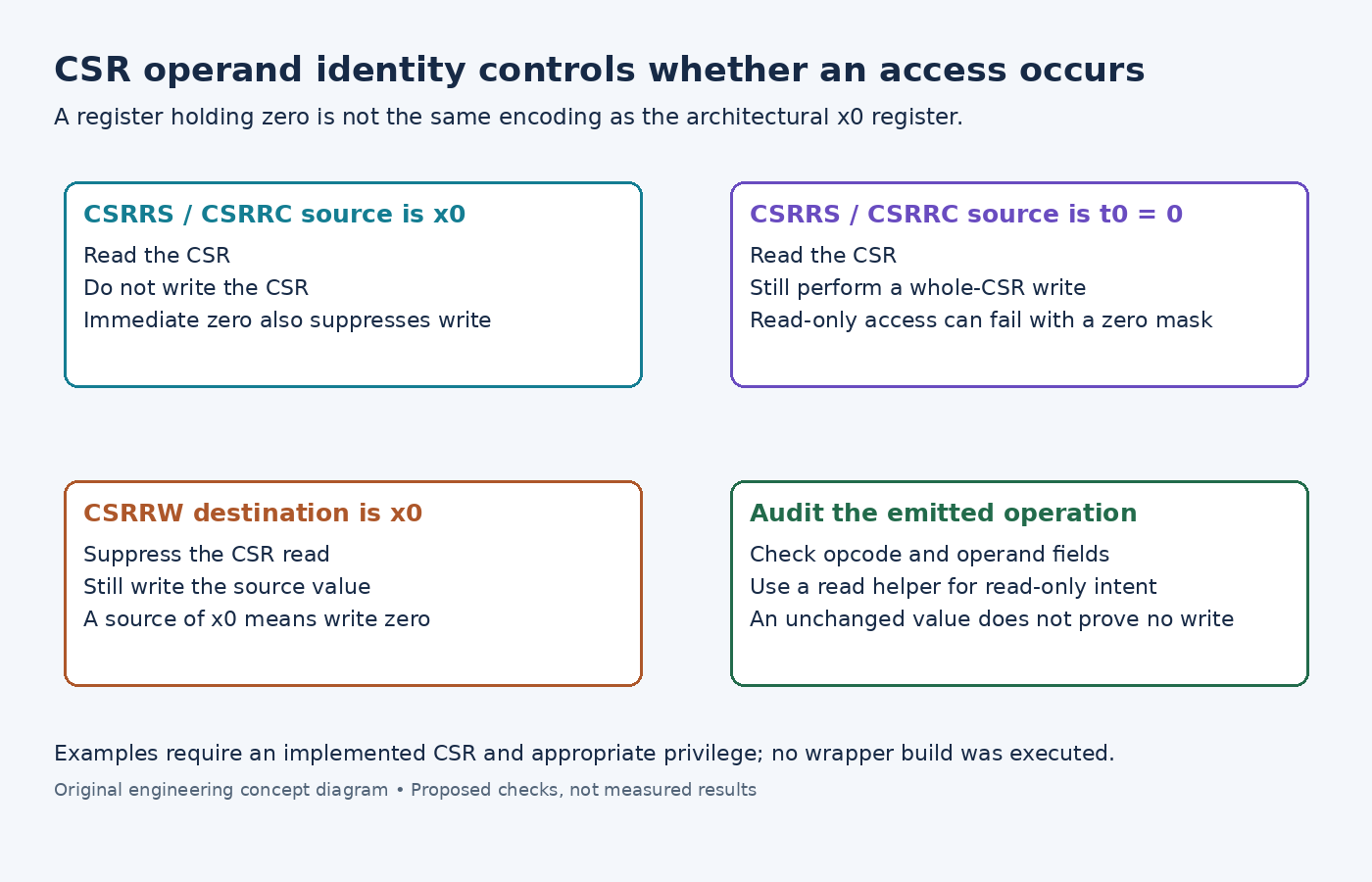
The Zicsr 2.0 specification gives CSRRS and CSRRC a special no-write case when the source register field names x0. They still read the CSR.
For csrrs a0, cycle, x0, that encoding suppresses the CSR write. If t0 contains zero, csrrs a0, cycle, t0 still attempts a CSR write even though no bits are requested to be set. A read-only CSR can therefore distinguish the two cases. This example assumes the counter exists and the current privilege is allowed to read it; those independent access conditions are not established by the opcode alone.
The immediate set/clear forms use another explicit rule: CSRRSI or CSRRCI with an immediate field of zero performs no write. A runtime zero supplied through a general register does not acquire that immediate-form behavior.
Discarding the result does not always suppress the read
CSRRW has a different special case. When its destination is x0, it does not read the CSR, but it still writes the source value. Conversely, a source of x0 means write zero; it does not mean omit the write.
CSRRS and CSRRC always read the addressed CSR, even if their destination is x0. Replacing a swap-style write with a set/clear operation because the return value is unused can therefore change the access contract.
The standard csrr pseudoinstruction encodes a set-bits instruction with x0 as its source. The standard csrw pseudoinstruction encodes a swap with x0 as its destination. These are purposeful operand choices, not merely convenient spellings.
Inspect the wrapper's assembly contract
The OpenSBI v1.9 CSR helpers provide separate read, write, swap, read-set and read-clear interfaces. Their templates make the selected operation explicit; several accept register-or-immediate input constraints.
For a proposed audit, compile the actual call sites under the product's compiler settings and inspect the resulting instructions. Compare a plain read, a compile-time zero mask and a zero produced at runtime. Do not assume that all three must generate the same source-register encoding or opcode.
If the intention is an unconditional read without a write attempt, express that through a read operation rather than relying on optimization to recognize a zero mask. For a genuine read-modify-write, verify that the CSR permits writes and that the wrapper preserves the required result and compiler-visible effects.
Keep architectural side effects distinct from unchanged values
The specification distinguishes effects of writing an entire CSR from effects on particular fields. A non-x0 zero mask can still perform whole-CSR write side effects even though it does not action per-field set/clear side effects. Standard CSRs have no read side effects in the examined text, while custom CSRs may define them.
Also avoid assuming that read-modify-write preserves every hidden state bit merely because a mask excludes it. The specification gives a PMP address example where a bit's readback differs from its underlying value; reading and writing that value back can alter the underlying bit.
The acceptance question is precise: does the final instruction perform the intended read and write actions for this CSR under this privilege? It is not enough that the register value appears unchanged afterward. No helper was compiled or executed for this article.