TinyML Tensor Arenas: Explain Why a Model Fits in Flash but Fails to Allocate
A model occupies only a modest amount of flash, yet AllocateTensors fails before the first prediction. The model file is not a RAM estimate. Stored weights, simultaneously live activations, operator workspace and runtime bookkeeping answer different memory questions.
For TensorFlow Lite Micro, abbreviated TFLM in its source repository, start with the failing allocation stage and the arena layout. Do not keep increasing a buffer solely because the error occurred inside a function named AllocateTensors.
Separate stored parameters from working memory
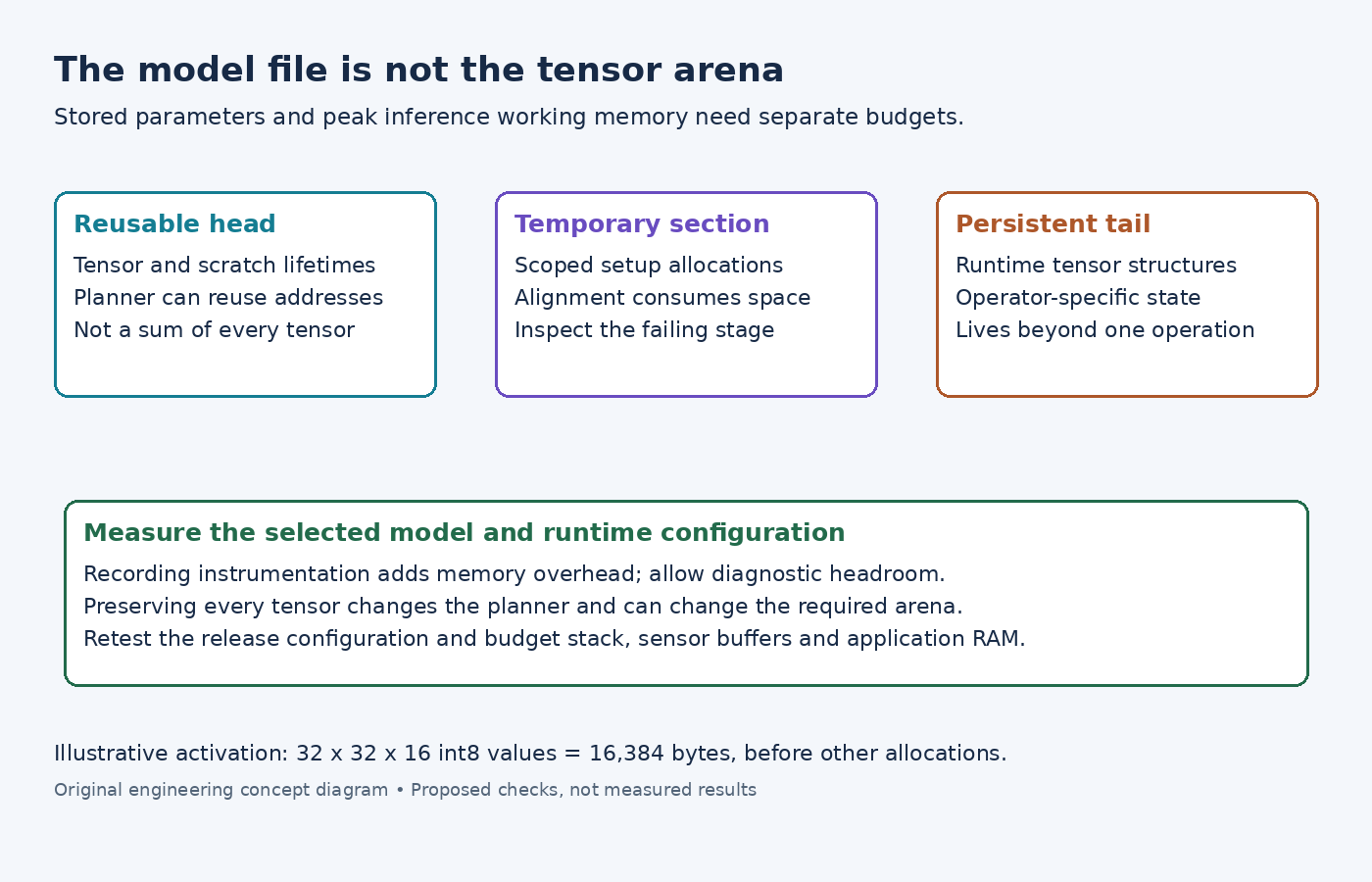
The TFLM memory-management guide describes three arena regions: a head for planned nonpersistent buffers, temporary scoped allocations and a tail for persistent allocations. The greedy planner can reuse storage when tensor lifetimes do not overlap.
A hypothetical int8 activation with dimensions 32 by 32 by 16 contains 16,384 bytes before considering other buffers. A layer with relatively few trained parameters can still produce that activation. Conversely, adding every tensor's size can overestimate the reusable head because some tensors are never live together.
Use those observations to choose an intervention. Reducing a weight array may improve flash use without reducing the dominant activation. Changing input resolution, feature-map dimensions or the selected operator implementation can affect a different part of the working-memory requirement.
Identify whether allocation is really the first failure
The examined interpreter implementation performs operator registration setup, initialization and preparation before finishing the memory plan. AllocateTensors therefore also reports failures unrelated to insufficient arena capacity.
Read the earliest diagnostic. A missing operator registration needs a compatibility repair. An operator that rejects its tensor types needs a supported model or implementation. Neither is repaired by reserving another block of RAM.
For actual capacity failures, the single-arena allocator distinguishes head resizing, temporary allocation and persistent tail allocation. Alignment can consume space between requested data and the current boundary. Keep the allocation class and requested-versus-available values, rather than reducing the message to “out of memory.”
Measure with the recording interpreter
The recording-interpreter header provides RecordingMicroInterpreter for auditing a specific model and runtime configuration. After a successful AllocateTensors or first Invoke, its allocator can print the recorded allocation categories with interpreter.GetMicroAllocator().PrintAllocations().
Instrumentation itself uses additional memory. The header recommends increasing the diagnostic arena by at least one kilobyte for recording overhead; that recommendation is not a guaranteed universal margin. Begin with enough diagnostic headroom for the chosen model, then inspect what the report actually attributes.
Compare the head and tail contributions before optimizing. If operator runtime data dominates the tail, shrinking an unrelated input buffer may accomplish little. If the reusable head dominates, inspect activation shapes and scratch requirements. A report from a different kernel selection is not a reliable substitute for the intended firmware configuration.
Also distinguish a failed partial setup from a complete recorded allocation. The last category printed before failure does not prove that every later allocation would fit.
Retest the production configuration, including non-arena RAM
The examined interpreter switches to a linear planner when preserve_all_tensors is enabled. A debug build preserving intermediate tensors can consequently have a different memory requirement from the ordinary greedy-planned build. Make that setting explicit when comparing results.
Once a candidate arena size works, repeat initialization and representative inference in the intended production configuration. Keep the recording build as a diagnostic instrument, rather than assuming its exact total is the release minimum.
Finally, account separately for the stack, sensor capture buffers, application state and any other RAM users. Enlarging the arena can make initialization succeed while exhausting a different memory region later. The useful outcome is a working-memory budget tied to the selected graph and runtime, followed by target verification under the actual sensor workload. No allocation report or model inference was produced for this article.