TwinCAT OPC UA Symbol Exposure: Audit Filtered Import and Pragma Inheritance Together
Adding an OPC UA enable attribute to one PLC declaration can expose
more variables than an integrator intended. In TwinCAT, the
declaration’s location affects inheritance, and the server’s chosen
symbol-import mode determines whether explicit enables are used as a
filter. Review both before accepting the public PLC interface.
The scope is TwinCAT 3 PLC symbolism and the TwinCAT OPC UA server
documentation inspected on 19 October 2026. This is an
interface-exposure review, not a claim that visibility alone defines
authorization. No project was activated, symbols downloaded or server
configuration changed.
Review the
declaration that owns the attribute
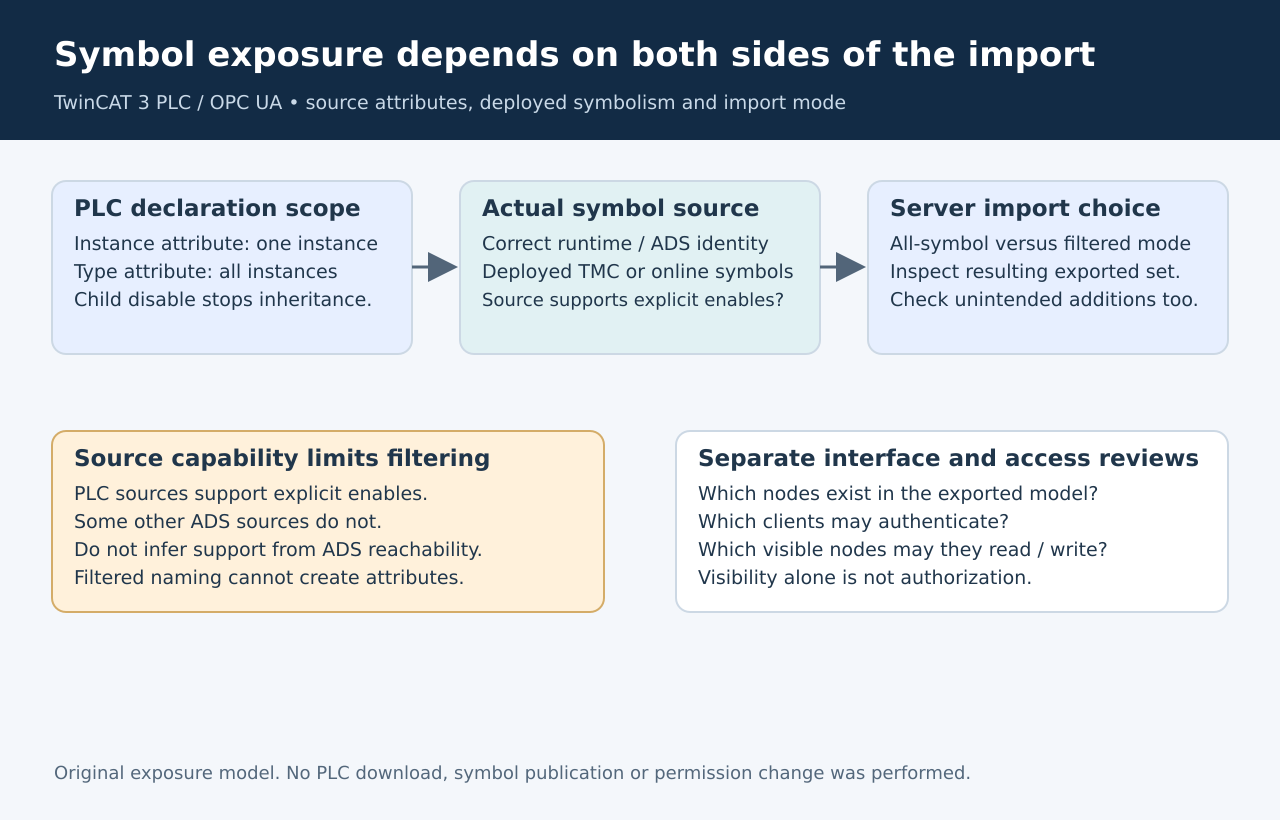
Beckhoff’s PLC
symbol documentation describes OPC.UA.DA enabling and inheritance to
child symbols. Placing the enable attribute on a structure or
function-block instance enables that instance and its children. Placing
it on the type definition applies it to all instances of that type. A
child-level disable can stop inheritance at that point.
A hypothetical machine has several instances of a common diagnostic
structure, but only one is intended for an external monitoring
interface. Enabling the shared type is a materially broader declaration
than enabling the selected instance. A quick browse of the intended
instance alone would not reveal that additional instances had also
become visible.
Review the complete intended export set: instance paths, enabled
descendants and deliberate exclusions. Keep those expectations with the
PLC source review. A type refactor that looks internal can change the
exported interface if the attribute moves from an instance to its
definition.
Verify which symbol
source the server reads
The same guide requires the relevant TMC symbol file to be
transferred and selected by the server configuration. The documented
filtered TwinCAT 3 PLC device uses the chosen PLC runtime’s identity and
symbol file. A source-code attribute is therefore only one part of the
deployment chain.
Check the application build, runtime ADS port, transferred symbol
artifact and configured server source as one set. An old TMC file can
make the exported interface disagree with the source being reviewed. A
file for another runtime can make a correct attribute appear ineffective
on the intended controller.
Do not resolve that uncertainty by enabling every symbol temporarily
on an operating system. Reproduce the import against an isolated project
or controlled staging configuration and compare the resulting exported
names with the expected set.
Filtered
import depends on the source’s capability
Beckhoff’s Online
symbolism guide distinguishes importing all symbols from importing
only explicitly enabled symbols. The online interface can supply
attributes as well as symbol types and addresses.
The guide also warns that explicit symbol enabling is not available
in every real-time environment. Its examples identify TwinCAT 3 PLC as
supporting it, while EtherCAT Master and I/O Task with Image sources do
not; those sources provide all symbols. A configuration option
containing the word “Filtered” cannot invent per-symbol enable
information that the source does not offer.
Keep the actual Data Access source type in the acceptance record. Do
not copy a filtered-import expectation from a PLC example to a different
ADS server merely because both are reachable through ADS.
Test the
exported set, then test permissions separately
Use a small isolated PLC project with two instances of one type and a
deliberately excluded child. Compare instance-level enabling with
type-level enabling and inspect every affected instance. Then confirm
that the actual filtered server import matches the selected artifact and
runtime.
A useful regression compares the complete expected symbol set,
including names that must remain absent. Merely confirming that one
desired variable exists catches missing exports but misses unintended
additions.
Finally, qualify authentication and read/write permissions through
the product’s separate security controls. Hiding a node from the
exported model and denying access to a visible node solve different
problems. The exposure review should establish exactly which interface
was published; it should not be presented as proof that every permitted
client has the correct privileges.