Zephyr OS Disk Access: Balance Initialization References Before Powering Down Media
One component releasing a disk does not necessarily mean the backing hardware is deinitialized. Zephyr's disk-access layer counts initialization references, so another successful initialization can keep the disk active. Repeated initialization used as a harmless readiness check can therefore change later shutdown behavior.
For a Zephyr OS storage service, assign an owner to each initialization reference. This explanation is anchored to v4.4.0 and does not report an executed media-removal or power-cycle test.
Initialization is an acquisition, not merely a query
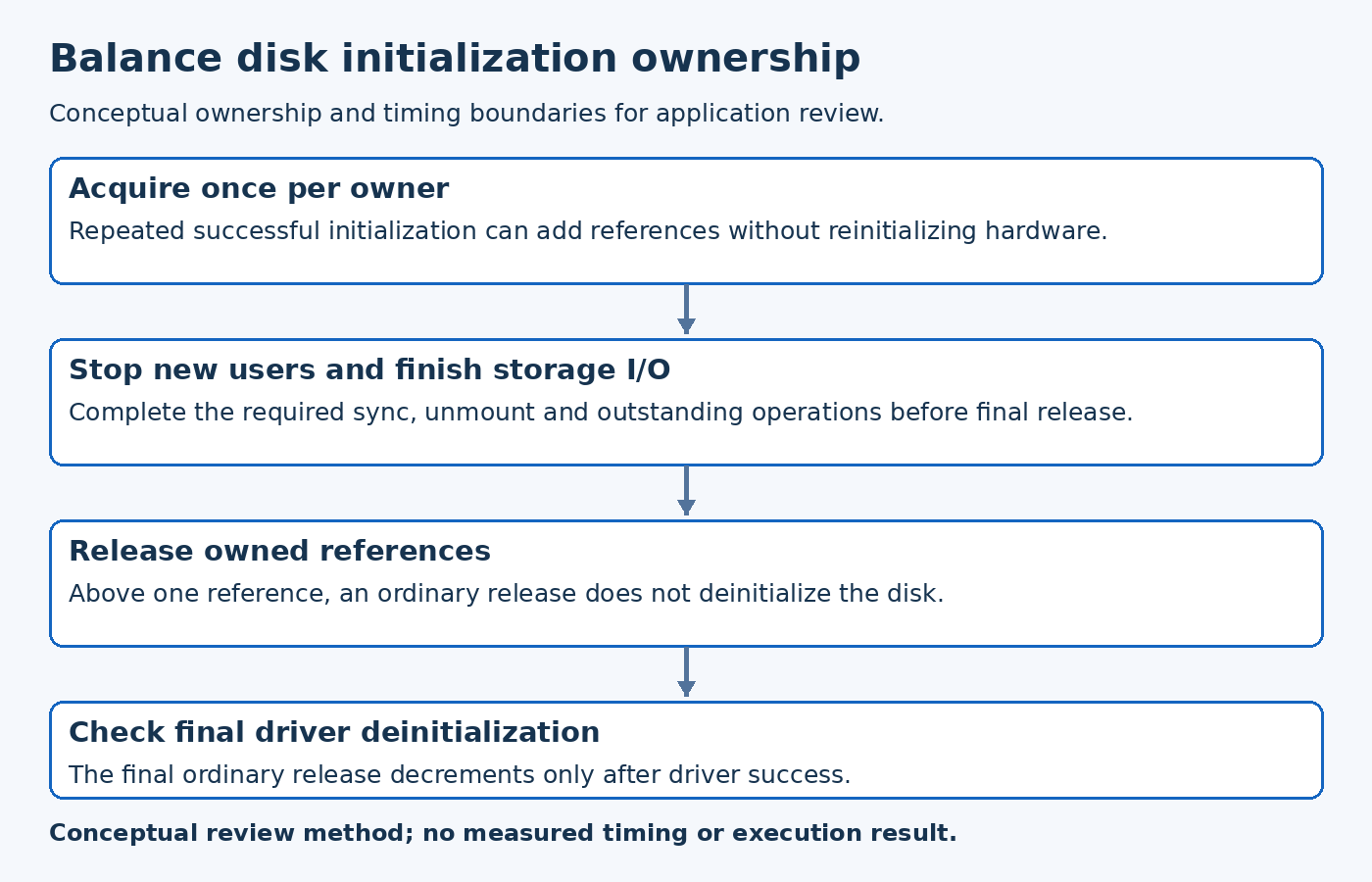
The tagged disk-access header documents reference-counted initialization and recommends DISK_IOCTL_CTRL_INIT through disk_access_ioctl() over the legacy initialization entry point. Only the first successful initialization of an uninitialized disk performs the underlying initialization.
Imagine a hypothetical application that initializes a disk during boot and then calls initialization again before every file operation. Those later successes are not neutral probes. If their acquisitions are never balanced, a single deinitialization during shutdown cannot represent all of them.
Use the actual status interface when the purpose is to query status, while respecting the selected driver's status contract. Keep acquisition separate from inspection in wrapper names and comments so that a future maintainer does not accidentally convert a probe loop into a reference leak.
Understand the final-release boundary
The tagged disk-access implementation increments a nonzero initialization count without repeating hardware initialization. An ordinary deinitialization above one reference decrements the count. At the final reference it calls the driver's deinitialization operation and decrements only if that operation succeeds.
That means a failed final deinitialization is not interchangeable with a successful release. Record the result and retain an accurate ownership state. Do not simply mark the device powered down because the application reached the line that requested deinitialization.
For a hypothetical logger and diagnostic service sharing a disk, each should release only the reference it acquired. The component coordinating power should wait until the intended users have stopped, rather than repeatedly issuing release calls until the hardware appears inactive. Releasing someone else's reference hides the real lifecycle error.
Reference counting does not finish outstanding I/O
An initialization reference records a layer-level lifetime obligation; it does not describe whether every file is closed or whether a pending write has reached stable storage. Stop new users, finish the filesystem's required synchronization and unmount sequence, and coordinate outstanding operations according to their own contracts before removing power.
Similarly, the count should not be treated as a complete hot-removal protocol. If physical media disappears while a filesystem is active, higher layers still need a defined failure response. A later initialization result does not retroactively validate writes issued before the interruption.
Where multiple components can change lifecycle state concurrently, review their coordination explicitly. Do not assume that the registration-list lock visible in the implementation serializes every application-level init/deinit sequence or protects all driver operations.
Keep forced deinitialization out of routine balancing
The implementation includes a forced-deinitialization path that clears the reference count and invokes the driver's operation. That bypasses the normal ownership accounting. It should not become a convenient way to compensate for unexplained extra references.
In the inspected version, this forced path reports success after calling the driver without propagating that driver's return value. A caller must therefore not treat its zero result as evidence that every hardware-specific shutdown step succeeded. Any product-specific use needs a stronger, independently justified recovery policy.
For a disposable test, instrument acquisitions by owner, release them in different orders and observe when the driver is actually initialized and deinitialized. Include a failed final driver deinitialization and verify the application's resulting state. Keep those tests separate from filesystem durability testing.
The useful shutdown evidence is a balanced ownership history plus successful completion of the required storage and driver stages. A single successful API return cannot stand in for all of those facts.