What to Retest After a Buildroot LTS Migration: Toolchain, Peripherals, Updates and Recovery
A migrated image reaching a login prompt establishes only a small part of release readiness. Toolchain changes can affect unchanged applications; a new service layout can break persistent settings; a working update can leave rollback unable to read the data. Build the acceptance matrix from these changes and from the hardware actually shipped. The method below uses Buildroot 2025.02.18 as its planning baseline and reports no hardware test results.
Derive regression scope from the change list
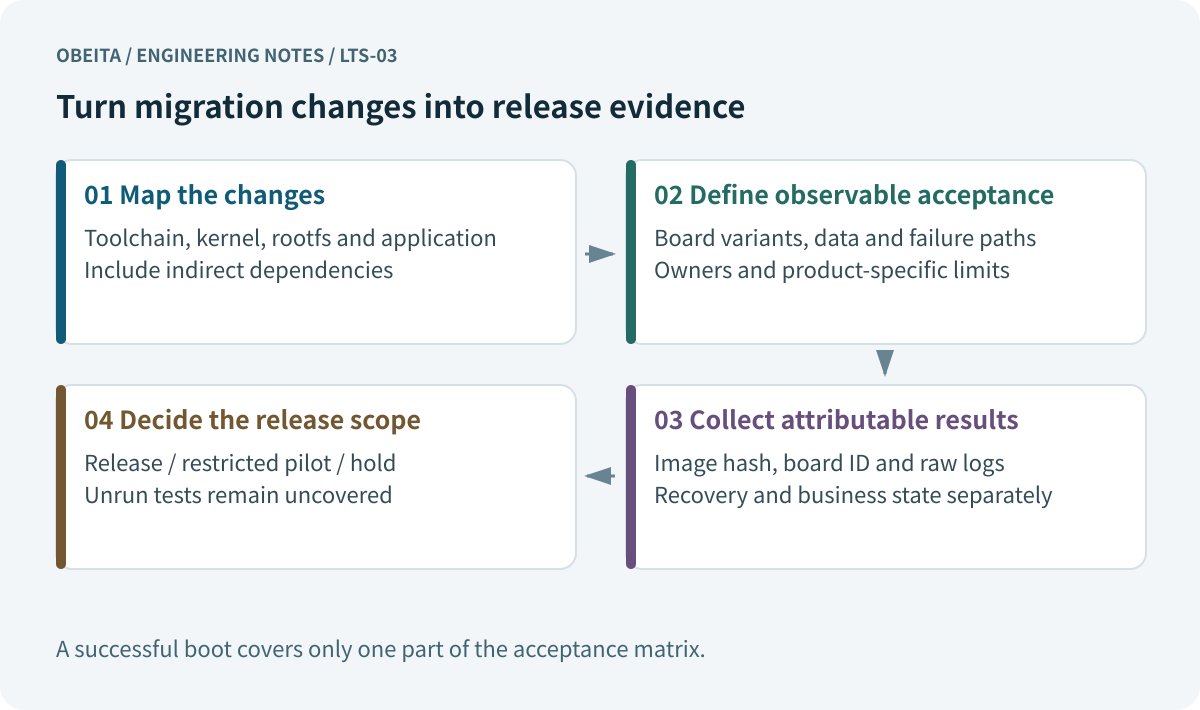
Build a before-and-after list covering compiler, libc, kernel, drivers, bootloader, root filesystem and application. For each change, name the functions that depend on it and the hardware variants that expose those functions. Include indirect changes: an unchanged application may now link against a different C++ runtime, and an unchanged peripheral may receive different device-tree defaults.
Classify checks as mandatory, conditional or explicitly uncovered. A conditional test needs a reason and a trigger, such as a changed power-management path or a shipped storage variant. Assign an owner and an observable pass condition before scheduling boards. The table below illustrates useful decisions, not a universal list of tests. The actual matrix must reflect the product’s supported behavior and its consequences of failure.
Check toolchain ABI and application runtime assumptions
Record CPU architecture, ABI, floating-point convention, libc, dynamic loader and required library versions for both rebuilt and supplied binaries. Start with static inspection of the ELF header and dynamic dependencies, then run the intended application on an appropriate target. Separate a loader failure from an application that starts but produces different results; they need different evidence and different owners.
For a supplied binary, verify its documented compatibility against the selected root filesystem and kernel. For rebuilt applications, compare known input/output fixtures and error paths, including locale or time handling where relevant. Include resource use over a representative operating cycle. Successful linking cannot establish that an application’s timing, plugin loading or third-party interface still works. Keep unresolved binary compatibility as a release restriction rather than quietly excluding that component from the matrix.
Retest boot media and board peripherals
Select boards by shipped revision and relevant component variation, including storage device, network PHY and required peripherals. Capture serial logs from power-on through business readiness. Define that final event precisely: a process existing can be different from a gateway accepting valid traffic or a controller completing its self-check. Record boot media and the exact flashed image checksum alongside the board identifier.
For changed DTS or driver paths, add the applicable transitions: suspend and resume, cable removal and reconnection, device reset, or sensor fault recovery. Only exercise capabilities the product is designed to support. A device-tree schema check is useful structural evidence, but it does not observe wiring, power rails or timing on a board. See the kernel project’s schema-validation documentation for that source-level check.
| Change or risk | Required evidence | Release decision if absent |
|---|---|---|
| New libc or external binary | ELF/loader checks plus target application fixtures | Restrict or hold affected application |
| DTS or driver change | Affected board and peripheral transitions | Do not claim that hardware variant covered |
| Persistent schema change | Old-data import, repeat execution, recovery behavior | Hold affected upgrade path |
| New update activation sequence | Controlled interruption and business recovery logs | Hold remote deployment |
| No repeatable performance baseline | Controlled measurements against product limits | Record gap; assess timing-critical release risk |
Validate persistent data and configuration migration
Test an upgrade from each supported old data or configuration schema, not only a clean factory image. Use representative sanitized data sets containing ordinary values, missing optional fields and boundary cases. Check ownership, permissions, writable paths and first-boot initialization. A service can start correctly on a new unit while failing on an upgraded unit because an old directory remains owned by a different user ID.
Make migration steps safely repeatable according to the product design. Interruptions or repeated startup should lead to a defined old or new state, rather than a partially converted file without a recovery route. Record how completion is detected and where backup data is stored. If conversion is irreversible, the release plan must acknowledge that limitation before anyone treats a boot-slot switch as sufficient rollback.
Qualify update, rollback and rescue paths
Draw the product’s real update architecture: image slots or partitions, boot selection, health confirmation, persistent storage and rescue entry. Buildroot generates system components; the product must supply and qualify its chosen update mechanism. It does not provide a universal OTA rollback policy for every board. State which old and new image/data combinations are allowed and which are deliberately blocked.
Use authorized laboratory hardware for controlled failure injection, with a restoration method already available. Choose interruption points from the actual write and activation sequence. Record boot recovery and business-data recovery independently: returning to a prompt with missing calibration can still be a failed recovery. Retest the procedure from the operator’s instructions, including the equipment and access required. Do not run destructive interruption experiments on production devices as a shortcut.
Compare performance and sustained-operation baselines
Compare old and new releases under the same workload, peripheral state, network conditions and power settings. Define measurements such as power-on to service readiness, working memory, CPU saturation and application deadlines. For each, record the observation window and acceptance bound chosen for this product. Keep raw samples and distributions where useful; an average alone can conceal a missed deadline or a repeated restart.
Sustained-operation tests need a workload, duration rationale, resource-pressure conditions and stop rules. Preserve logs across failures and avoid allowing logging itself to fill persistent storage. Diagnose drift, leaks and unexpected recovery attempts separately from one-off peak use. This article supplies no benchmark improvement claim. If a comparison has not been measured on the relevant configuration, mark it unmeasured and decide whether that gap blocks the intended release scope.
Make the release decision from an evidence matrix
Each matrix row should identify the requirement, old and new versions, board ID, image hash, procedure, raw evidence, result and approved deviation. Use “not run” or “not covered” when evidence is absent. Reusing an older result requires a documented reason showing why the changed dependencies do not invalidate it. A spreadsheet filled with green cells without those references is difficult to audit or repeat.
Decide between release, restricted pilot and hold based on the required rows and remaining risks. A restricted pilot needs explicit device coverage, monitoring and rollback constraints. Preserve the recovery materials and confirm that another engineer can follow them. Link build provenance from the migration difference package and scope from the maintenance plan. Package CI can support this decision, but it cannot certify all boards, field data or failure-recovery paths.
References and version boundary
Examples are engineering illustrations for the stated version. No board execution, full cross-build, performance benchmark or field-deployment result is claimed.
- Buildroot 2025.02.18 source archive
- Buildroot manual rebuild and customization guidance
- Buildroot LTS snapshot
- Linux bug hunting
- Linux kernel device-tree schema validation
For a focused BSP maintenance or build review, contact Obeita with the relevant version baseline, a sanitized configuration and the first complete failure log. Include the hardware or toolchain scope and the result you need to establish.