First-Boot Entropy in Buildroot Devices: Random Seeds, Cloned Images and Key Generation
Treat first boot as a security lifecycle state
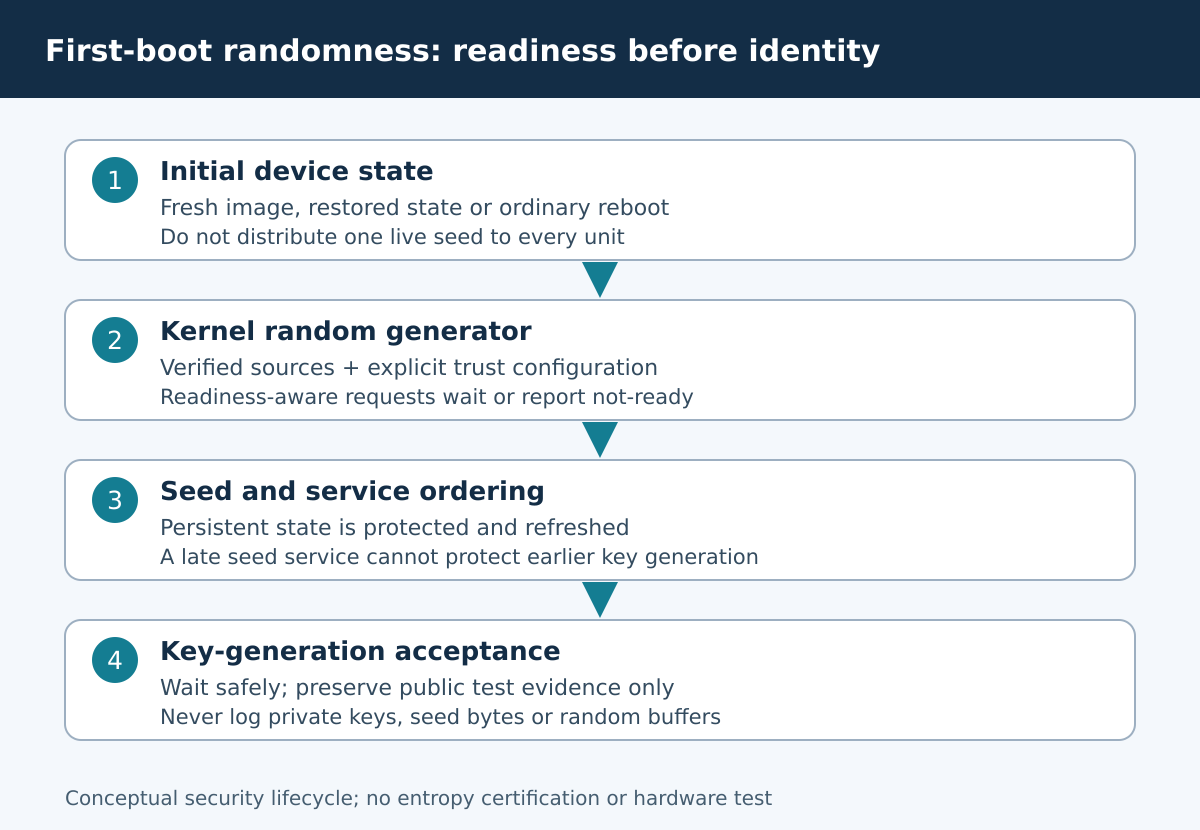
A device cloned from a manufacturing image has a different randomness history from a unit that has already booted and saved fresh state. If both paths generate long-lived keys, they must reach a securely initialized random generator before proceeding. A fast boot is not a sufficient acceptance result when its shortcut is predictable key material or a copied device identity.
This guide uses Buildroot 2025.02 with its systemd 256.7 package for the userspace example, and Linux 6.12 for kernel random-generator behavior. Products using another init system must establish equivalent ordering and seed management themselves. This is a design and validation checklist; no entropy quality measurement, key generation or hardware test was performed.
Inventory the earliest consumers of randomness
List every operation that needs cryptographic randomness, including host-key creation, enrollment keys, TLS libraries and application credentials. Record when each operation can run: bootloader, initramfs, early userspace or normal service startup. The earliest consumer determines which randomness source must be ready; a seed loaded later cannot retroactively protect a key already generated.
Also distinguish creation from reuse. A provisioned identity may already exist and should not be regenerated accidentally on every boot. The product needs a deliberate policy for first initialization, factory reset, image replacement and recovery. Keep identity lifecycle decisions separate from “make the service start” fixes, because they affect trust relationships outside the device.
Use a readiness-aware kernel interface
In Linux v6.12 random.c, getrandom without insecure flags waits for the cryptographic generator to be ready. With GRND_NONBLOCK, an unready generator returns EAGAIN instead. Applications must handle the actual return value, interruptions and partial results according to the API, rather than assuming one call always supplies the requested bytes.
For key generation, do not respond to an early-boot wait by falling back to time, a MAC address, a serial number or an uninitialized source. Those values may distinguish devices but are often predictable. A library should use a supported secure randomness path; an application-level timeout should report initialization failure or wait safely, not silently downgrade the source. Readiness is a security condition, not just a startup delay to suppress.
Separate hardware presence from a justified entropy source
A hardware random peripheral is useful only if the product kernel supports it, the device is enabled and the integration’s trust assumptions are justified. Inspect the selected driver, firmware/device description and relevant kernel configuration. Do not assume that a device node named hwrng establishes health, correct routing into the kernel generator or suitability for every product’s threat model.
Likewise, a counter showing available entropy is not a complete audit of source quality. Establish what the kernel credits and why, using the exact kernel configuration and platform design. Changes to trust settings should be reviewed as security decisions. Record their rationale with the board configuration instead of making an unexplained boot-time tuning change to eliminate a wait.
Understand what the systemd seed service guarantees
The systemd 256.7 random-seed reference stores state under /var/lib/systemd/random-seed. By default it does not credit entropy merely because that file is loaded. The service generally runs after the initramfs phase and after /var becomes available, so it is not an answer for every earlier consumer.
The service refreshes the seed using randomness from the initialized kernel and can serve as an ordering point for services that otherwise use an unsafe early path. Review the actual units and dependencies in the image; do not assume a filename implies correct startup ordering. A read-only root design also needs a deliberate writable seed location or another supported persistent arrangement, with permissions that keep the seed confidential.
Do not clone the saved seed into every unit
An image intended for replication should not distribute one live saved random seed unchanged to all devices. The systemd documentation warns about repeated seed material on otherwise entropy-starved systems. Build image preparation and per-device initialization as separate stages, and verify that manufacturing does not reintroduce the same seed through a backup, overlay or recovery archive.
A unique serial number does not make a shared seed unpredictable. A bootloader-provided seed can improve early availability only when its own generation, per-device uniqueness, confidentiality and update behavior are correctly designed. Do not enable forced entropy credit as a general workaround for cloned or missing seed state. Seed refresh and power-loss behavior belong in the lifecycle review, particularly when devices repeatedly restart before a successful normal boot.
Validate without exposing random state or private keys
Use a lab matrix covering fresh devices with no prior state, ordinary reboot, interrupted initial boot, restored images, factory reset and recovery. Record when secure initialization becomes available, whether key-generation services wait correctly, and whether an error leaves the device in a recoverable state. Do not print seed bytes, random buffers or private keys into diagnostic logs.
Comparing public-key fingerprints can detect accidental duplicate identities where the product expects uniqueness. A duplicate is actionable evidence, but the absence of duplicates in a small sample is not proof of cryptographic quality. Preserve configuration, service-ordering evidence and pass/fail results instead of collecting secret material. Define acceptable startup timing from product requirements after measuring the actual platform, not from a number copied from another board.
Acceptance and ownership
Accept the design when every key-generating consumer has a readiness-aware path, replicated images do not contain a shared live seed, persistent state is protected, and first-boot/recovery scenarios have explicit outcomes. The Buildroot 2025.02 recipe fixes the systemd version used for this example; verify the actual package and kernel versions in the product image.
Assign ownership for manufacturing cleanup, kernel entropy-source configuration and application error handling. These checks do not certify a random-number generator or replace a product security review. They establish a traceable chain from initial device state to safe key generation, without relying on a successful boot or a plausible-looking key as the only evidence.