Network Interface Names After Embedded Linux Updates: Keep Services Bound to the Right Port
Bind a product role to a physical port
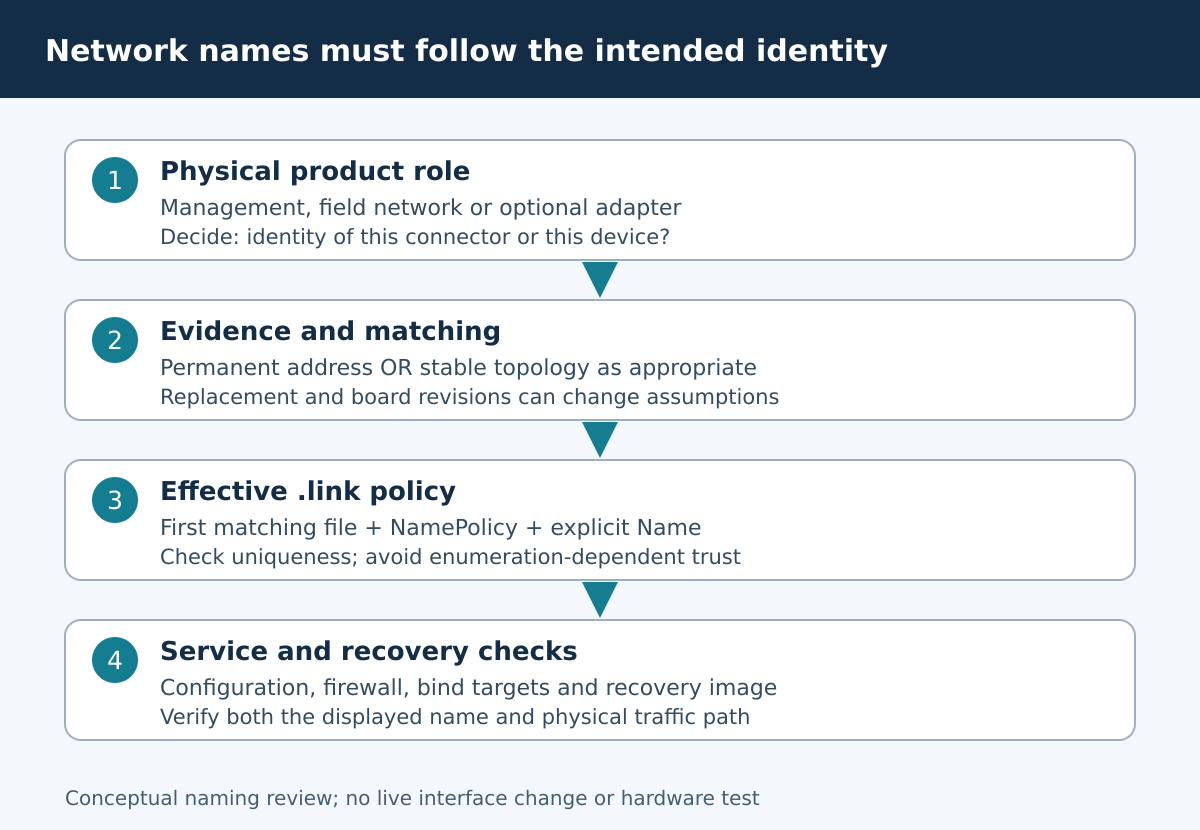
After an embedded Linux update, a service may be healthy but attached to the wrong network interface. A management daemon expecting eth0 can miss its port when driver probe order changes; a firewall rule can become more serious if it now covers a different connector. The first task is to map physical product roles to stable evidence about the interfaces, before choosing names.
This guide uses Buildroot 2025.02, whose systemd package recipe selects 256.7. The naming details below therefore use systemd 256.7 documentation. A BusyBox-only or alternative device-manager product needs its own equivalent review. Nothing here assumes every Buildroot image runs systemd, and no interface was renamed or hardware tested for this article.
Inventory identity, topology and current policy
For each connector, record its chassis label, product role, driver, device path, current interface name and relevant MAC identity. Distinguish a permanent hardware address from the current operational address, which software or firmware may change. Map these observations to the board schematic or manufacturing records where available.
# Read-only inspection; set IFACE to an existing interface.
ip -details link show dev "$IFACE"
udevadm info --query=property --path="/sys/class/net/$IFACE"
The second command is relevant only where udev tooling is available. Save the installed naming rules and command-line settings alongside the properties. Do not collect unrelated network credentials. A useful inventory explains how to recognize the management connector after a reboot, not merely which name happened to appear during one boot.
Understand the naming stage in this product
The kernel initially creates an interface name, and the configured device-management path may apply another naming policy. systemd .link files control link properties through udev; they are not the same as networkd .network files that configure addresses and routes. A product can use .link processing without using networkd for all network configuration.
The systemd 256.7 link-file reference states that the first matching link file in the applicable alphanumeric ordering is applied. Review the effective rule set, including administrator overrides and any early-boot copy. Adding a well-written rule that is never the first match changes nothing. Record the winning file as part of the acceptance evidence.
Choose the identity that matches the replacement policy
A path-based match can preserve the role of a physical slot even when a replaceable adapter changes. A permanent-MAC match can preserve the identity of a particular adapter when it moves. Those are different product promises. Decide whether “LAN” means this connector or this removable device, and select the match accordingly.
Neither choice is universally stable. A board revision, firmware change or USB hub layout can change topology-derived properties. A module replacement changes its permanent address, and some devices do not expose one reliably. Do not use a current randomized or provisioned MAC as a hardware identity without documenting that assumption. Where available evidence cannot distinguish two ports reliably, stop and correct the hardware/firmware identity model before assigning a trusted service role.
Make the requested name win for a clear reason
For a dedicated systemd link rule, review Match conditions, NamePolicy and the explicit Name together. The 256.7 reference gives NamePolicy precedence over Name; an explicit name is effective when the policy does not supply one. An empty NamePolicy can be appropriate in a narrowly matched rule that intentionally chooses a product name, but must be reviewed in the context of the installed rule set.
Choose product-role names that do not race with the kernel’s ordinary eth-number allocation. Avoid relying on a broad OriginalName=eth0 match as proof of physical identity. Verify name uniqueness across onboard, USB and optional interfaces. A collision or a late rename can disrupt services, so changing naming policy requires a planned reboot or controlled maintenance procedure with local recovery access.
Update consumers of the old name
Search the product configuration for the previous interface name: address configuration, firewall rules, DHCP services, routing policy, monitoring, application bind options and recovery scripts. A new name is not accepted merely because ip link displays it. Each consumer must resolve the intended role consistently after the change.
Check startup ordering as well. A daemon may cache an interface index or try to bind before the intended interface appears. Network availability and correct identity are separate conditions. Prefer an explicit failure when the management role cannot be identified, rather than falling back to whichever interface happens to exist. The safety of any fallback depends on the product’s network separation requirements.
Test topology changes without risking remote access
Use a lab setup with a console or separate recovery channel. Cover cold boot, warm reboot, changed driver timing, optional adapter absent, adapter replacement, USB reconnect and the supported board variants. Compare both the assigned name and the physical traffic path. A name that remains constant while pointing to another connector is a failed identity test.
Include software rollback and recovery-image behavior. If the candidate uses lan0 while the recovery image still expects eth0, field instructions may silently target the wrong port. Preserve the old and new mappings and decide whether configuration migration is required. Do not deploy a naming change remotely until the product’s management and recovery paths have been demonstrated under the supported combinations.
Acceptance and scope
Accept the policy when every supported port role has an evidence-backed identity, exactly the intended rule wins, names remain unique, and all services attach to the correct physical path. Record exceptions for replaceable modules and topology changes. Keep the mapping with the Buildroot 2025.02 systemd version reference and the actual image configuration.
This process verifies naming and binding assumptions. It does not establish link reliability, throughput or network security by itself. Its value is narrower and practical: a software update should not silently move management, field traffic or firewall policy from one connector to another because an incidental enumeration order changed.