Buildroot Virtual Packages: Select a Provider Without Creating Ambiguous Dependencies
Start with the interface contract
A virtual package is useful when an application needs an interface and the product can choose between implementations. It is not a promise that arbitrary libraries are interchangeable. Before adding configuration symbols, write down the headers, link names, required functions, feature level, target architecture and runtime behavior that every accepted provider must supply. A graphics API implemented in software and one backed by a particular GPU can share an interface while having very different deployment constraints.
This guide uses the Buildroot 2025.02 tag. The examples describe a fictional transport interface, not an existing upstream package. The objective is to make provider selection explainable in both configuration and build ordering. No example package has been compiled or tested here. Apply the checks to a separate product configuration before treating either provider as supported.
Keep capability and provider identity separate
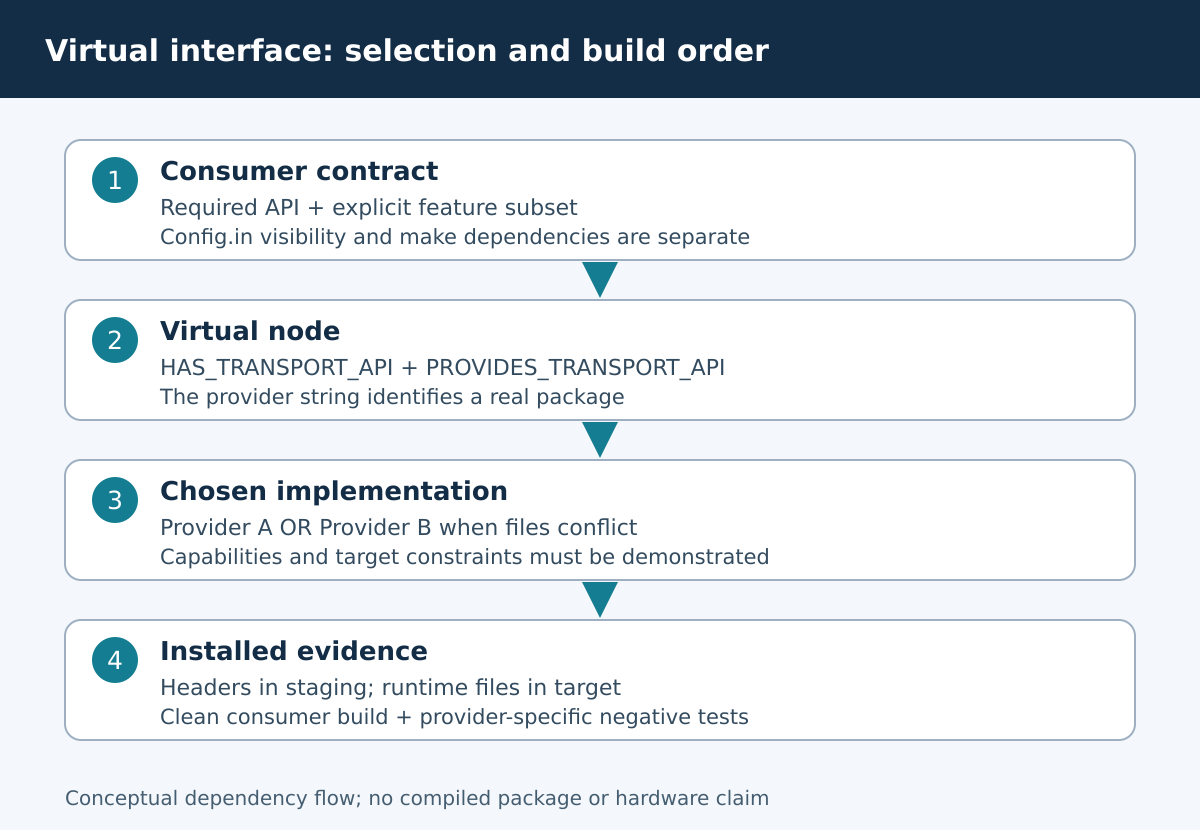
The virtual package declares a hidden capability boolean and a provider-name string. A real implementation enables the capability and supplies its own package name as the string value. The virtual package makefile evaluates the virtual-package infrastructure; it does not download another implementation. These roles are defined in the 2025.02 virtual-package documentation.
config BR2_PACKAGE_HAS_TRANSPORT_API
	bool

config BR2_PACKAGE_PROVIDES_TRANSPORT_API
	string
	depends on BR2_PACKAGE_HAS_TRANSPORT_API

# package/transport-api/transport-api.mk
$(eval $(virtual-package))
Treat the names as an interface boundary. A typo can leave a consumer visible while the build points at no real package. Do not use the provider string as a free-form label, product SKU or library filename. It must resolve to the package name used by Buildroot.
Make one implementation the product decision
A provider such as transport-posix selects HAS_TRANSPORT_API and conditionally defaults PROVIDES_TRANSPORT_API to transport-posix. Its makefile declares TRANSPORT_POSIX_PROVIDES = transport-api. Another provider needs equivalent wiring plus its own actual dependencies. The product configuration must make the intended implementation unambiguous. Where providers cannot coexist, express that policy in the relevant configuration structure instead of relying on the order of default strings.
The important negative case is a consumer that secretly selects its favorite provider. A user may already have enabled a different one. The official documentation says a consumer requiring a specific provider should depend on that provider, rather than select it. This keeps the restriction visible and avoids an implicit second implementation. A generic consumer should depend on the shared capability instead.
Connect the build graph explicitly
Configuration visibility and execution ordering answer different questions. In this fictional example, a portable application can use depends on BR2_PACKAGE_HAS_TRANSPORT_API in Config.in and CLIENT_DEPENDENCIES += transport-api in its makefile. The virtual node then introduces the selected provider dependency. Inspect the 2025.02 infrastructure implementation when diagnosing an empty provider string or an unexpected host dependency.
Headers needed during compilation must reach staging through the real provider. Runtime libraries must reach the target image through the provider installation. A passing link on a developer workstation is weak evidence if an older provider left files behind. Review the verbose compiler and linker commands, then repeat the relevant product build in a fresh output directory. Do not repair a graph defect by manually copying libraries into staging.
Model feature differences honestly
An interface name is usually broader than one application’s requirements. One transport implementation might support polling only, while another supports asynchronous completion. If the consumer genuinely needs asynchronous behavior, record that as an additional capability constraint or restrict its provider explicitly. Avoid silently disabling important application behavior to make the build succeed.
Create a small provider matrix with columns for required headers, symbols, supported modes, runtime assets and licensing obligations. Mark each cell as demonstrated, unsupported or awaiting validation. A provider that exports the right symbol but returns an unsupported error is not an accepted substitute. Similarly, a vendor implementation tied to one device family cannot become portable merely because it satisfies the virtual-package mechanism.
Use a deliberate failure matrix
Test four configuration states: no provider, provider A only, provider B only and an attempted conflicting selection. The first should keep a dependent consumer unavailable or cause an intentional configuration failure. Each supported single-provider state should resolve to exactly the intended package. The conflicting state should be prevented or explicitly rejected according to product policy. Preserve the resulting configuration and provider string for every case.
Next test a consumer that requires a provider-specific extension. It should be unavailable with the wrong implementation, even if the shared capability is true. This catches a more subtle mistake than a missing dependency: an apparently valid image whose consumer assumes features it never requested. Keep provider-specific integration tests separate from generic interface tests so that a failure identifies which contract broke.
Read failures at the correct boundary
An empty implementation error points toward provider-name wiring. A missing header points toward the selected provider, its staging installation or the build graph. Duplicate files or libraries suggest overlapping provider selection or polluted output. A successful build followed by unsupported runtime operations points toward the capability contract. These are diagnostic hypotheses, not proof; confirm each one with the saved configuration and build log.
When changing providers, preserve the old output and create a new comparison build. Record what changed in the filesystem and link dependencies. An existing output directory may still contain files that the new provider no longer installs. A clean result matters especially when the two implementations happen to use the same library filename, because that coincidence can conceal which implementation was linked.
Acceptance and handover
Accept the integration when the configuration identifies one intended provider, the make dependency reaches it, required development files come from that provider, and each supported provider passes the same consumer contract. Include a negative test proving that an unsupported extension cannot be enabled accidentally. Archive the provider matrix, exact Buildroot tag, product configuration and relevant logs together.
This acceptance establishes selection and integration evidence, not hardware acceleration, throughput or long-term ABI compatibility. Those require separate product tests. The useful handover is a clear statement of which implementations are substitutes, which features distinguish them and how a future maintainer can detect a configuration that falls outside that promise.