Go Plugins in Embedded Images: Treat Toolchain and Dependency Identity as a Compatibility Contract
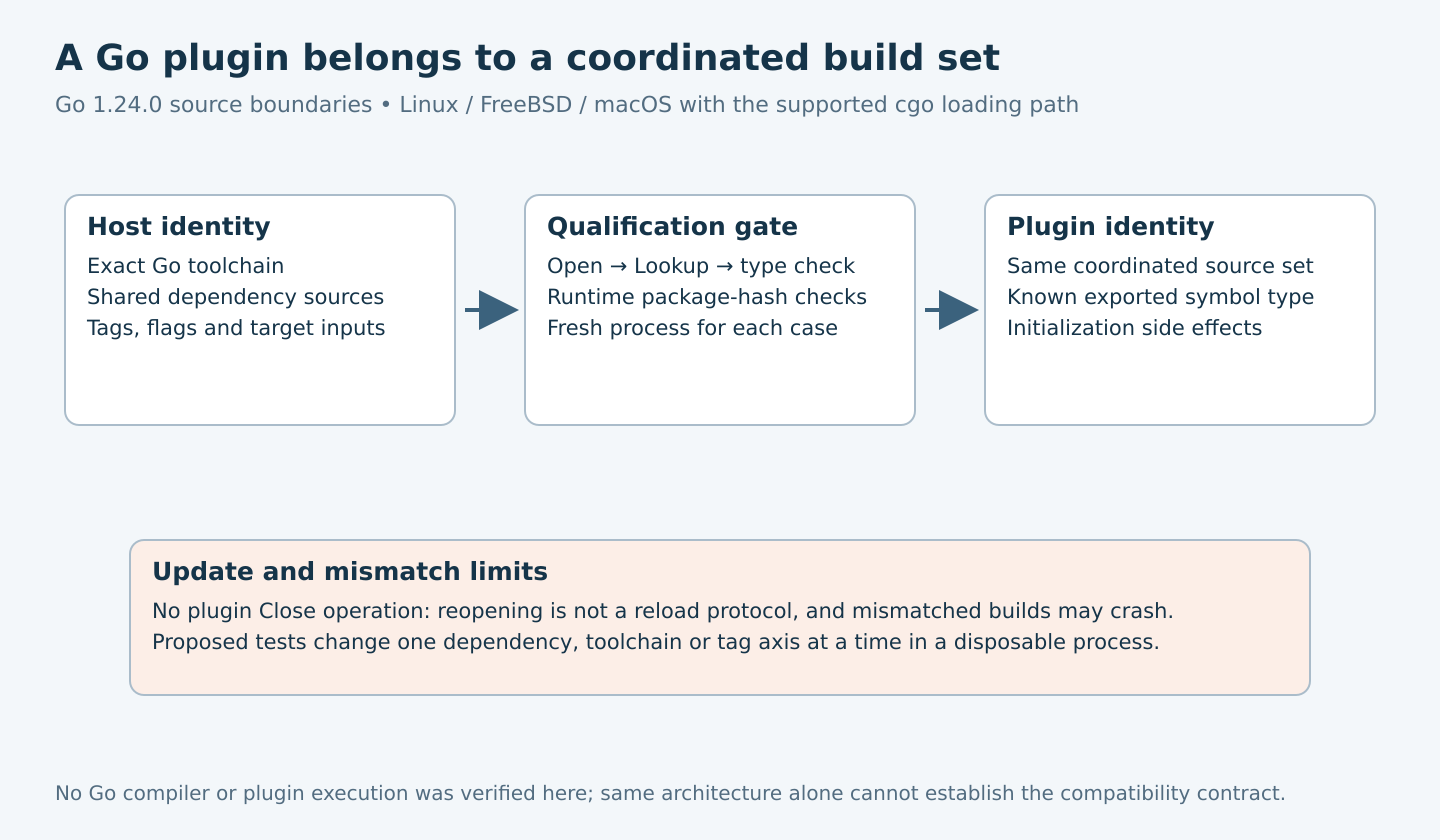
A Go plugin is not compatible merely because its ELF machine type matches the host executable. Treat the executable and plugin as a coordinated build set: their Go toolchain, shared package sources, build tags and relevant options must agree. If independently upgradeable components are required, reconsider whether an in-process Go plugin is the right boundary.
This article pins Go 1.24.0 source. The build-identity matrix and deliberate mismatches below are proposed qualification tests. No verified Go compiler was available, so no Go plugin was compiled, loaded or deliberately crashed for this article.
Check platform support before designing the interface
The tagged plugin package documentation limits support to Linux, FreeBSD and macOS and warns about race-detector limitations. The implementation’s build constraints also require cgo for its supported dynamic-loading path.
That is a narrower claim than “Go runs on this board.” Confirm the selected Go target, cgo configuration, native toolchain and loader environment before promising plugin support. A working statically linked Go application does not independently qualify the plugin path.
The package is built from a main package with buildmode=plugin. Its exported functions and variables become lookup candidates, while its main function is not run. The plugin’s initialization behavior still matters, because loading can execute package initialization before the host begins calling the intended interface.
Construct a host/plugin identity ledger
| Identity axis | Evidence for both sides |
|---|---|
| Toolchain | Exact Go release and toolchain provenance, not only the major language version. |
| Target | GOOS, GOARCH, architecture tuning and cgo/native compiler context. |
| Source graph | Main source revision, module versions, replacements and identical shared-package sources. |
| Build configuration | Build tags, relevant flags and environment variables affecting compilation. |
| Artifact set | Host/plugin hashes, interface revision and qualification results retained together. |
The Go 1.24.0 documentation explicitly requires the same toolchain version and compatible tags, certain flags and environment settings. It also requires common dependencies to be built from exactly the same source. Matching an exported function name or a module’s advertised version does not replace those conditions.
A local replacement, patched dependency or generated source file can change a shared package while leaving a familiar version label intact. Preserve the resolved source inputs, including replacements and generated files, rather than relying only on the top-level module name.
Understand what a mismatch check can establish
In runtime/plugin.go at go1.24.0, plugin loading compares recorded package hashes with runtime package hashes. A mismatch can produce an error identifying a package built with a different version. This is concrete implementation evidence for checking shared-package identity.
It is not a promise that every unsupported combination will fail cleanly at that branch. The package documentation warns that inconsistent builds can cause runtime crashes. Do not turn a successful Open call into a blanket compatibility certificate or use production processes for deliberate mismatch experiments.
When an error names a package, compare that package’s resolved files, generated content, toolchain and options on both sides. Rebuilding only the plugin may preserve the underlying disagreement. A clean coordinated build is a better diagnostic control than repeatedly copying a differently named shared object.
Design a small lookup contract
For a hypothetical telemetry plugin, begin with an exported function whose expected type is func(uint32) uint32. The host should check the error from plugin.Open, then Lookup, then use a checked type assertion on the returned symbol before calling it.
A successful name lookup does not guarantee the caller’s expected type. Also remember that lookup of an exported variable exposes a different shape from lookup of a function. Specify the symbol’s kind and exact type in the interface contract, and test an intentionally wrong expected type without invoking it.
Keep initialization side effects minimal and observable. Record which packages initialize during the first load, what resources they acquire and how failures are handled. A plugin that starts goroutines during initialization can affect the process before its advertised function is called.
Run a bounded qualification matrix
Start with a host and plugin built together from one pinned source graph and toolchain. In a disposable process, require successful load, checked lookup, a known arithmetic result and controlled shutdown of application-owned activity. This is the positive control, not a performance benchmark.
Next rebuild only a shared dependency used by the plugin while keeping the host unchanged. Use a harmless source change in an isolated test graph and record whether loading rejects the mismatch. A rejection naming that dependency supports the intended identity guard; a crash or other failure is still a failed configuration.
Separately test a different Go toolchain release and a relevant build-tag difference. Change one axis at a time, save diagnostics and use a fresh process for each case. Do not assume the exact error text will be identical for all mismatches.
Finally test repeated loading of the same plugin path. The documented behavior returns the already loaded plugin; initialization occurs once. This matters when an application mistakenly expects reopening the file to reload newly installed bytes.
Plan updates around the no-unload boundary
The plugin package does not provide a Close operation. Replacing a file on disk is not an in-process unload-and-reload protocol, and an application cannot reclaim the whole plugin simply by dropping its own reference.
Ship the host and plugin as a coordinated image set and restart the owning process when the qualified update procedure requires new code. If separate suppliers or independently evolving release schedules must be supported, assess a process boundary with an explicit protocol instead of treating Go plugins as a stable cross-version binary interface.
The release record should name the exact passing artifact pair and all untested combinations. This article establishes the source-level constraints and a concrete test plan; actual compatibility remains pending until those proposed cases run on the intended platform.