Rust bindgen in Buildroot: Make libclang Parse the Target Headers and ABI
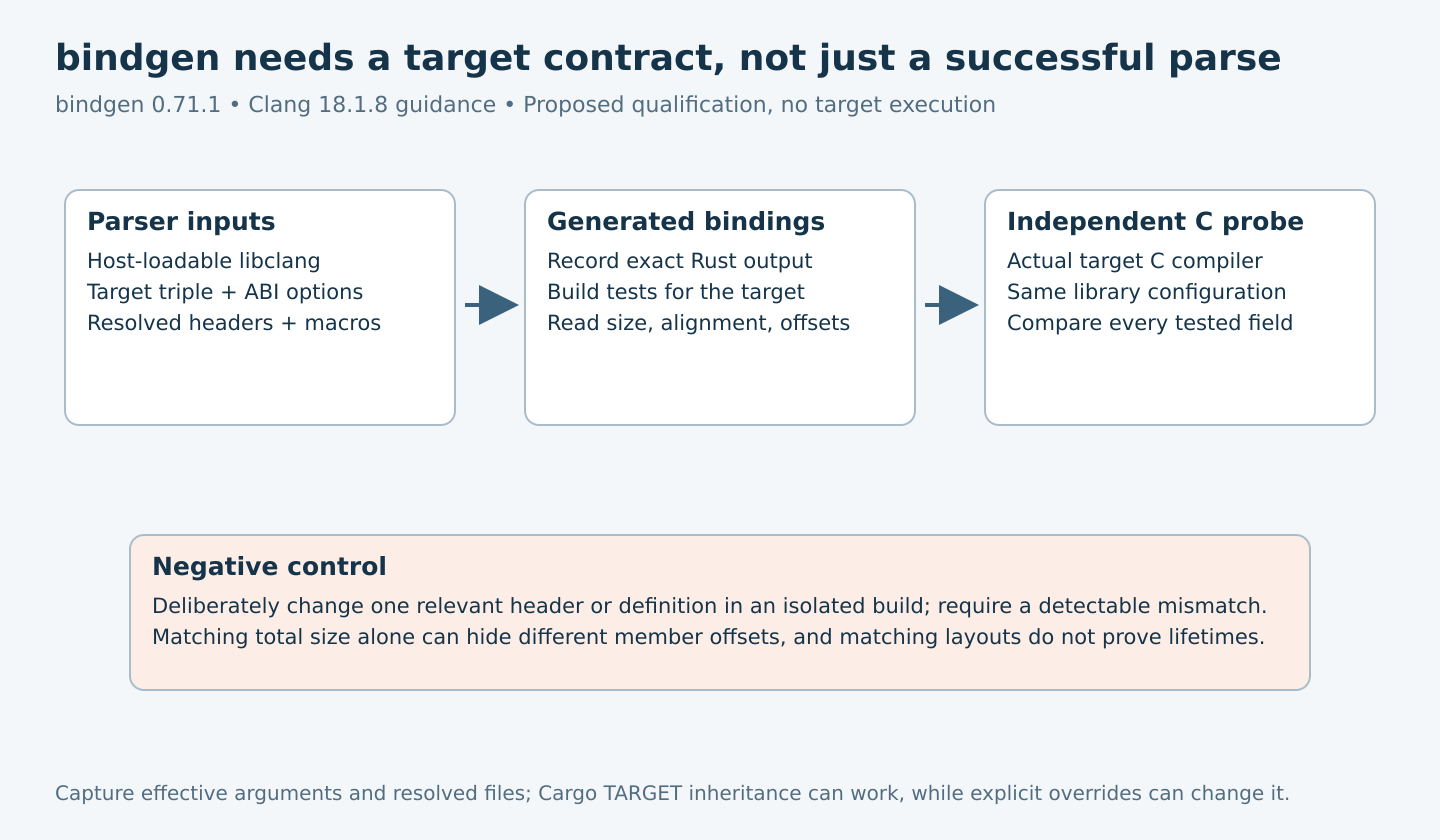
A successful bindgen run proves that libclang parsed something. It does not prove that the resulting Rust types match the C library shipped in the target image. Make the parser’s target, headers, preprocessor configuration and ABI flags explicit, then compare generated layouts with an independent target C probe.
This procedure is pinned to bindgen 0.71.1 and Clang 18.1.8 documentation. Buildroot is the integration context, not an assumed source of correct parser arguments. No bindgen execution, cross compilation or target layout measurement was performed here; the ledger and probes below are proposed qualification steps.
Track three distinct tools
The build script runs on the build machine. Its libclang shared library must be loadable there, while the declarations it parses describe the target. A host-loadable libclang is therefore normal; host headers and host ABI assumptions are the potential error.
Record the bindgen crate version, the loaded libclang file and version, and any Clang executable used to discover include directories. These need not be the same installation. The tagged implementation contains both libclang loading and Clang-based include-path discovery, so identifying only a clang command on PATH leaves part of the chain unqualified.
Keep the actual C compiler used for the target library as a fourth, independent identity. A matching spelling of the CPU architecture does not establish matching integer widths, packing, floating-point ABI or preprocessor-selected structure fields.
Build the effective-argument ledger
| Input | Evidence to preserve |
|---|---|
| Target selection | Cargo TARGET, explicit Clang target arguments and the final effective Clang triple. |
| Header roots | Target sysroot, ordered include directories and the resolved files actually parsed. |
| Preprocessor state | Feature definitions, undefinitions, generated configuration header and wrapper header. |
| ABI options | CPU/architecture, floating-point and packing options required by the library build. |
| Tool identity | bindgen, loaded libclang, include-discovery Clang and target C compiler versions. |
In bindgen 0.71.1, an explicit –target argument or -target value takes precedence in target detection. Otherwise the implementation can derive a Clang target from Cargo’s TARGET and add an argument for cross generation. It is incorrect to assume that every Cargo build silently uses the host target, or that manually adding a target flag is always the missing fix.
Also capture environment overrides. The tagged code checks a target-qualified BINDGEN_EXTRA_CLANG_ARGS variable, then a form with target hyphens replaced by underscores, before the unsuffixed variable. A developer shell can therefore supply different parser options from the build recipe even when the Rust source is unchanged.
Resolve headers before judging layouts
The Clang 18.1.8 cross-compilation guide distinguishes target selection from finding the correct libraries and headers. A target triple does not automatically describe every SDK’s filesystem layout. A sysroot and explicit include paths may still be necessary.
Use the same wrapper header and relevant preprocessor definitions as the native library interface. Capture a preprocessor include trace using a qualified Clang driver with the intended arguments, then compare it with the headers expected from the Buildroot staging sysroot. Treat this trace as corroboration: if the driver and loaded libclang differ, their equivalence still needs checking.
Inspect resolved paths for host /usr/include leakage, unintended SDK versions and a stale generated configuration header. Do not fix a missing declaration by adding another broad host include directory. First establish why the target header or feature definition is absent.
Keep the argument ledger near the binding-generation rule. A changed configuration header must regenerate bindings, not merely relink the Rust crate. Review build-script invalidation for relevant files and environment inputs; a correct parser invocation is ineffective if the build system reuses bindings generated under an older contract.
Compare one ABI-sensitive structure independently
For a hypothetical sensor API, choose a structure containing an integer, a pointer and a conditional field selected by the library’s configuration header. That combination exposes more useful mismatches than a structure made entirely of fixed-width byte arrays.
Compile a small C probe with the actual target compiler and library flags. It should report sizeof the structure, _Alignof the structure and offsetof each named, non-bit-field member. Run it on the target or an explicitly qualified execution environment. A host execution is not a substitute for a 32-bit or differently aligned target.
Generate the Rust bindings with the recorded parser inputs, then obtain the corresponding size, alignment and member offsets in a target-built Rust test. Bindgen’s 0.71.1 options enable generated layout tests by default, but compiling or running them for the host only qualifies the host layout used by that test.
Compare values field by field, not just total size. Two structures can have the same size while placing a member differently. Add signedness and enum-value checks where the interface depends on them. Bit-fields, unions and unusual packing require dedicated access tests rather than forcing them into an ordinary offsetof worksheet.
Use controlled mismatches to validate the check
In an isolated qualification build, remove one required feature definition or substitute an intentionally different header revision. The probe comparison should fail at a predictable field or constant. Restore the correct input and require agreement again. These are proposed negative controls, not tests run for this article.
If only the C probe changes, inspect bindgen regeneration and cached output. If both change together but the shipped library does not, the probe is testing the wrong header/library pair. If layouts agree while calls fail, move to calling convention, ownership, lifetime and semantic API checks.
Accept the binding contract, not the generation exit code
The release evidence should bind generated Rust bytes to the wrapper header, resolved target headers, configuration definitions, parser tools and target-library build. Retain the independent C/Rust comparison and the deliberate mismatch result.
Layout agreement is necessary for the tested types but does not prove safe pointer lifetimes, callback behavior or complete API coverage. The useful conclusion is narrower: the selected declarations were generated under an identified target contract and matched independently compiled target observations. That is a defensible basis for proceeding to functional FFI tests.