Reproducible Buildroot Delivery: From a Booting Image to a Release Kit
A Buildroot image becomes a deliverable when another engineer can rebuild it, identify exactly what it contains, and recover the target without relying on the original developer’s workstation. For a gateway or operator terminal, that means treating source, configuration, build environment, image layout and acceptance evidence as one release. A booting SD card is only one output of that process.
Define what “reproducible” means in the contract
Set two separate acceptance gates. A rebuildable release has a complete recipe that produces the intended functions from archived inputs. A byte-reproducible release additionally produces identical bytes for an explicitly named set of artifacts. The latter follows the Reproducible Builds definition; it needs comparison evidence, not a configuration checkbox.
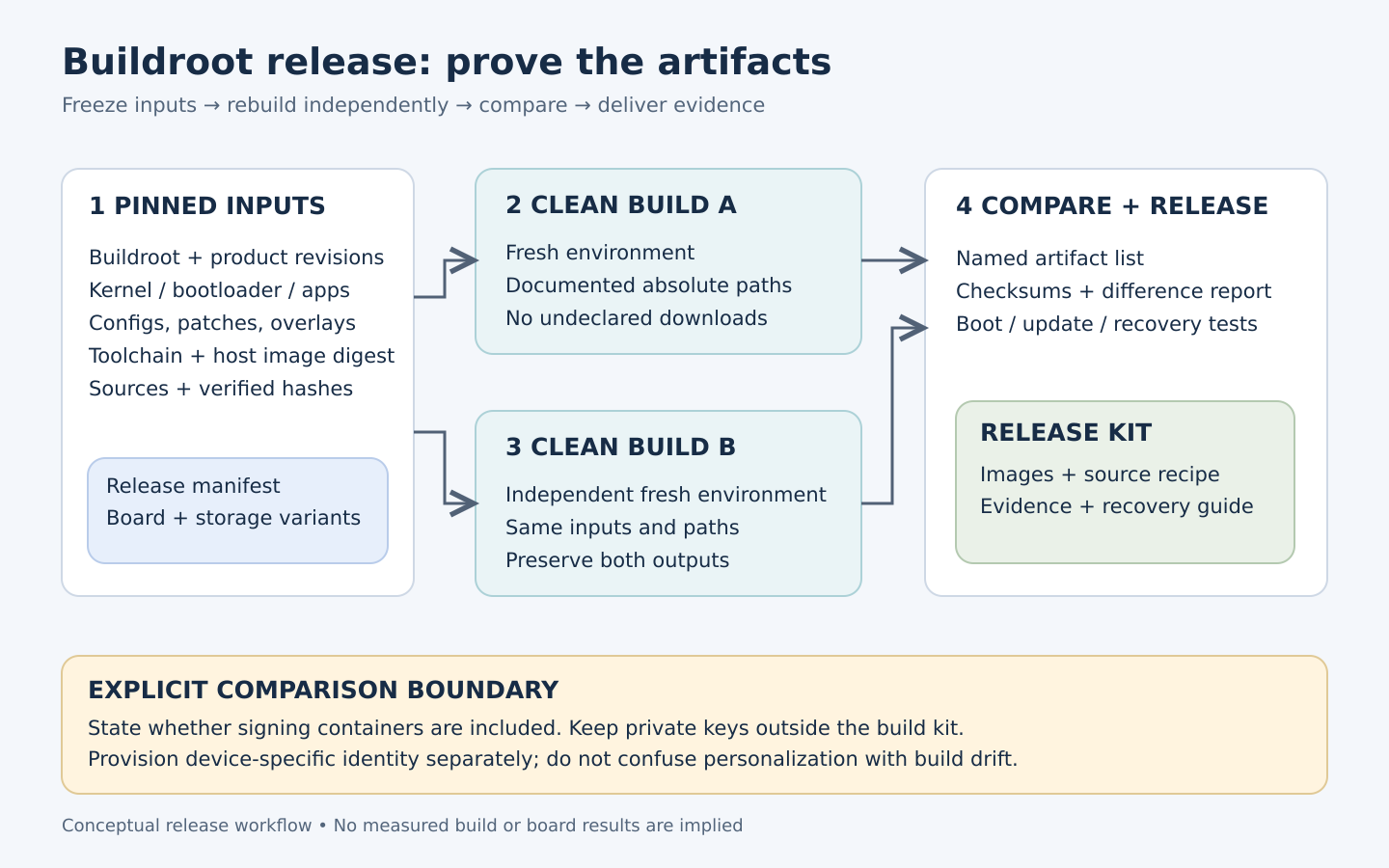
Name the artifacts: kernel, device trees, root filesystem, bootloader and possibly the final disk image. Declare whether signed containers and manufacturing personalization are inside that comparison boundary. A per-device identity should be provisioned separately from the generic image; otherwise different devices are expected to have different bytes. Keep private signing keys outside the source bundle and build logs.
Freeze the complete input set
Create a release manifest before generating a production image. It should identify the Buildroot revision, product configuration revision, application commits, kernel and bootloader revisions, external toolchain digest if used, and every vendor patch. Include the board revision and populated storage variant. “The vendor SDK” is too ambiguous when several archives share the same filename.
Store product customization in a versioned BR2_EXTERNAL tree: defconfig, kernel configuration, device-tree changes, overlays, package recipes and image-generation scripts. Archive the resolved .config as release evidence. Use the generated files in output/images for delivery; the intermediate target tree is not a deployable root filesystem with final permissions and device handling. These mechanisms are described in the Buildroot manual.
For each proprietary binary, record its supplier, version, checksum, target ABI and redistribution terms. A redistributable binary can be a pinned input even when its source is unavailable, but the delivery statement must describe that boundary. Assign someone to maintain download availability rather than assuming an upstream URL will survive the product’s service life.
Make the environment and sources reconstructible
Record the Linux build environment, container or VM image digest, host packages, architecture and resource requirements. Use stable absolute source and output paths. Buildroot’s BR2_REPRODUCIBLE remains experimental; its configuration help documents path-related constraints and packages that may still be non-reproducible. Review the help in the pinned release rather than assuming a newer branch behaves identically.
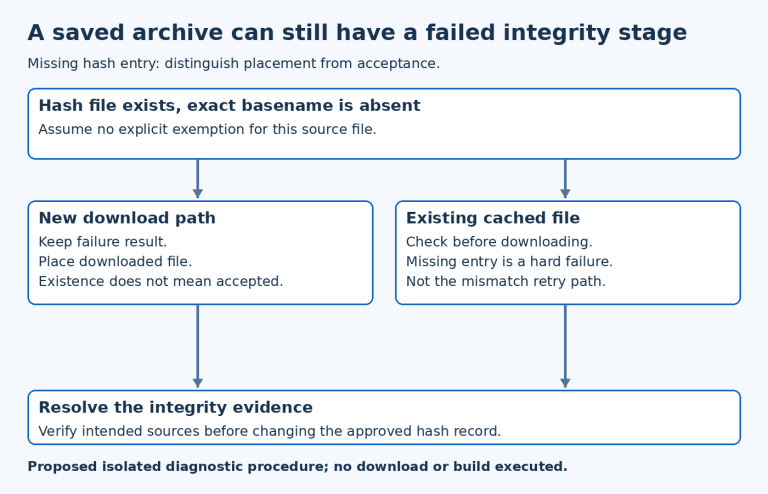
Retain an approved source cache and verify download hashes. A cache makes rebuilding practical; it does not authenticate sources by itself. Run a separate rebuild with outbound network disabled after fetching dependencies. If it fails, capture the exact missing input instead of quietly allowing a package to download an unrecorded dependency during compilation.
The following is a release-job sketch. The paths and product_defconfig are project-defined; enable reproducibility in that committed defconfig. Run as an unprivileged build user in a clean environment.
export BR=/work/buildroot
export EXT=/work/product
export OUT=/work/out
export LC_ALL=C TZ=UTC
export SOURCE_DATE_EPOCH="$(git -C "$EXT" log -1 --format=%ct)"
make -C "$BR" O="$OUT" BR2_EXTERNAL="$EXT" product_defconfig
make -C "$BR" O="$OUT" source
make -C "$BR" O="$OUT"
make -C "$BR" O="$OUT" legal-info
SOURCE_DATE_EPOCH represents a stable source-related timestamp for tools that support it. It cannot make arbitrary build scripts deterministic. Confirm how the chosen Buildroot release propagates it and inspect custom scripts for wall-clock dates. The SOURCE_DATE_EPOCH documentation defines its semantics.
Compare two independent clean builds
Run the same recipe in two fresh environments at the same documented paths. Preserve both outputs before the next job starts. Compare the exact artifact list and checksums first. For an illustrative product that generates these two files:
cd /work/out/images
sha256sum Image rootfs.squashfs > /work/release/SHA256SUMS
Create /work/release beforehand and replace that list with the actual release manifest, including device trees and boot components. A matching rootfs does not establish that the whole disk image matches. If a checksum differs, use diffoscope to inspect embedded files, metadata and archive differences; retain the comparison report.
Classify differences before changing flags. Kernel build timestamps, user/host strings, debug paths and automatically generated module-signing keys are documented sources of variation in the kernel reproducibility guide. Other likely investigation points are filesystem UUIDs, image-generation timestamps, unsorted file lists and application version scripts. Preserve security requirements while defining and testing any separate signing stage.
Test the release, not just the compiler result
| Test | Evidence to retain | Release decision |
|---|---|---|
| Two clean builds | Input digests, artifact list and comparison report | All in-scope bytes match or the release is not labelled byte-reproducible |
| Offline rebuild | Network-disabled job log and cache manifest | No undeclared download is needed |
| Cold boot on each hardware revision | Serial boot log and hardware identification | Correct device tree, storage and application start |
| Upgrade and recovery | Version transition, interrupted-update and recovery logs | Documented usable state is recovered |
| Configuration migration | Old/new schemas and retained settings | Upgrade and supported rollback preserve intended behavior |
| Manufacturing image | Flash procedure, checksum verification and identity audit | Correct image installed without duplicated device secrets |
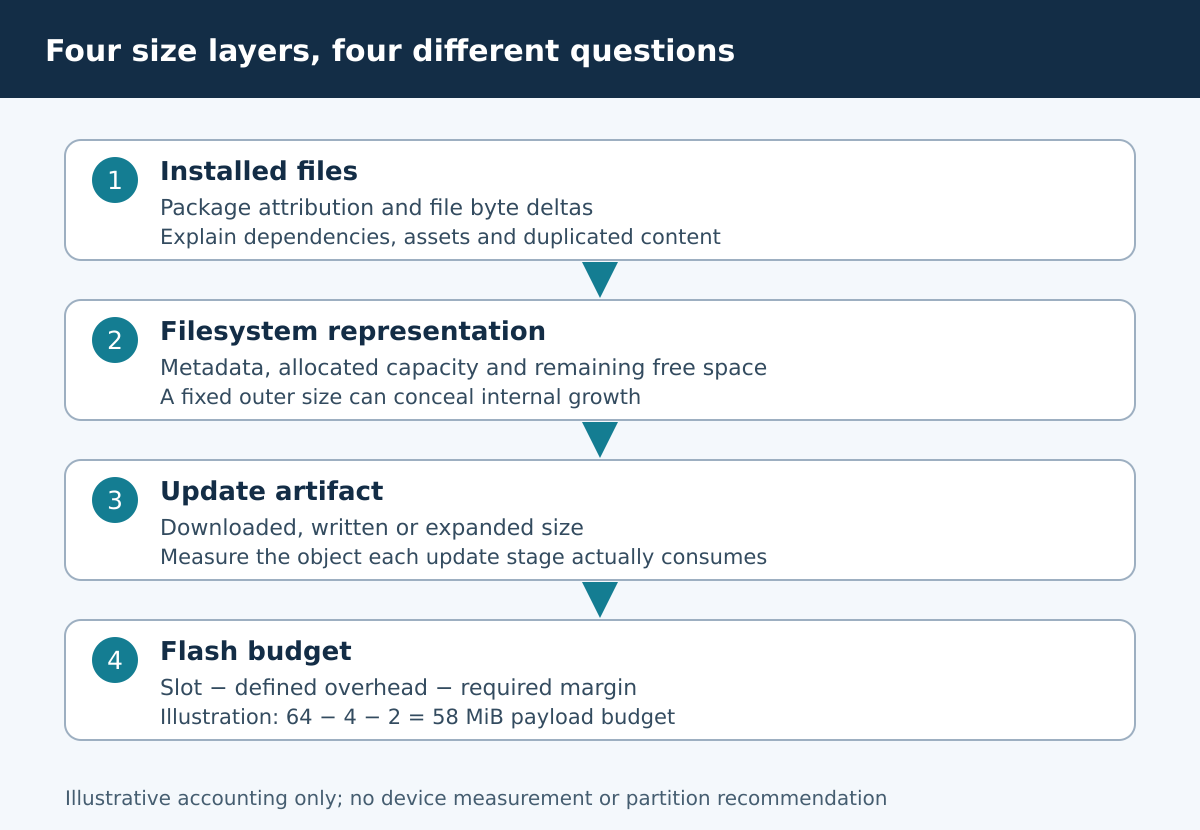
Define measurable product limits alongside this matrix: boot-time endpoint, maximum memory consumption, storage headroom, network behavior and watchdog recovery. Set their numeric limits from the actual requirements. This article describes a validation plan, not measured results for any particular board.
Common handover failures and how to isolate them
- Clean build fails, developer build passes: check local source overrides, uncommitted patches and host-installed tools. Reproduce in the archived environment before changing dependencies.
- A removed package remains in the image: rebuild from a fresh output tree. Incremental development output is a poor release baseline after configuration changes.
- The application starts only on one board: compare board revision, device tree, firmware blobs and storage layout before blaming Buildroot.
- Images match but recovery fails: examine boot selection, partition offsets and recovery instructions. Reproducibility does not validate a flashing procedure.
- License bundle looks complete: review
legal-info/READMEwarnings and missing materials. Buildroot’s collection is useful input to a compliance review, not an automatic legal clearance.
Deliver a release kit someone else can use
Package a README with one supported build entry point, manifest, checksums, source access instructions, configuration, image files, release notes, test evidence and recovery procedure. Record known limitations, update compatibility and the responsibility for future security fixes. Verify the kit through a handover exercise performed without access to the original workstation.
For scope discussions, Obeita’s Firmware/BSP diagnostics service is relevant to boot, kernel and rootfs integration. The delivered RK3566 embedded terminal project provides related platform context. This case does not establish that the reproducibility workflow described here was implemented or validated on that platform.