Production Test Time Budget: Separate Every-Unit Screening from Sampled Engineering Tests
Reduce production test time by identifying the fault each test detects, the population its evidence represents and the resources on its critical path. Keep every-unit requirements distinct from approved lot sampling and engineering qualification. A slow test cannot simply become a sample test because the line is behind schedule.
This article provides an original planning worksheet informed by NASA SP-2016-6105 Rev2 and NIST acceptance-sampling guidance. All durations and fault assignments are hypothetical. No station timing, sampling campaign, yield result or product release was measured or executed.
Start with faults and claims, not a stopwatch ranking
For each test, identify the requirement, plausible fault mechanism, observable failure and reason the selected stimulus exposes it. A short communication check can establish connectivity without covering analog accuracy, output loading or a missing assembly component.
Record the test’s subject. Does it inspect this individual unit, characterize a design configuration, monitor the station or support a lot-level decision? Those claims require different evidence and cannot be exchanged merely because they use the same instrument.
The NASA verification handbook links methods, criteria, configurations and results. The factory adaptation is a fault-to-test ledger that makes coverage consequences visible before a proposed time reduction is approved.
Build the fault-to-test/time matrix
| Illustrative check | Claim and fault target | Population decision to approve | Time contributors |
|---|---|---|---|
| Unit identity and image binding. | This unit carries the intended identity/software association. | Required per-unit gate in this hypothetical plan. | Read, compare and record. |
| Basic connected I/O path. | This assembly responds through the required physical interface. | Per-unit screen if required by the product plan. | Setup, stimulus, settling and response. |
| Extended environmental characterization. | The identified design/configuration meets a defined operating envelope. | Engineering qualification with its own representative selection. | Conditioning, dwell and multiple operating points. |
| Lot inspection characteristic. | Evidence supports an approved lot-disposition rule. | Controlled sample and escalation policy. | Selection, measurement and lot-level review. |
| Fixture reference check. | The specified station path remains qualified. | Station-control schedule, not a DUT population pass. | Reference handling and path challenges. |
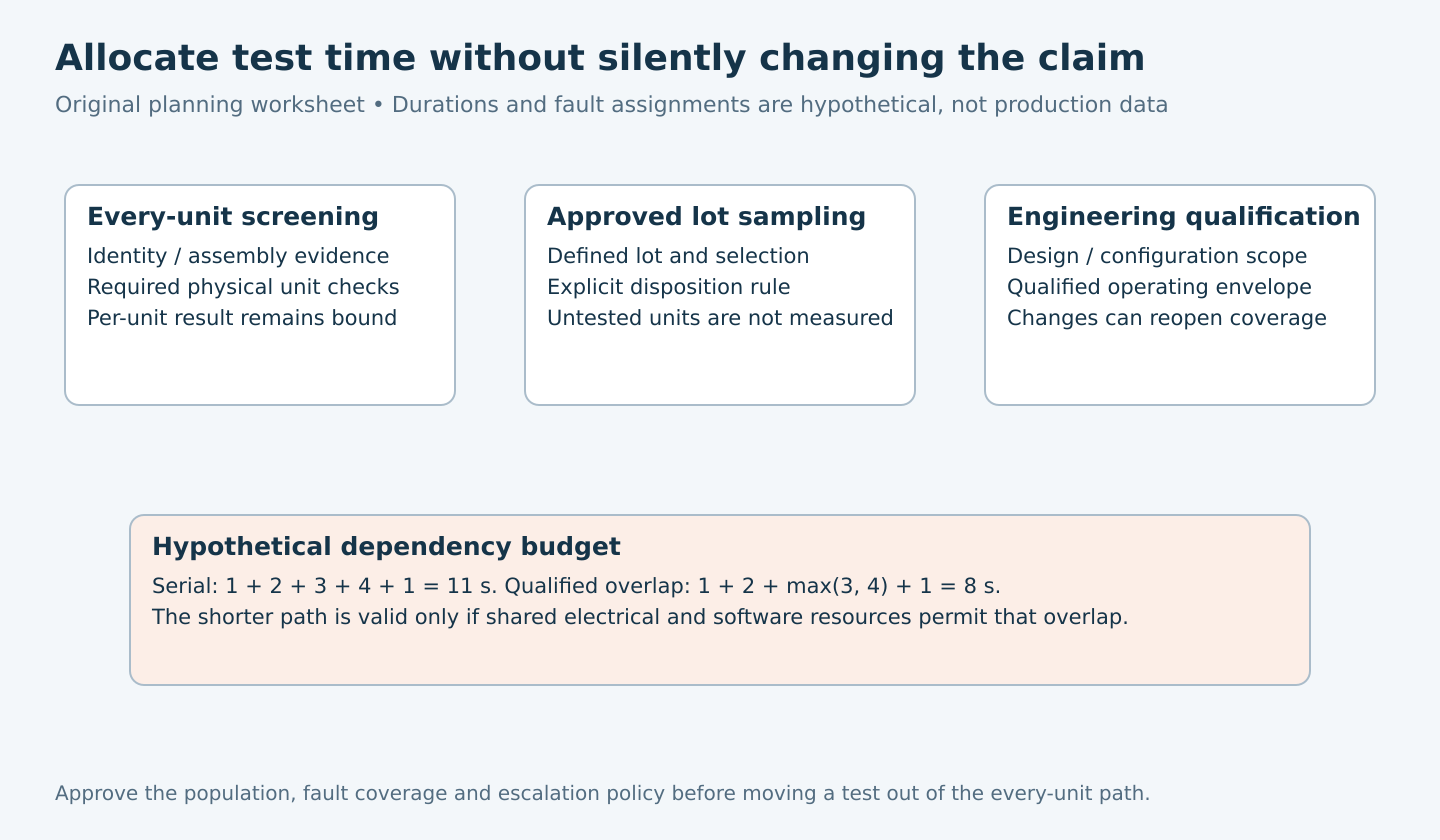
These assignments are examples, not universal manufacturing requirements. The responsible engineer must decide which defects need every-unit detection, which evidence can be sampled and which conditions belong to design qualification.
Measure the full cycle and its long tail
Separate fixture loading, identity binding, setup, warm-up, stimulus, acquisition, transfer, analysis, persistence and unloading. Include ordinary failed-test handling and required cleanup. A benchmark of only the successful instrument read can understate the actual station occupancy.
Record distributions and the conditions that produce slow cases. Repeated retries, unavailable resources and upload outages can dominate cycle time without adding product coverage. Fixing those infrastructure problems may preserve more evidence than deleting a useful test.
Keep measurement and estimation labels distinct. A vendor’s conversion-time specification can inform a budget, while actual host, fixture and instrument timing still requires observation. Do not turn an estimated budget into a claimed production throughput.
Optimize dependencies before removing coverage
Draw the test dependency graph. Some setup can be shared across measurements; some independent operations can overlap if electrical and resource interactions are qualified. Other steps must remain serial because one result establishes the precondition for the next.
For a hypothetical sequence, identity takes 1 second, setup 2, measurement A 3, communication B 4 and final recording 1. Fully serial execution totals 11 seconds. If A and B are genuinely independent and can overlap, the idealized critical path becomes 1 + 2 + max(3, 4) + 1 = 8 seconds.
This arithmetic excludes overhead and is not measured performance. If the two operations share a supply, instrument route or CPU bottleneck, the overlap assumption may be false. Qualify concurrency before crediting the shorter budget.
Treat sampling as a separate technical decision
NIST’s acceptance-sampling introduction describes selecting a sample from a lot to support a lot acceptance/rejection decision. It distinguishes that purpose from estimating the lot’s quality. Sampling is therefore not equivalent to declaring every untested unit individually verified.
Document the lot definition, selection method, characteristic, approved plan, acceptance/rejection conditions and response to a failure. Identify who may change the plan and what triggers tightened inspection or renewed engineering review.
Do not supply a convenient sample size without the required risk, population and process inputs. This article gives no acceptable-quality level, defect-rate guarantee or universal sampling table. Applicable customer, regulatory or safety requirements may constrain the choice.
Preserve what a shortened screen can and cannot detect
If a faster surrogate test is proposed, compare its detection mechanism with the original. A resistance check might detect an open connection while missing a load-dependent contact defect. A brief boot check can miss a failure that requires sustained thermal or memory pressure.
Use known-fault or representative challenge evidence to assess the surrogate’s coverage, with safe test artifacts. Agreement on good units alone cannot show that both methods detect the relevant faults.
Record residual gaps and the stage that will cover them. Moving a check to engineering qualification is defensible only when the claim and variation model support that move; it does not automatically address random assembly defects on individual units.
Define escalation before the sample fails
A failed sample should activate the approved lot disposition and investigation, not trigger repeated sampling until a favorable subset appears. Preserve the initial sample and selection record. Define the affected material hold and any additional inspection through the authorized process.
Likewise, station drift or a changed fixture can invalidate assumptions behind the time and coverage plan. Reassess the relevant tests when the product, process, supplier, firmware or measurement method changes.
Release a budget with evidence ownership
The final worksheet should show each test’s fault target, population meaning, required frequency, measured or estimated duration, dependencies, owner and remaining limitations. Separate the normal cycle budget from recovery capacity.
Approval should explain both the expected time effect and the preserved detection claim. The useful outcome is a faster, reviewable process whose untested population and residual risks remain explicit, rather than a shorter sequence that quietly changes what “passed” means.