Linux Debug Objects: Diagnose Timer or Work Item Reuse in the Wrong Lifecycle State
Translate an ODEBUG warning into the attempted operation and the object’s recorded lifecycle state. Then find the code path that allowed those two to disagree. Reinitializing an active timer, freeing a container with live work, and using an object after destruction are different failures even when all eventually crash in a callback.
The baseline is upstream Linux v6.12’s debugobjects infrastructure, with timer and workqueue integrations checked in the same tag. This is a tracked-lifecycle investigation, not a general guarantee against use-after-free or a replacement for subsystem cancellation contracts. The negative tests are proposals for an isolated development kernel; none was executed for this article.
Confirm the object type is actually tracked
The generic debugobjects reference describes type-specific descriptors and lifecycle hooks. Tracking works because a participating subsystem calls those hooks. Enabling the generic feature does not automatically understand every private structure in a driver.
The v6.12 options distinguish CONFIG_DEBUG_OBJECTS, timer tracking, work tracking and checks for tracked objects inside memory being freed. Verify the final values of CONFIG_DEBUG_OBJECTS_TIMERS, CONFIG_DEBUG_OBJECTS_WORK and, for the free-container case, CONFIG_DEBUG_OBJECTS_FREE. Record whether runtime initialization succeeded and whether tracking remained enabled.
Read the available statistics at /sys/kernel/debug/debug_objects/stats where debugfs is provided. Save warning and fixup counts before and after a bounded case. Console output can be limited, so one printed warning does not necessarily mean one violation. A missing interface or disabled tracker is a coverage issue, not a clean test.
Decode operation, state and generation
Keep the warning type, object address, named object class, state, hint symbol where present, and complete stack. Resolve the containing allocation and its generation. Address reuse can make a newly allocated container resemble an old one unless the trace records creation and retirement explicitly.
For a synthetic warning worksheet, suppose the attempted operation is initialization, the recorded state is active, the class is a timer, and the call stack leads to a reconnect handler. The first hypothesis is that reconnect reinitializes a timer that remains armed. That is narrower than “the timer subsystem failed.” Confirm whether the earlier activation belongs to the same container generation.
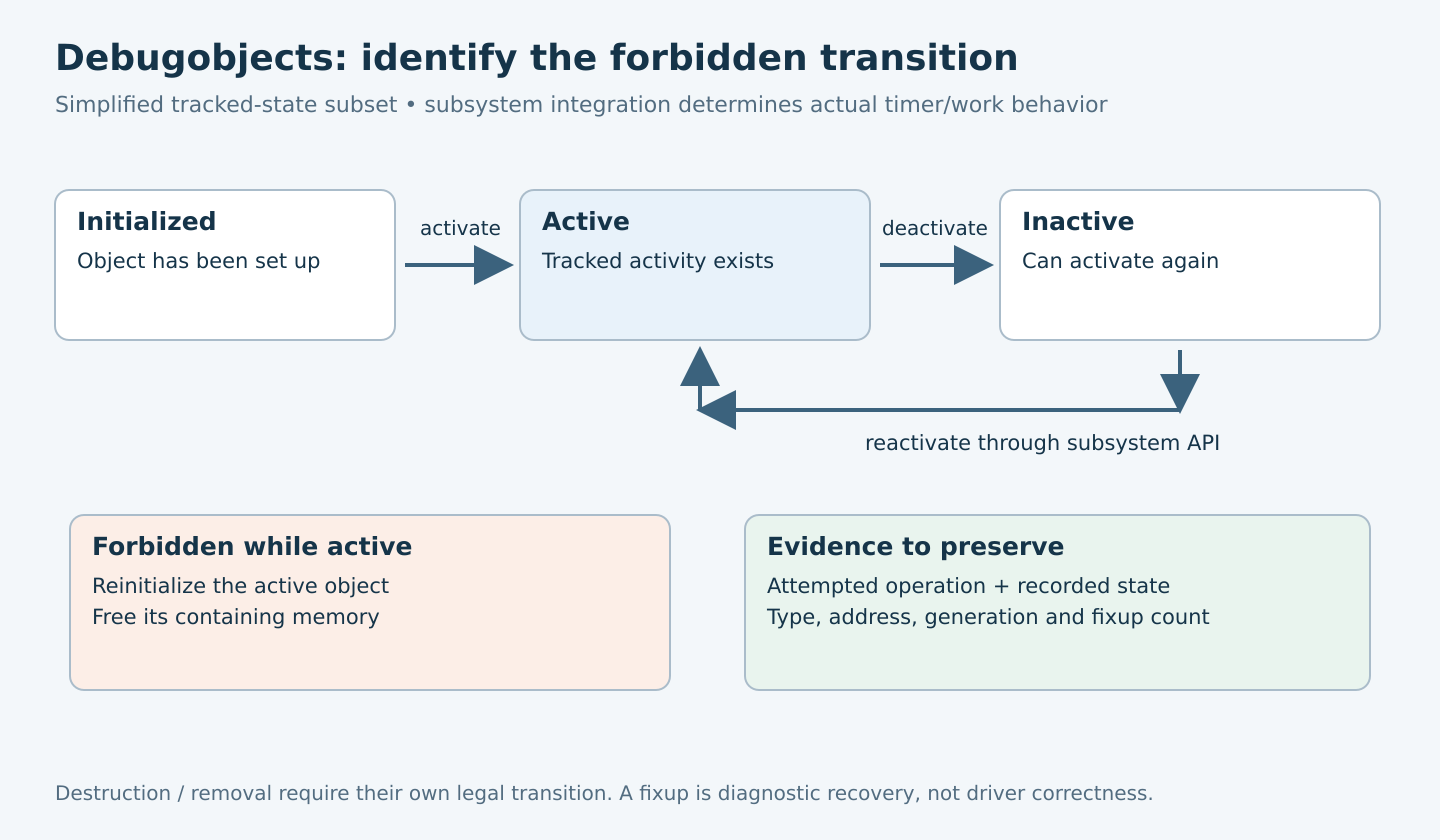
The generic state model allows initialization, activation, deactivation and eventual destruction or removal from tracking under defined conditions. Initializing an active object and freeing an active tracked object are violations. However, generic tracking state is not a complete execution-state enum for a work item; read the subsystem integration before equating active with every meaning of queued or running.
Understand fixups before interpreting survival
The v6.12 timer integration supplies fixups for specific mistakes. Its active-object initialization and free fixups synchronize timer deletion before updating tracking state. The workqueue integration likewise uses synchronous work cancellation in its relevant fixups.
These recovery attempts help preserve evidence; they are not an application lifecycle protocol. A diagnostic build that survives because a fixup ran can conceal a failure that returns when checking is disabled. Count successful fixups as detected defects requiring explanation, not as proof that the driver cleaned up correctly.
Also examine the context in which a fixup might run. Waiting for a callback while holding a resource the callback needs can deadlock. A deliberate negative test must not rely on the tracker to rescue arbitrary execution contexts. Keep the test controller independent of callback locks and use bounded external recovery.
Reconstruct the missing transition
Build an event ledger with container generation, initialization, timer arm or work submission, callback entry and exit, stop-admission event, synchronization completion, and final reclamation. Record accepted versus rejected submissions where the subsystem API provides that distinction. Do not turn a “pending” snapshot into permission to free storage.
Review all ways the object can become active again. A callback may rearm its timer; another CPU may queue work after teardown inspected a flag; an error path may skip the synchronization boundary. The ledger should identify which producer can still acquire a reference at the moment the driver believes the object is retired.
For the hypothetical reconnect timer, decide whether reconnection reuses the same initialized timer or creates a new container generation. A repeated constructor call is not a substitute for stopping the prior activity. Keep any chosen reuse protocol within the timer API’s exact lifetime and callback guarantees.
Use paired positive and negative tests
- Valid lifecycle control: initialize a test-only timer, arm it, stop and synchronize it from a valid controller context, then release its container. Verify the intended callbacks and final completion.
- Active reinitialization case: in a disposable fixture, keep a test timer armed and intentionally invoke its initialization path again. Expect a diagnostic attributable to that transition; record any fixup and do not treat continued execution as success.
- Free-while-active case: with free-object checking verified, use a separate isolated fixture that attempts to release a container with an active tracked object. Prepare for a warning, recovery failure or kernel failure.
- Corrected driver case: repeat the real reconnect, abort and removal operations while tracing generation and final-use boundaries.
These are test specifications, not copy-and-run instructions. Prefer a reviewed subsystem-specific fixture and the generic infrastructure self-test appropriate to the build. The deliberately invalid cases must never operate on a live actuator, production storage path or valuable workload. If the fixture cannot guarantee isolation, do the source review and stop before fault injection.
Review stack objects separately
An on-stack timer or work item requires its matching on-stack initialization and tracking teardown, along with actual lifetime synchronization. Returning from the containing function while a callback can still use that memory is unsafe even if the stack address later happens to contain plausible values.
The timer and workqueue sources provide separate on-stack tracking paths. Follow the subsystem’s APIs rather than directly manipulating generic debugobjects state in a driver to silence a warning. Removing a tracking record does not cancel a callback or make storage safe to reuse.
Close with a lifecycle argument
Accept the change when the event ledger explains who admits activity, who prevents new references, how existing users finish, and when storage becomes reusable. Require normal and error paths to reach that contract, with no unexplained warnings or fixups under the covered tests.
A quiet debugobjects run remains limited to integrated object types and observed transitions. It cannot prove that an untracked payload or a stale external reference is safe. Deliver the raw warning, state worksheet, source-backed transition repair and test status so another engineer can distinguish the actual fix from diagnostic recovery.