Retiring an MQTT Device: Remove Retained State Without Erasing Another Device’s Topics
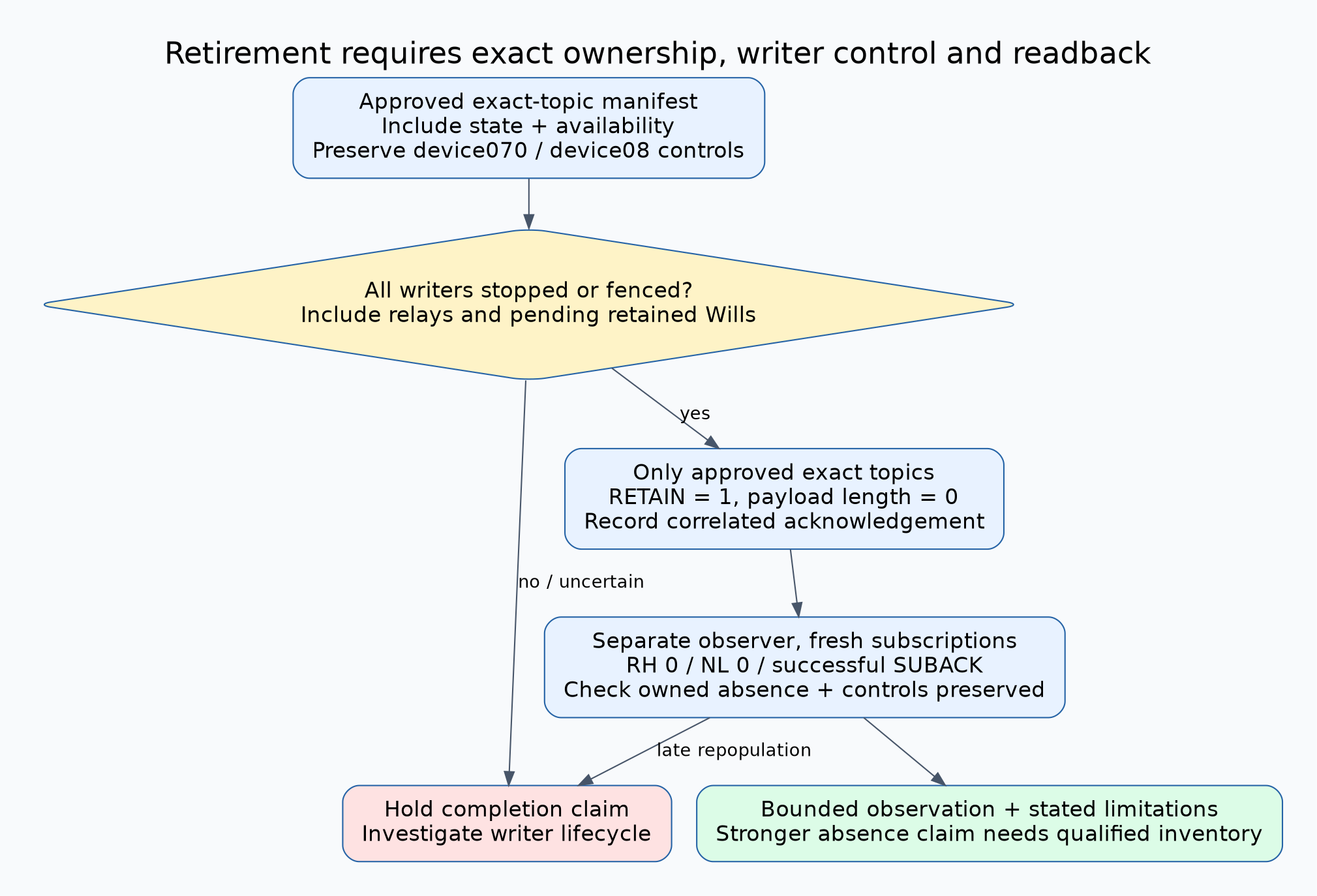
Retire a device’s retained state through an approved list of exact topic names, after stopping every writer that can recreate those values. For each owned topic, MQTT removes the retained value when it accepts a publication with RETAIN set and a zero-byte payload. Unsubscribing, ending the device session or publishing an empty payload without RETAIN does not perform this cleanup.
This guide pins the OASIS MQTT 5.0 Standard, 7 March 2019. Its procedure is a proposed isolated-lab qualification, not permission to delete production data. An original in-memory manifest model was executed. No broker state was changed, and no actual retirement or network readback was tested.
Build an ownership manifest before creating tombstones
Start from the device’s approved publication contract and deployment inventory. List exact topic names, expected owner, retained purpose, known writers and retirement disposition. A matching topic prefix is discovery evidence, not sufficient ownership proof. A shared site summary may contain this device’s data without belonging exclusively to it.
| Hypothetical lab topic | Decision | Reason |
|---|---|---|
| lab/retire/device07/state | Owned cleanup candidate | Dedicated device state |
| lab/retire/device07/availability | Owned cleanup candidate | Dedicated presence value; inspect Will writer |
| lab/retire/device070/state | Preserve | Different device despite similar prefix |
| lab/retire/device08/state | Preserve | Independent neighboring device |
Keep unknown topics on hold. Do not turn a wildcard subscription result into an automatic deletion list. MQTT PUBLISH topic names cannot contain wildcard characters, so a cleanup implementation must already resolve each intended publication to an exact topic. Make that resolution reviewable rather than hiding it inside a broad loop.
Stop repopulation before removing the values
Enumerate direct publishers, gateway relays, bridges, backend state services and configured Wills. Establish an authorized retirement state that prevents ordinary reconnect or provisioning from restarting those writers. An offline device can still have a pending retained Will, so losing its network connection is not proof that no future write remains.
Sections 3.1.3.2.2 and 3.14.4 distinguish pending Will behavior from normal client DISCONNECT with reason zero, which discards the Will. Coordinate that lifecycle using the actual implementation’s supported procedure. Ending a session can itself make a delayed Will eligible. Do not clear the topic first and then assume session termination cannot recreate it.
Record evidence that all relevant writers are stopped or intentionally fenced, including the final Will disposition. If that cannot be established, classify cleanup as provisional and retain monitoring and an explicit unresolved risk. Repeatedly deleting a value while an active publisher restores it is not a completed retirement.
Use the exact removal operation
Section 3.3.1.3 defines the removal case: RETAIN one and a payload containing zero bytes remove the retained message for that exact topic. The zero-byte message itself is not stored as a retained value. It is still processed normally for existing subscribers, whose application handling must tolerate the empty publication.
A textual null, an empty JSON object, or a quoted empty string contains bytes and can become a new retained value. Likewise, a genuinely zero-byte payload with RETAIN zero leaves any prior retained value unchanged. Verify serialized payload length and flag rather than relying on a command-line label or visual blank field.
For the lab plan, use QoS 1 so each cleanup attempt has a correlated PUBACK result. Record topic, payload length, RETAIN, Packet Identifier, acknowledgement reason and application operation identity. A failed or missing acknowledgement leaves a different evidence state from a successful acknowledgement; never label all three “deleted.”
Separate session removal from retained-store removal
Section 4.1 explicitly places retained messages outside the server’s Session State. Ending the device session therefore does not delete its retained messages. Removing a subscriber’s filter also changes subscription state rather than removing the publisher’s retained value.
This distinction matters during factory replacement. A fresh ClientID or clean session can coexist with old retained device-state topics. Confirm the topic ownership transition separately from credentials, connection identity and session cleanup. Do not delete a shared topic merely because the retiring client once published to it.
Verify through a separate observation path
- Before cleanup, establish retained fixtures for the two owned lab topics and the two neighboring controls.
- Use a separate observer with the required read permissions, a fresh nonshared subscription, Retain Handling zero and No Local zero.
- Confirm successful per-filter SUBACK results and the expected baseline fixtures. Prepare callbacks before SUBSCRIBE because deliveries can precede SUBACK.
- After quiescence and acknowledged tombstones, recreate the observer’s subscriptions and record every delivered exact topic and payload.
- Verify neighboring controls remain unchanged and no owned retained fixture is observed within the declared test window.
- Recheck after the qualified reconnect or restart scenario that could otherwise revive an old writer.
A quiet subscriber is bounded observational evidence, not a universal proof of absence. Permissions, packet-size limits, failed subscriptions or a stopped observer can also hide data. SUBACK confirms subscription processing; it is not a complete retained-inventory snapshot marker. Keep the successful controls and observation limits in the result.
If release requires authoritative retained-store absence, add a documented, version-qualified server-side inventory/readback mechanism with its consistency limits. This guide does not assume a standard MQTT enumeration API or a particular broker administration command. Hold that stronger acceptance claim when the necessary evidence is unavailable.
What the local model established
The executed dictionary model allowed only the two exact owned topics, rejected a wildcard and the similar device070 topic, and preserved both neighboring controls. It confirmed that nonretained empty data did not delete, while nonempty null became stored data. Approved zero-byte retained operations removed only the owned entries.
A final simulated late writer recreated an owned value, demonstrating why the manifest alone is insufficient. These assertions validate the proposed selection logic, not broker conformance. The retirement record should close ownership, writer disposition, per-topic acknowledgement and readback separately, with any unproven completeness or repopulation condition left visible.