Modbus Listen-Only Mode: Keep a Diagnostic Command from Stranding a Serial Device
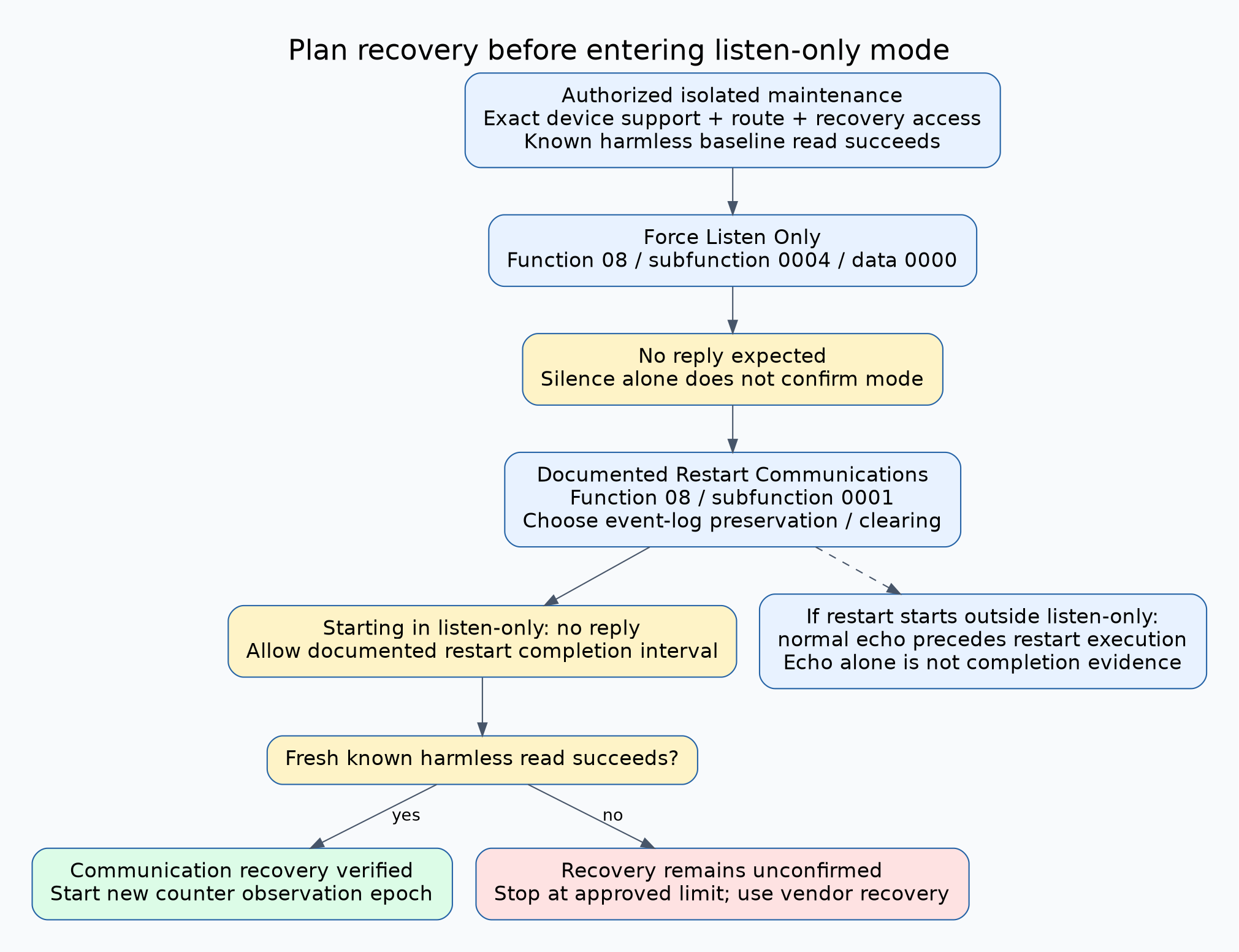
Treat Force Listen Only Mode as an authorized maintenance transition with a prepared recovery path. Its successful protocol behavior includes silence, and the Restart Communications request sent while already in listen-only mode also receives no response. A normal request/reply retry loop can therefore misclassify both transitions and leave the operator uncertain about the device’s state.
This guide pins Modbus Application Protocol V1.1b3, 26 April 2012, section 6.8.1. Function 08 is a serial-line diagnostic function; actual subfunction support, process consequences and recovery access depend on the exact device and firmware. No serial device was commanded and no hardware recovery test was executed.
Separate diagnostic reading from mode control
A Function 08 scanner must not discover support by trying every subfunction. The family includes counter reads, counter clearing, communication restart and mode changes. Giving a user permission to view diagnostic counters does not automatically authorize operations that disable communication.
For maintenance software, define a separate allowlist entry for the specific device, serial segment, addressed operation and approved maintenance window. Require the device manual and recovery procedure before enabling that entry. Keep this capability outside normal polling and onboarding.
Use one individually addressed bench device for qualification. Do not use broadcast discovery or apply the operation to a mixed production segment. A gateway’s accepted TCP request does not establish which downstream serial port processed the command.
Record the two distinct no-response contracts
| Operation and starting state | Defined response behavior | What remains unproved |
|---|---|---|
| Force Listen Only: function 08, subfunction 0x0004, data 0x0000 | No response | Whether this particular device received and entered the mode |
| Restart Communications: subfunction 0x0001, starting in listen-only | No response | Whether restart tests completed and the port returned online |
| Restart Communications, starting outside listen-only | Normal response before restart executes | Successful completion of the subsequent restart |
The table describes PDU fields and observations, not ready-to-run serial frames. Addressing, RTU framing, CRC, gateway routing and device-specific support still require the qualified implementation.
In listen-only mode, the specification says addressed and broadcast messages are monitored without normal actions or responses. Restart Communications is the only Modbus function processed to bring the port out of that mode. Ordinary reads and repeated counter requests cannot confirm readiness while it remains silent.
Do not call communication silence a physical safety state
The specification describes disabling active communication controls and allowing the Ready watchdog to expire. That is a communication-mode description, not a universal claim that actuators are de-energized, process control has stopped or electrical bus isolation has been achieved.
Review the selected device’s process behavior and safety procedures separately. A controller may continue an independent application while its Modbus port is unavailable. The maintenance plan must cover what loss of communications means to the surrounding system, including watchdogs and supervisory logic.
Prepare recovery before transmitting the mode change
- Record exact device model, firmware, supported Function 08 behavior and the physical recovery access available.
- Confirm a harmless addressed read succeeds and identifies the intended device or documented object.
- Capture routing, serial settings and the approved recovery operation without changing them during the experiment.
- Stop competing pollers through the authorized maintenance procedure so retries and old responses cannot confuse the timeline.
- Set a bounded observation window and a stop/escalation condition based on the device manual.
- Confirm who can perform the vendor-documented local recovery if communication does not return.
A missing manual, uncertain route or unavailable recovery access is a reason to leave the operation disabled. Do not discover whether a power cycle clears the mode by experimenting on equipment still responsible for a live process.
Preserve the restart side effects
Restart Communications initializes and restarts the serial port and clears communication event counters. Its data field selects an additional event-log effect: 0xFF00 clears the Communications Event Log, while 0x0000 leaves that log as it was.
Choose that data value deliberately. Preserving the event log does not mean counters survive the restart. End the prior counter-observation epoch so a new low value is not interpreted as wraparound or a sudden improvement in communications.
The device attempts restart and performs its power-up confidence tests. Successful completion brings the port online. The standard does not provide one universal completion delay suitable for every implementation.
Use a post-recovery read as the completion check
After the documented restart opportunity, issue the previously qualified harmless read under a bounded schedule. Validate its address association, function, response structure and expected object meaning. One arbitrary byte arriving on the bus is not a recovery result.
If the restart began outside listen-only mode, its normal echo precedes restart execution. Keep “restart request acknowledged” separate from “communication verified after restart.” If it began inside listen-only, no echo is expected at all.
Persistent silence leaves recovery unconfirmed. It can reflect unsupported diagnostics, lost traffic, wrong routing, a continuing mode or failed restart. Preserve those alternatives and escalate through the approved recovery procedure rather than sending increasingly disruptive commands.
Hypothetical maintenance timeline
Imagine a bench device that passes the baseline read. The tool sends the approved Force Listen Only request, records transmission and observes no reply. Its state becomes “mode transition requested; silence expected,” rather than “device acknowledged listen-only.”
The operator then authorizes the documented Restart Communications request with event-log preservation. Again there is no response. After the manual’s recovery interval, the known read succeeds and the tool records communication restored, with a new counter epoch.
If that read fails, the tool retains an unresolved recovery result and stops at its agreed limit. These are hypothetical states and observations, not measured behavior from a real device.
Acceptance checklist
Qualification should prove that ordinary diagnostic users cannot emit mode controls, the intended route is explicit, expected silence cannot trigger automatic repeated mode changes, and recovery requires fresh post-restart evidence. Exercise lost-entry-request and lost-restart-request cases on the authorized bench to ensure the tool preserves uncertainty.
Keep the vendor-specific recovery record beside the protocol reference. The engineering outcome is a reversible, observable maintenance procedure whose software can explain what was requested, what was actually observed and what remains unknown.