Buildroot Kernel Headers and Runtime Kernels: Test the Oldest Kernel Your libc Must Support
Track the headers used to build userspace, libc’s configured minimum kernel and the oldest deployed runtime kernel as three separate facts. A successful build establishes that declarations and libraries were available. It does not prove that the deployed kernel implements every operation the resulting application will attempt.
This guide uses Buildroot 2025.02 configuration and package source, with GNU libc 2.41’s build documentation. It proposes an oldest-kernel compatibility test suite; no Buildroot image, libc or target application was built or executed here. The procedure is not a general libc replacement plan.
Separate the three version records
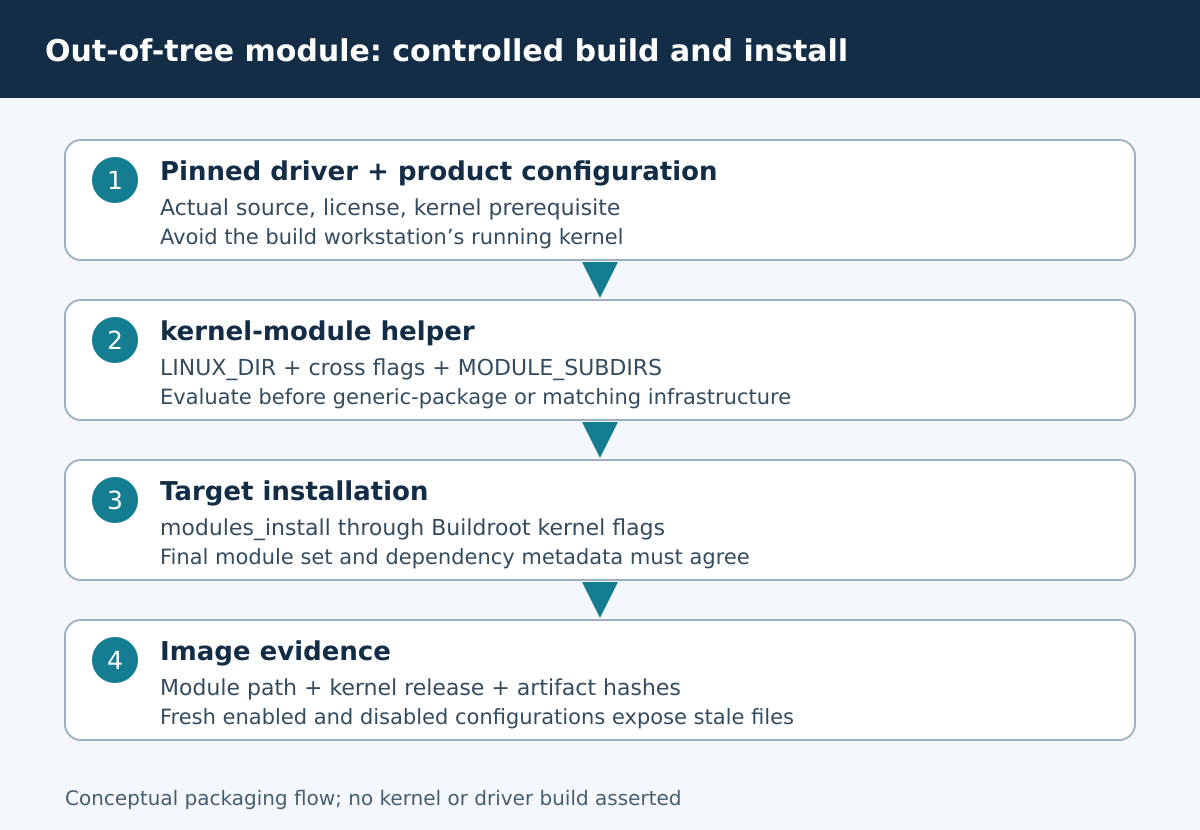
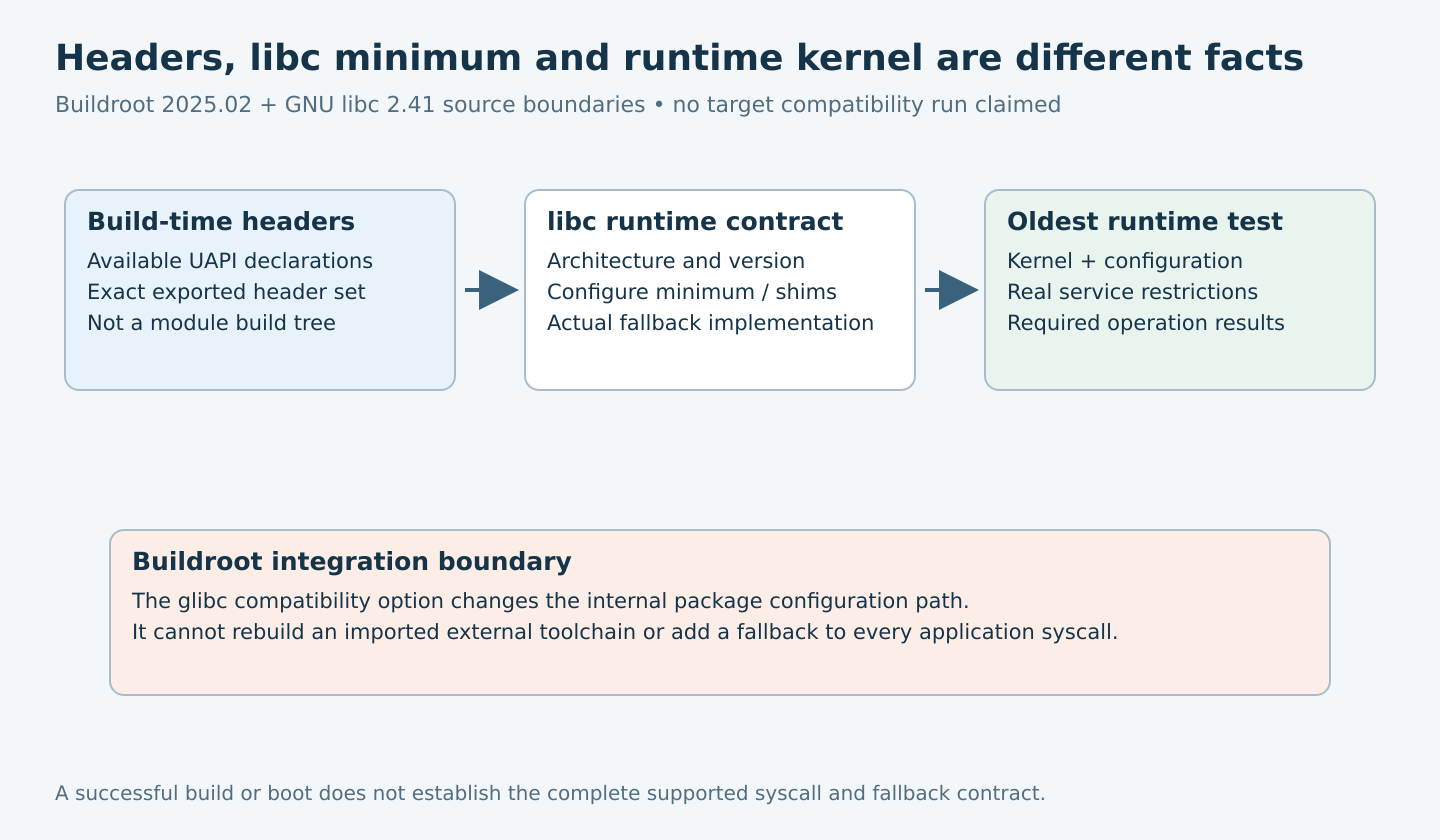
First record the exported Linux UAPI header version used by the toolchain. These headers describe userspace-visible definitions; they are different from the configured kernel build tree used for external modules. Do not substitute one for the other.
Second record the libc source version, architecture and configure options controlling its runtime assumptions. Third record every supported runtime kernel, including vendor revision, configuration and relevant backports. Preserve the actual build logs and image identities instead of relying on a release name shared by several different artifacts.
The Buildroot 2025.02 toolchain guide gives a conservative rule: headers should be no newer than the kernel that will run, because newer declarations may let libc use unavailable interfaces. It also makes clear that the versions need not match exactly.
Read the integration’s explicit compatibility option
The same release has an important glibc-specific qualification. Its glibc configuration provides BR2_PACKAGE_GLIBC_KERNEL_COMPAT for compatibility shims when the runtime kernel is older than the headers. The oldest supported kernel remains architecture-dependent. That option is not a promise of arbitrary backwards compatibility.
The package recipe shows what changes: when the compatibility option is not selected, it passes –enable-kernel using the configured headers-at-least value. When the option is selected, that recipe addition is omitted, leaving the libc build’s own supported baseline and architecture conditions relevant.
For an external toolchain, the internal glibc package option does not rebuild the imported libc. Obtain its actual build configuration and minimum-runtime contract from its producer. If that evidence is unavailable, record the supported-kernel relationship as unresolved rather than assuming a menu selection changed the binary.
Understand what the libc minimum permits
The GNU libc 2.41 INSTALL document in the official release archive defines –enable-kernel as the smallest Linux version the generated library is expected to support. Raising the value allows compatibility code to be omitted. Choosing a lower value cannot make an architecture or libc release support a kernel below its own minimum.
Headers and minimum-runtime policy therefore answer different questions. Headers can provide declarations for newer interfaces while libc retains selected older-kernel fallbacks. Whether a specific operation has such a fallback must be verified in the exact implementation. Do not infer a universal fallback mechanism from the configure option alone.
Application code and third-party libraries can also call newer syscalls directly or require behavior absent from the old kernel. Their requirements can exceed libc’s baseline. A small program that only prints a message does not exercise those paths.
Create a syscall and fallback inventory
| Inventory field | Evidence needed |
|---|---|
| Product operation | Startup, threading, file metadata, entropy or another real dependency |
| Userspace entry point | Actual wrapper/library version or direct syscall site |
| Runtime operation | Observed syscall sequence on each tested kernel |
| Unsupported result | Exact return and errno, without collapsing all failures together |
| Fallback | Source-backed trigger, alternate path and semantic differences |
| Acceptance | Correct product result or an explicitly supported failure mode |
Start with operations the application really uses. For example, a metadata probe should check the fields the application needs, not just whether one stat-like call returns success. A thread probe should create and join a bounded worker through the actual runtime. An entropy test needs a defined startup environment and must avoid logging secret output.
Read the fallback code before designing the expected result. Some wrappers fall back only on a specific error; others have no equivalent older operation. An alternate path may lose precision or an atomicity guarantee that the product requires. Record that semantic limitation explicitly.
Test the oldest kernel first
- Build the candidate userspace from a fresh, preserved configuration and record its toolchain provenance.
- Boot a recoverable target with the oldest supported kernel and the candidate userspace.
- Run the small operation probes, recording both application results and narrowly scoped syscall evidence.
- Exercise the corresponding real application paths, including startup and recovery.
- Repeat on the newer supported kernel without changing unrelated workload inputs.
- Investigate every unexpected fallback, unsupported error or semantic difference.
A hypothetical x86-64 product may support an older maintenance kernel and a newer replacement kernel while building one userspace image. The matrix must contain a result for each supported combination. Testing only the newer kernel cannot qualify the older one, even when both boot the same filesystem.
Keep security policy consistent and record restrictions separately. An unavailable syscall and a filter-generated denial can produce different wrapper behavior. Do not disable sandboxing to obtain a passing compatibility result and then ship the original restricted service untested.
Interpret a failure at the right layer
If compilation fails, investigate missing declarations or build assumptions. If the executable cannot load, investigate its loader and library ABI. If it starts but a required syscall path fails, inspect runtime capability and fallback behavior. These outcomes require different repairs.
Possible engineering decisions include using an older supported header baseline, enabling a verified compatibility configuration, retaining an application fallback, raising the minimum supported runtime kernel or restricting a feature. Select the decision from the product contract; do not silently claim support for a combination that was excluded from tests.
Changing toolchain options requires the appropriate complete rebuild. Copying different headers into an existing sysroot does not retroactively change the already built libc, and mixing those artifacts can conceal the real baseline.
Deliver the compatibility evidence
Keep the three-version ledger, relevant configure lines, operation/fallback inventory and oldest-kernel results with the release. Mark untested architectures and vendor configurations explicitly. Repeat the affected probes after libc, toolchain, application-library or sandbox changes.
The useful claim is that the required operations behave correctly on the declared oldest runtime under the actual service policy. “Headers match the kernel” and “the image boots” are narrower observations and cannot replace that evidence.