OpenSSL Providers in Embedded Images: Diagnose Algorithm Fetch Failures Beyond Missing Files
An OpenSSL algorithm fetch can fail even when the expected provider files are installed. The requested implementation must be available in the application’s library context and satisfy its effective property query. Diagnose those two conditions before changing module paths or weakening cryptographic policy.
This guide pins OpenSSL 3.5.7 primary documentation and an executed host fixture using that runtime. The fixture used fresh, owned library contexts and SHA256 test data. It did not edit system configuration, activate the legacy provider or qualify a FIPS deployment.
Capture the complete fetch request
Record the operation, algorithm identifier, OSSL_LIB_CTX identity, local property query and context-default properties. The libcrypto introduction explains that fetching considers providers in the specified context. Passing NULL selects the default context; it does not mean every provider in every application-created context becomes visible.
Keep the original error queue with the request. An unsupported result can describe the algorithm/property combination rather than a missing shared object. Capture errors immediately after the failed operation so later cleanup or unrelated OpenSSL calls do not obscure the relevant evidence.
For a digest, EVP_MD_fetch returns a fetched implementation object that must be released with EVP_MD_free. Check the result before using it. The digest API reference distinguishes the fetched algorithm from the separate digest-operation context.
Distinguish installed, loaded and selected
An installed module is only a candidate. Provider loading must initialize it successfully in the intended library context. A loaded provider can still offer no implementation matching the requested operation or properties.
The provider API describes built-in providers as well as loadable modules. Therefore absence of a provider-specific shared-object file is not automatically proof that a provider is unavailable. Conversely, file presence cannot prove initialization succeeded.
Preserve provider-load return values and search-path configuration as separate evidence. Do not infer the application’s provider state from an openssl command run in another process with another configuration. A command-line listing is useful context, but the application’s own fetch is the decisive boundary.
Make default-provider activation explicit where needed
The 3.5.7 default-provider documentation defines fallback loading when no provider-load attempt has already changed that state. A prior explicit load attempt can suppress the automatic fallback, even if that attempt failed. Applications combining providers should deliberately load the default provider when their supported policy requires it.
OSSL_PROVIDER_try_load has a retain_fallbacks parameter with different fallback behavior from an ordinary load attempt. Record which API the application uses rather than treating all provider-loading calls as interchangeable.
Do not repair a failure by loading every available provider. Identify the required implementation and the approved policy first. Some images intentionally exclude algorithms or providers; a failure under that policy can be the correct result.
Read mandatory and optional properties correctly
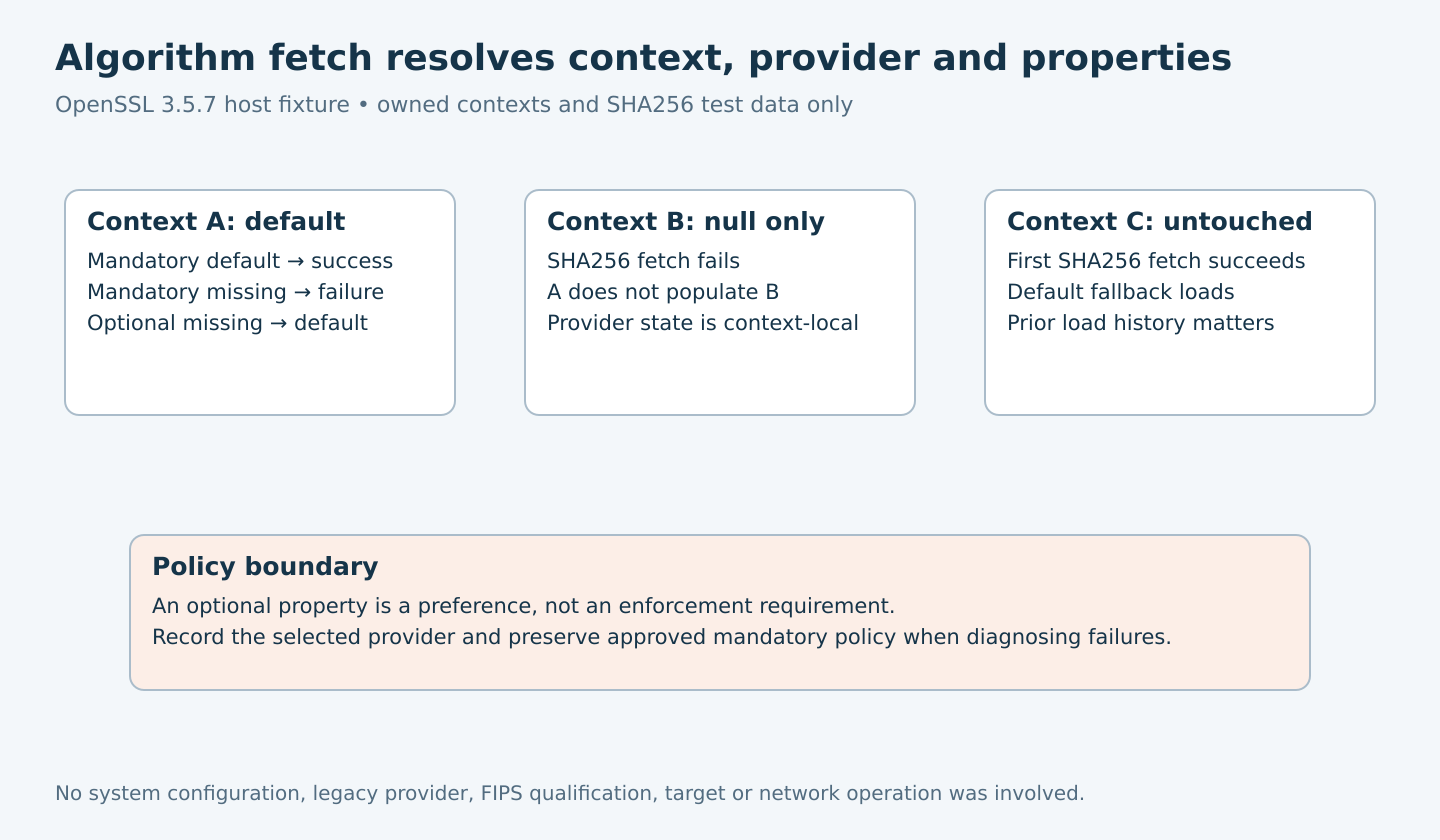
The property-query reference distinguishes mandatory clauses from optional preferences prefixed with a question mark. An optional preference can select another implementation when the preferred property does not match. It is not an enforcement boundary.
Context-default and local queries also interact: a local clause for the same property name overrides the context clause. Audit local query construction so a convenience call cannot accidentally weaken an application-wide requirement. Keep security-critical policy assertions explicit in tests.
The provider property is a convention implemented by providers, not a universal substitute for checking the returned provider identity. After a successful fetch, record the implementation’s provider through the applicable API and confirm it is an allowed selection.
Interpret the executed context matrix
The host fixture created three fresh contexts. Context A explicitly loaded the default provider. Context B loaded only the null provider. Context C was left untouched until fetching. All operations remained within the test process.
| Request | Observed outcome |
|---|---|
| A: SHA256 with provider=default | Fetched from default. |
| A: mandatory provider=missing_fixture | Fetch failed. |
| A: optional ?provider=missing_fixture | Fetched from default despite the unmatched preference. |
| B: SHA256 without a local query | Fetch failed; A’s provider did not populate B. |
| C: first SHA256 fetch | Default fallback loaded and fetch succeeded. |
Successful cases also completed a digest operation on the test string and returned a 32-byte result. The fixture recorded provider names and error queues. This is a resolution and API-lifecycle test, not a cryptographic validation certificate or a target performance measurement.
Turn the outcome into a specific diagnosis
If provider loading fails, investigate the module/build identity, dependency closure and initialization error before discussing algorithm properties. If loading succeeds but fetch fails, compare the requested operation and effective query with the provider’s advertised support.
If a minimal default-context example succeeds while the application fails, reproduce the application’s context creation and provider sequence. A fresh-context positive control can isolate context state without changing production configuration.
For an enforced property requirement, keep a deliberate nonmatching query as a negative test. Never convert the mandatory clause into an optional preference merely to make the test succeed. The optional fixture here exists to demonstrate why that change would alter the contract.
Qualify the deployed application
Repeat the matrix using the actual image, configuration-loading path and supported providers. Include startup errors and the application-specific algorithm family, since digest success does not qualify key management, signatures, encoders or ciphers.
Release fetched objects, operation contexts and provider references in the correct lifecycle, with no concurrent use after teardown. Preserve the exact OpenSSL build, provider identities, property policy and application request. The useful deliverable explains why an implementation was selected or rejected without treating a successful fetch as permission to relax the product’s cryptographic requirements.