Zephyr OS Retained Memory: Separate Storage Validity from Record Compatibility
A retained record can survive a restart and still be unsuitable for the new application. Before restoring state, distinguish three questions: could the hardware preserve these bytes, did the retention layer validate them, and does the current firmware understand their meaning? Treating any nonzero validation result as success creates a particularly avoidable startup bug.
This review uses Zephyr 4.4.0's retention API. The proposed record design and tests are engineering recommendations, not results from a particular board. Hardware reset-domain and startup-initialization behavior must be checked separately for the selected target.
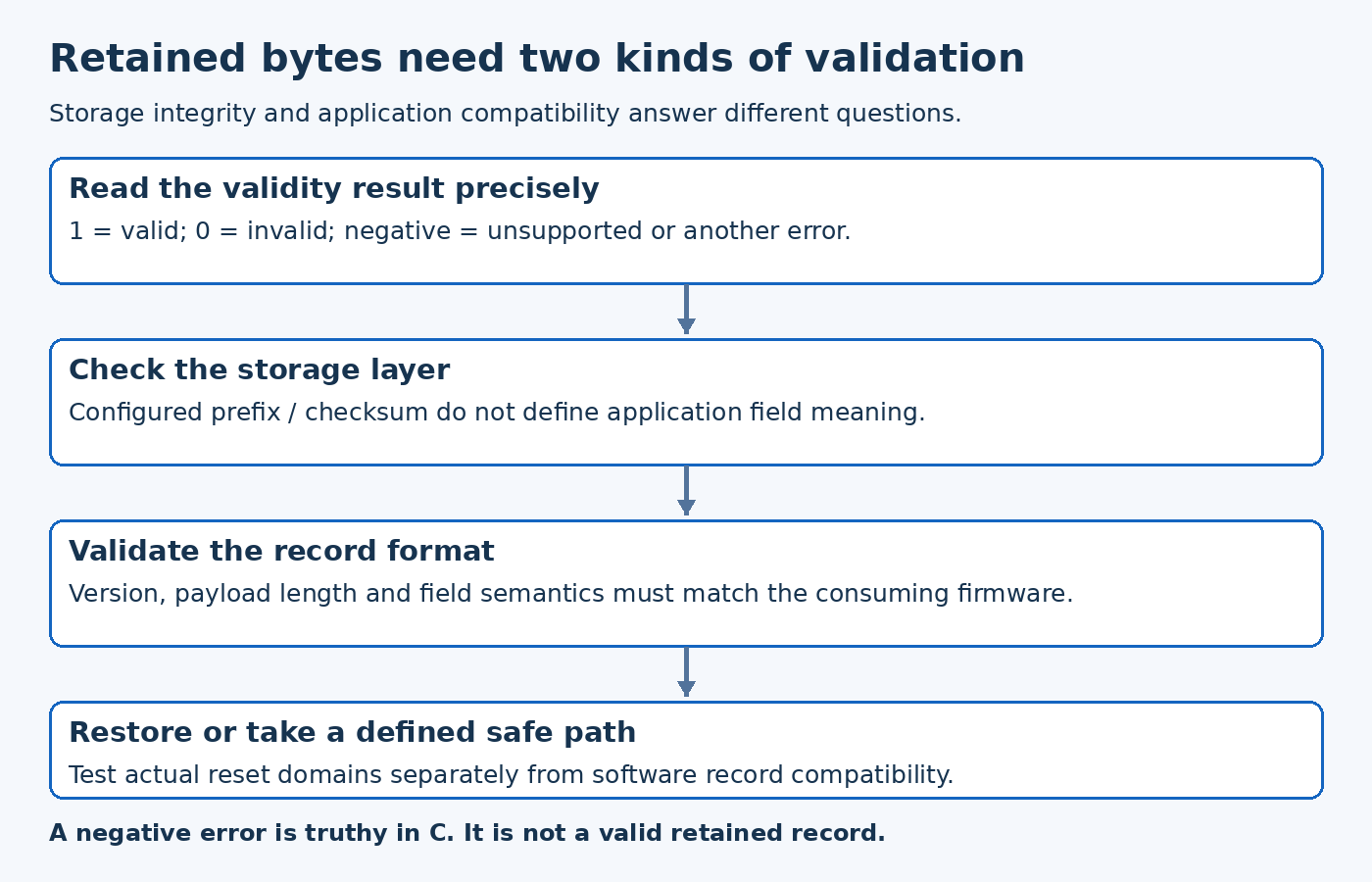
Decode the result before reading the record
The tagged retention API header defines retention_is_valid() as returning 1 for valid data, 0 for invalid data, and negative values for errors. With neither a header nor checksum configured, it returns -ENOTSUP. An ordinary Boolean test therefore accepts negative errors accidentally.
In an application wrapper, keep valid, invalid, unsupported validation, and other errors as distinct outcomes. Only the documented valid result should lead into the normal restore path. Invalid storage can trigger safe defaults; an unsupported configuration should expose a design decision rather than silently pretending integrity was checked. A read failure belongs on an error path even if an earlier validation succeeded.
This distinction makes startup diagnostics useful. “No compatible saved record” can be an expected first boot. “Validation was never configured” calls for a configuration review. “The backing driver could not read” needs a different investigation.
Know what the configured checks prove
The tagged retention implementation checks the configured prefix and checksum when present. Its read operation performs bounds checks and reads the backing memory; it does not call retention_is_valid() automatically. Usable size excludes reserved prefix and checksum space.
A prefix helps distinguish the intended storage layout. A checksum helps detect changed bytes. Neither supplies the application's knowledge of what a field means. Add an explicit application format version and bounded payload length to a proposed record, and validate both before interpreting optional fields. Define a migration or rejection policy instead of casting whatever survived directly into today's structure.
For example, suppose a hypothetical controller changes a retained field from seconds to milliseconds without changing the storage location. The bytes might pass their existing checksum while representing the wrong timeout. The relevant remedy is a format transition, not a stronger claim about retention hardware.
Treat writes as record updates
The implementation writes payload data and then maintains the configured validity information. This is useful infrastructure, but the article does not infer a transactional, power-loss-safe application record protocol from that sequence. A multi-call update can expose an intermediate application state between calls.
Prefer assembling a complete candidate record in ordinary working memory, validating its application fields, and defining how the retained copy is replaced. If several components update different fields, give one component ownership of the record-level operation or provide equivalent synchronization. Even when CONFIG_RETENTION_MUTEXES enables the retention layer's internal operation locking, that locking does not establish a transaction across several application calls.
For critical recovery decisions, evaluate whether a single retained record is sufficient. A generation number or a separate committed-state design may be appropriate, but its safety requires a specified write and reset model. Do not add such fields and claim atomicity without testing the resulting protocol.
Test the distinctions deliberately
Start with a valid record that the current firmware can restore. Then use controlled development tests for an absent prefix, modified payload, incompatible format version, excessive length, and an injected backing-read error. The expected outcome should identify the failed layer without attempting to consume questionable state.
Also test the actual reset types the product supports. A software restart, watchdog reset, and loss of the relevant power domain need not preserve the same state. Verify the board's memory placement and startup behavior; a successful validation test alone does not establish that a particular RAM region survives every reset.
The useful completion criterion is narrow: firmware restores only storage that passes the configured retention checks and its own format rules, and it has a defined safe path for every other outcome. That makes retained memory a deliberate startup input rather than an assumption hidden behind a truthy return value.