STM32WBA55 Without LSE: Budget LSI2 Calibration and Low-Power Support
Removing the low-speed crystal from an STM32WBA55 board trades a component for clock-source and calibration obligations. The substitute must support the radio's required sleep modes, and the firmware must keep its timing accuracy within the documented conditions. Selecting any available internal oscillator is not an equivalent design.
ST's guide describes LSI2 support beginning with STM32CubeWBA 1.6.0 and a CubeMX procedure requiring at least 6.14.0. This discussion is scoped to WBA55. The same guide explicitly excludes WBA25 and WBA23 because they do not have LSI2.
Compare the three radio sleep-clock choices
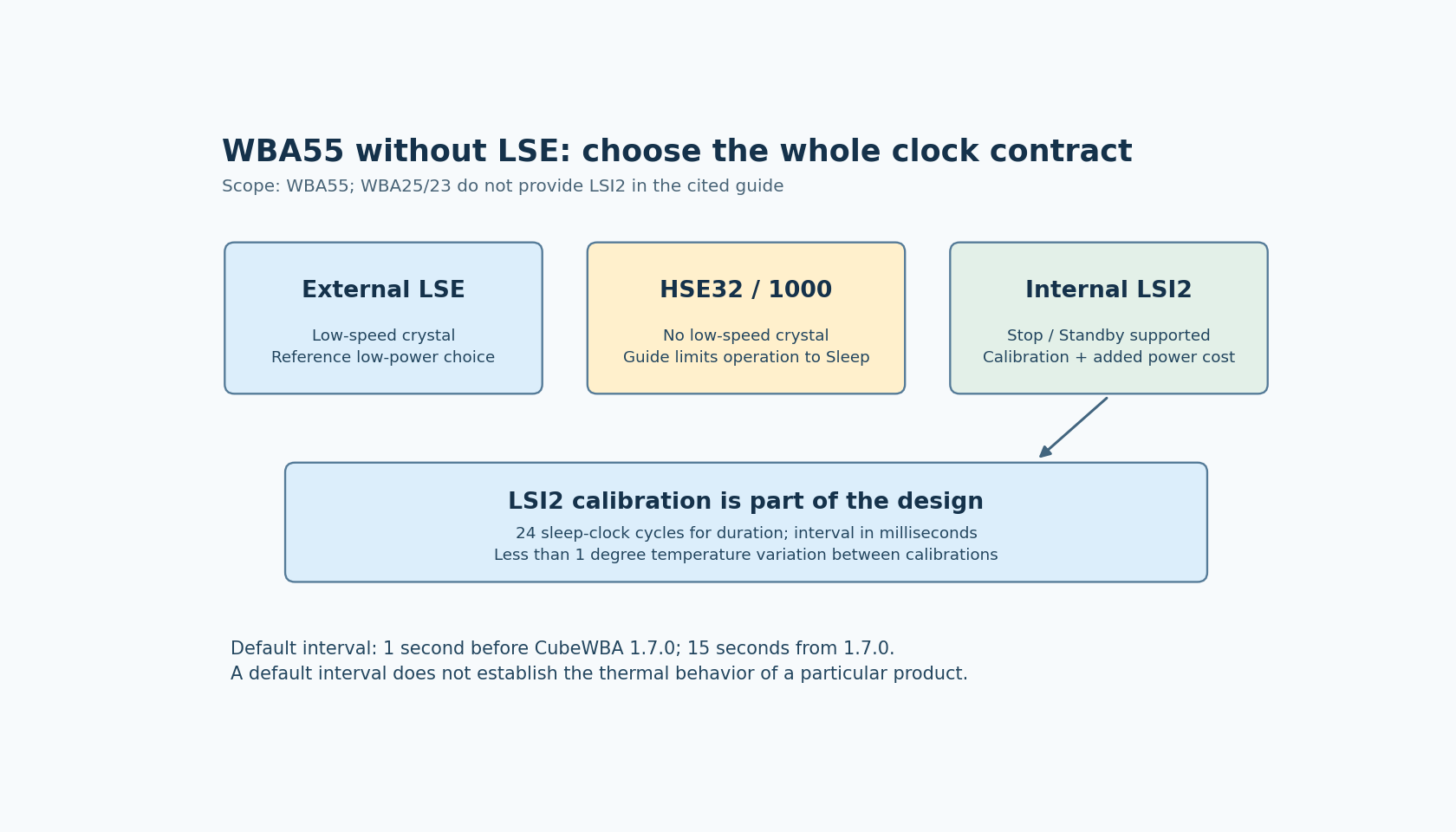
The WBA without LSE guide lists LSE, HSE32/1000 and LSI2 as sources for the 2.4 GHz radio sleep timer. The ordinary LSE choice uses the external low-speed crystal. Removing that crystal requires another source for the functions that depended on it.
HSE32/1000 avoids the low-speed crystal, but the guide says it prevents modes deeper than Sleep in this configuration. HSE is turned off when the system enters Stop or Standby, so this option does not preserve the same sleep behavior merely because it supplies a valid clock while running.
LSI2 remains available in Stop and Standby and can therefore support the deeper radio-sleep arrangement described by ST. The guide also identifies increased power consumption compared with LSE. A lower component count is consequently not evidence of lower product energy use.
Use RM0493 Rev 7 for the selected device's clock and power-mode controls. Keep oscillator availability, radio sleep-timer selection and RTC requirements explicit; a change made for one consumer can affect another.
Treat calibration interval as a thermal constraint
LSI2 drifts with temperature. The guide states a requirement of less than one degree of temperature variation between calibrations and explains that regular calibration is needed for the radio timing requirement.
The default interval changed from one second to 15 seconds starting with CubeWBA 1.7.0. That default does not prove that every enclosure, thermal transient or operating workload stays within the allowed temperature variation over 15 seconds. A product with rapid heating must assess the actual interval against its thermal behavior.
For example, an instrument that wakes a high-power neighboring load can have a different temperature trajectory from a board sitting on a laboratory desk. The relevant question is whether the oscillator's operating environment satisfies the between-calibration condition, not whether the same default value appears in a generated example.
Keep the two calibration parameters in their own units
The documented ll_intf_cmn_le_set_rco_clbr_evnt_params interface has a calibration duration and an interval. The duration is expressed in sleep-clock cycles and must be set to 24 in the guide's configuration. The interval is expressed in milliseconds.
Those values are not two interchangeable time quantities. Do not convert the documented 24-cycle parameter to 24 milliseconds or copy an interval expressed in seconds into the millisecond field. Retain the units beside the configuration values in the product's clock record.
The guide gives different integration locations for BLE and other RF protocols. Follow the path for the actual stack and package, rather than adding the call to an arbitrary startup function that might run before the link layer is ready or later overwrite the setting.
Notify the link layer of the real source
The link layer must know which low-speed source is in use so it can determine whether calibration is required. The guide says the CubeWBA package normally performs this through ll_sys_sleep_clock_source_selection, based on the radio sleep-timer configuration.
A custom clock-initialization port should verify that this notification still matches the hardware choice. Configuring LSI2 in RCC while leaving software assumptions at LSE can remove the calibration behavior the design relies on. Conversely, calibration is specifically required for LSI2 used by the radio sleep timer; it is not a reason to add the same mechanism indiscriminately to every low-speed clock consumer.
Decide whether the removed crystal is worth the obligation
Record the chosen source, required sleep states, calibration parameters and permitted thermal variation together. Then qualify radio timing and whole-cycle power on the intended board under its operating conditions. No such measurement was performed here, so no battery-life improvement is predicted.
If the design cannot support the calibration and thermal contract, retaining LSE may be the more defensible choice. If it can, LSI2 offers the documented crystal-removal path without giving up Stop and Standby merely to keep HSE running. The decision is complete only when the firmware obligations are as explicit as the component removed from the BOM.