Zephyr OS Semaphore Reset: Handle Aborted Waiters and Saturating Gives
Resetting a semaphore does more than discard its stored count. It also aborts outstanding takes. At the other end of its lifecycle, giving a semaphore already at its limit does not preserve an additional token. Both behaviors matter when a device uses a semaphore to signal work or recovery.
This discussion follows Zephyr v4.4.0. The examples describe proposed application checks, not observed failures in a particular product. Treat the semaphore count as bounded synchronization state rather than a complete operational history.
Read the take result before touching the resource
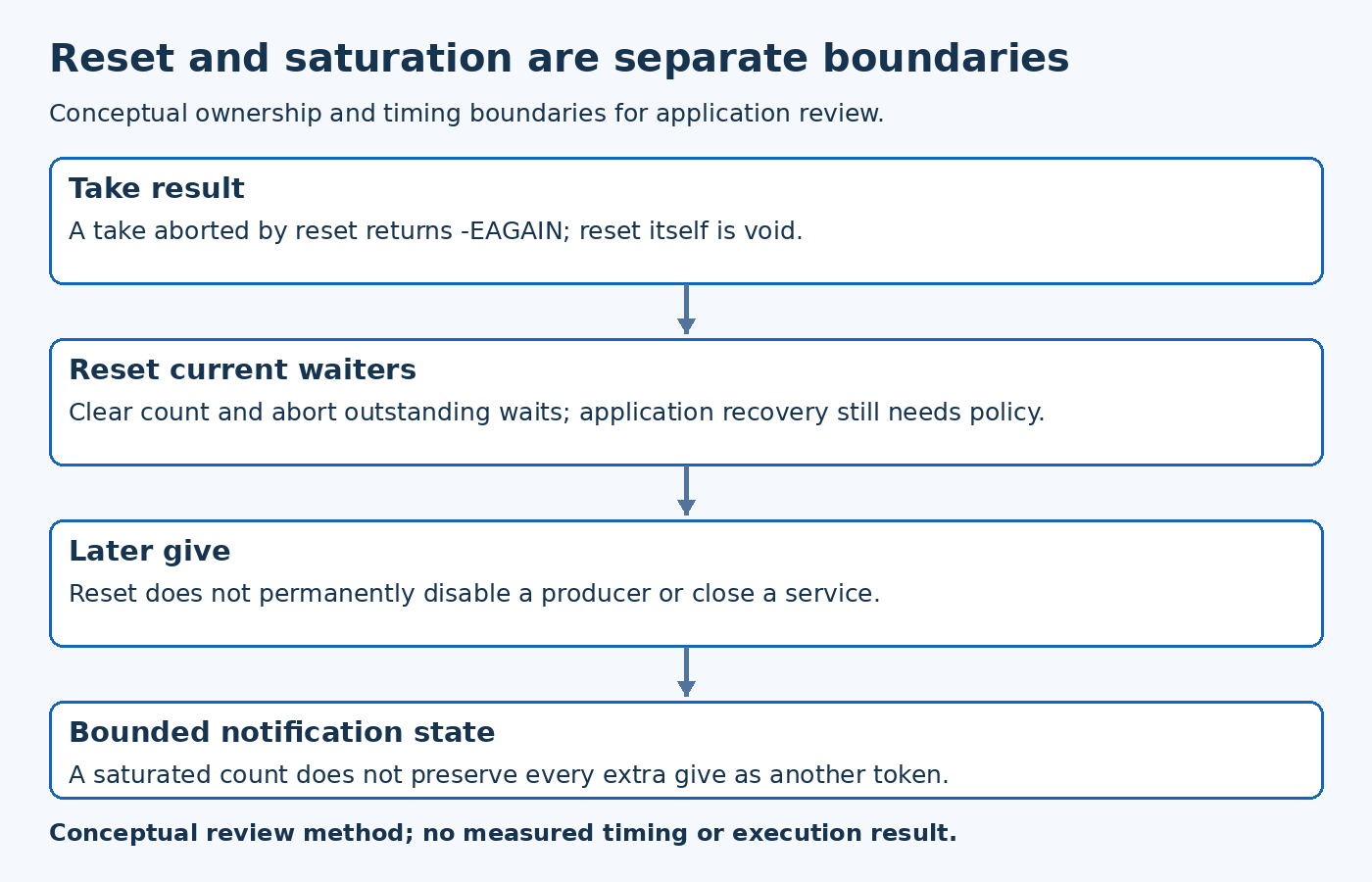
The tagged public contract specifies zero for a successful take. A non-waiting unsuccessful take reports -EBUSY. A timed-out wait or a wait aborted by reset reports -EAGAIN. Reset sets the count to zero and aborts outstanding takes with that latter result.
Consider a hypothetical worker that waits for a sample-ready semaphore and then reads a device buffer without inspecting the return value. A recovery routine resets the semaphore while the worker is blocked. If the worker treats the resulting return as successful acquisition, it can process stale or unrelated data.
Make the success path explicit. Error handling should consult synchronized application state when it needs to distinguish recovery from ordinary timeout; the shared return code alone does not identify that cause. Avoid inferring it from an unrelated log line whose timing is not synchronized with the worker.
Reset is not a permanent shutdown barrier
The v4.4.0 semaphore implementation wakes the current waiters with -EAGAIN and clears the stored count under its lock. A later give remains a valid new operation. Reset therefore does not disable a producer or make an enclosing service object safe to destroy.
For an acquisition restart, define the boundary between old and new data independently. One possible design uses a synchronized generation identifier: each accepted sample belongs to an acquisition generation, and recovery changes which generation consumers may accept. The semaphore then signals availability without being asked to encode the entire restart protocol.
If a worker should stop rather than retry, communicate that decision through a lifetime-safe control path. A loop that immediately retries every -EAGAIN can return to waiting after reset instead of exiting. Whether that is correct depends on the intended recovery behavior.
Saturation means excess gives are not queued forever
When no thread is waiting, the implementation increments the stored count only below its configured limit. When a waiter exists, a give can satisfy that waiter directly. Consequently, observing a zero stored count does not prove that nobody was signalled, and a maximum count does not reveal how many extra gives occurred.
For a hypothetical binary doorbell with limit one, coalescing repeated notifications can be deliberate. The worker wakes and drains a separate queue until it is empty. In that design, the queue preserves the work items; the semaphore merely provides a reason to inspect it.
For a design that requires one completion per transaction, that same bounded doorbell may be insufficient. Preserve transaction identity and results elsewhere, with capacity and overflow behavior appropriate to the workload. Increasing the semaphore limit without checking the payload storage can create a different mismatch rather than solving the original one.
Test recovery and bursts independently
In a disposable test configuration, block two workers, reset the semaphore and verify their actual return paths. Then give after the reset and confirm whether the service accepts the new generation or deliberately rejects it. Keep this separate from tests that intentionally time out, since both paths can report -EAGAIN.
For saturation, pause consumption and issue more notifications than the configured count limit. Compare retained work records with successful processing, not only the semaphore's snapshot count. Finally, repeat with a worker already waiting to exercise the direct handoff path.
These checks establish what the synchronization primitive actually represents. They do not require inventing a precise event count from state that was intentionally bounded or reset.