STM32WBA52 to WBA55: Screen Radio and Supply Features Before Calling It a Firmware Upgrade
A request to add IEEE 802.15.4 to an existing STM32WBA52 product can sound like a wireless-stack update. A request to improve battery life with the internal SMPS can sound like a power-setting change. Both decisions first encounter hardware availability: the WBA5 family name does not make those resources present on every member.
For this comparison, use DS14127 Rev 10 and RM0493 Rev 7. The relevant distinction is between the WBA52, WBA54 and WBA55 device columns, followed by the supply connections of the actual package. This is a feasibility review, not a claim that a WBA55 is a drop-in replacement.
Read the radio rows before selecting a software package
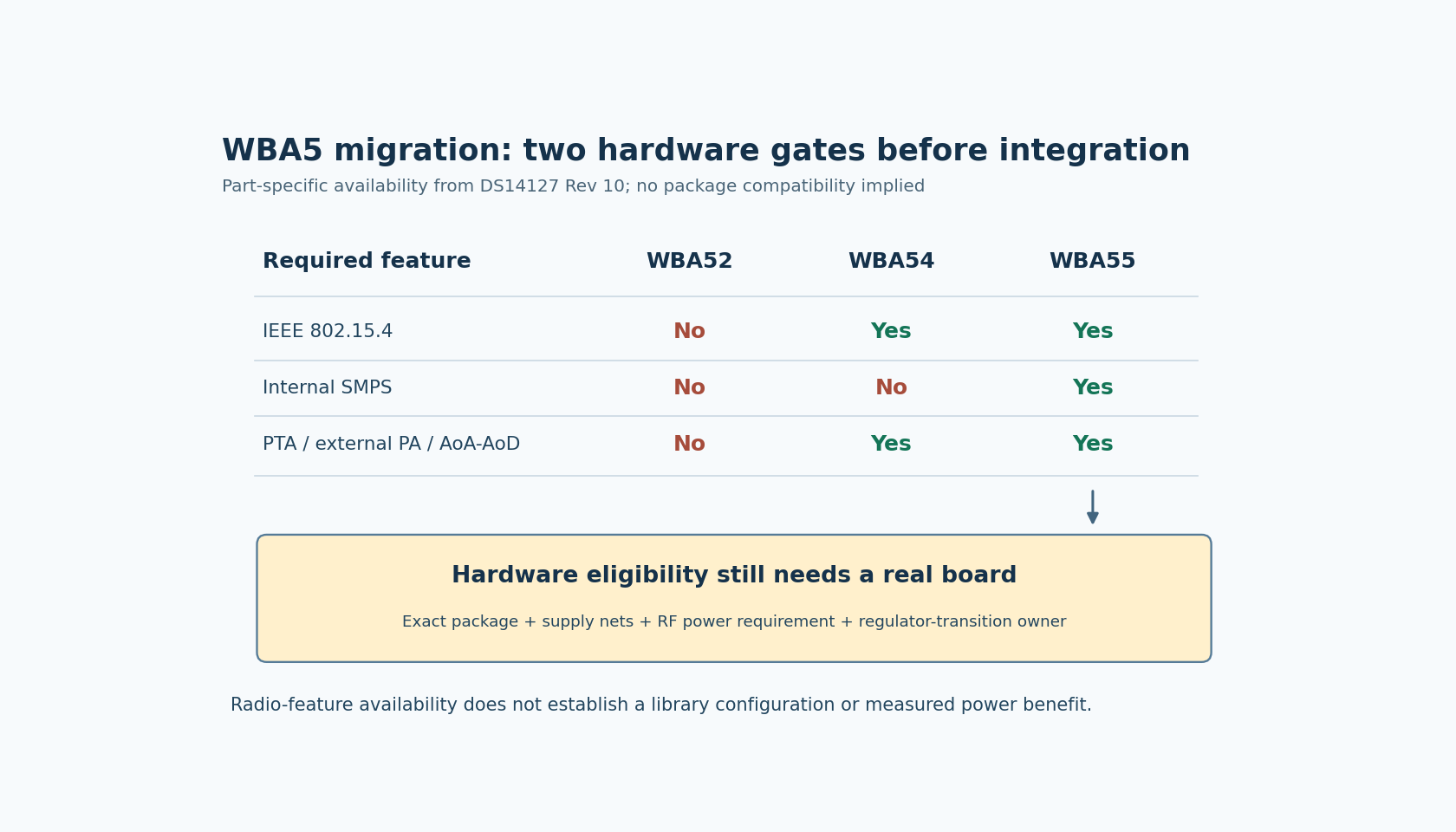
Table 2 of the STM32WBA5 datasheet lists Bluetooth LE for WBA52, but marks IEEE 802.15.4, PTA, external PA support and BLE AoA/AoD support as unavailable. Table 3 lists those additional radio capabilities for WBA54/55. It also makes a separate power distinction: WBA54 has no internal SMPS, whereas WBA55 does.
That separation gives a useful first decision:
- A WBA52 design requiring IEEE 802.15.4 has a device-selection issue before it has a stack-integration issue.
- A WBA54 candidate passes the cited IEEE 802.15.4 availability check, but does not satisfy a requirement for the internal SMPS.
- A WBA55 candidate passes both availability checks. Its board implementation and software configuration still need examination.
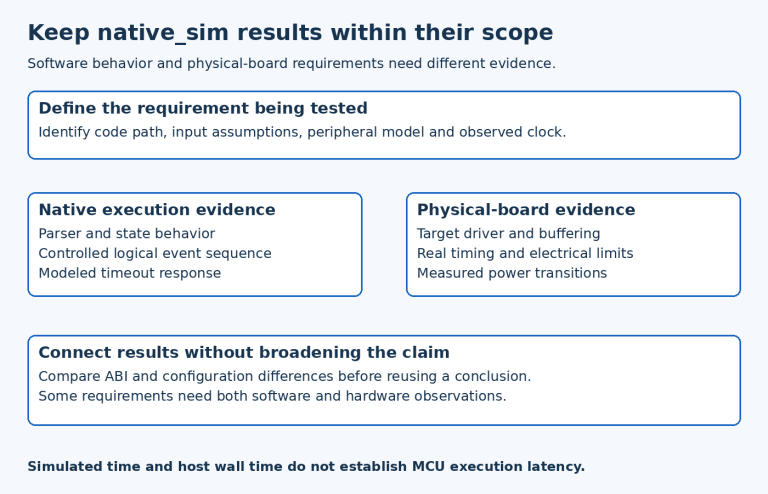
A positive radio-feature entry is only hardware eligibility. It does not establish that a particular library build enables the required protocol combination, that an antenna-switching design supports the intended direction-finding method, or that the proposed operating schedule meets the product's timing requirements. Keep those implementation decisions downstream of the silicon check.
An SMPS changes the supply review
The RM0493 power-control chapter makes the internal SMPS specific to WBA55. Section 11.4.1 identifies its supply and switching pins and notes package-dependent availability. VDDSMPS must use the same supply as VDD. This is not a peripheral that can be added to a WBA52 schematic by enabling a driver.
The radio supplies also matter. Sections 11.4.1 and 11.4.5 distinguish the radio's supply domains and explain that feeding VDDRFPA from VDD11 corresponds to a lower maximum transmit-power arrangement than feeding it from VDD. A proposed low-power configuration therefore needs a transmit-power requirement alongside its current-consumption target. Selecting the internal converter does not by itself establish the desired RF output capability.
Make a supply worksheet for the proposed ordering code. List the actual package pins, their board nets, external components and intended supply sources. Then compare it with the applicable datasheet power-supply figure. A net named “core supply” in the old design is insufficient evidence that the new converter, its switching node and the radio supply connections are implemented correctly.
RM0493 also limits on-the-fly regulator switching to times when the radio is inactive. If an application plans to alternate between LDO and SMPS, its design must identify who coordinates that transition with radio activity. A successful idle demonstration is insufficient evidence for arbitrary switching during connected operation.
Separate three migration decisions
Consider a hypothetical WBA52 sensor whose next revision needs an IEEE 802.15.4 network and a lower-energy operating profile. The first decision is whether a different device is required; the availability table answers that. The second is whether the product specifically needs the internal converter; that distinguishes WBA54 from WBA55 in this comparison. The third is whether the proposed board and firmware actually realize the chosen power architecture.
Do not collapse those decisions into “use the larger part.” Record the required radio features individually. Compare the exact memory-density suffix and package, rather than carrying over a family-level memory maximum. Review the pin table even when the package description looks familiar: a shared package size does not prove that every old net has the right function on the replacement.
For the engineering change, the useful outputs are a part-specific feature matrix, a supply-net comparison, and a list of firmware responsibilities affected by the chosen configuration. Any unanswered hardware row stays open before the software estimate is treated as complete.
The cited documents establish which hardware paths are available and several important supply constraints. They do not establish the battery-life improvement, RF performance, board compatibility or protocol coexistence of a particular product. Those outcomes require the selected implementation and its measurements; none are reported here.