Zephyr OS Native Simulation: Keep Software Evidence Separate from Board Timing Claims
Passing a Zephyr native_sim test can provide valuable evidence about application behavior, but it does not demonstrate that the same firmware meets timing or electrical requirements on a particular microcontroller board. Decide which requirement the simulated environment can observe before treating a passing result as hardware validation.
This article uses Zephyr 4.4.0's native_sim model. It proposes a division of testing responsibilities; no simulation or physical-board measurement was performed for this article.
Identify what actually runs
The tagged native_sim board documentation describes a Zephyr application, kernel, and libraries compiled into a Linux executable. It explicitly does not model one particular hardware device. Its provided peripherals support application development and testing, with implementation-specific limitations.
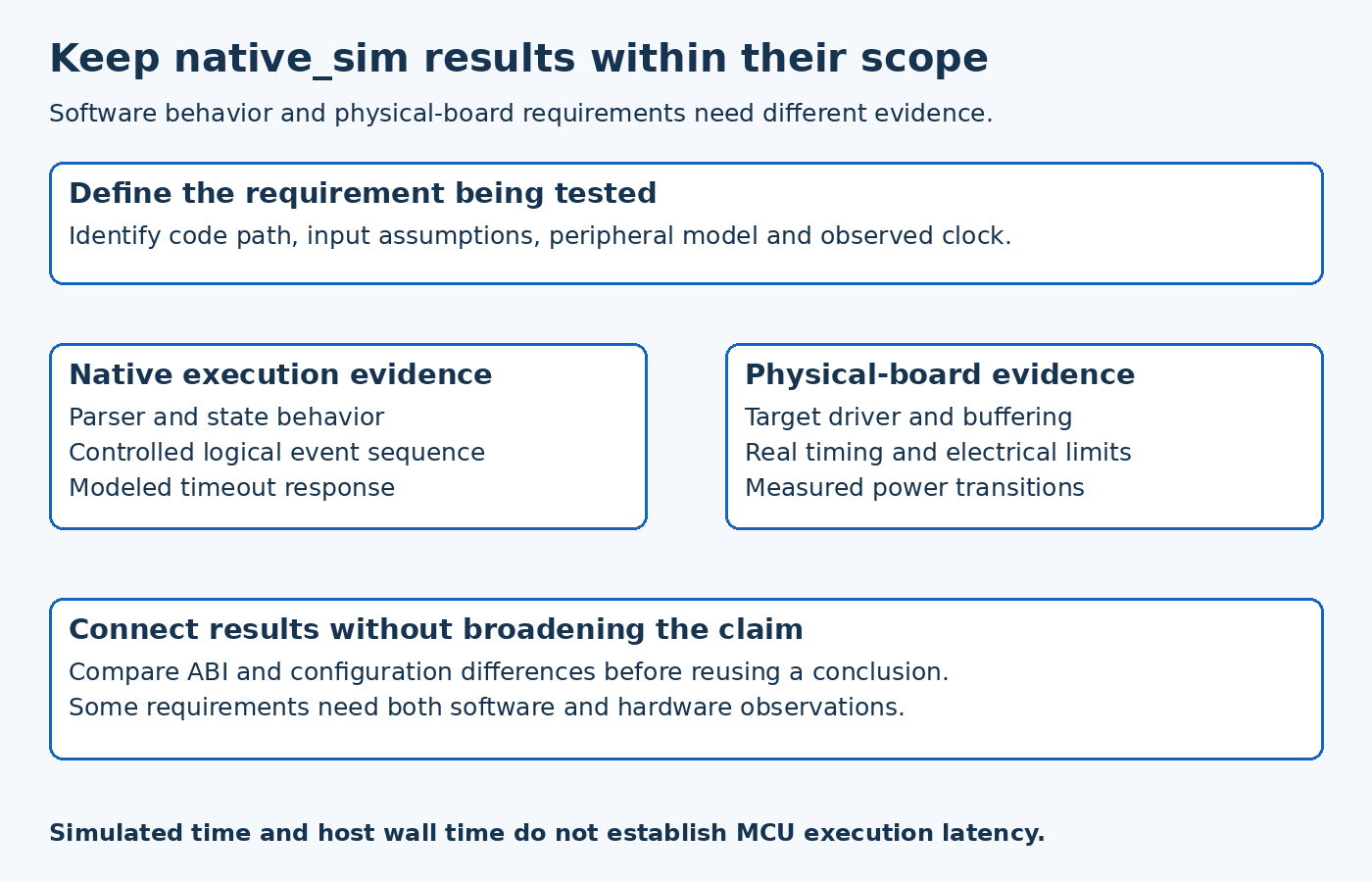
That makes the environment useful for software questions such as whether a parser rejects a malformed record or a state machine handles a defined event sequence. The conclusion should name that behavior and its inputs. It should not silently expand into a claim about a target UART's FIFO, DMA engine, pin routing, or power transitions.
Write down which interfaces are modeled, replaced, or connected to host resources. A test using a simulated peripheral and one connected through a host device can exercise different paths even if the application-facing API looks similar.
Simulated time is its own clock domain
The same documentation explains that simulated time normally advances independently of host wall time. Real-time synchronization options regulate that relationship, but they do not turn the host into the target microcontroller. Debugger pauses and host load can affect how simulation time relates to what an external observer experiences.
The tagged native simulator timer implementation connects kernel clock behavior to the simulator's timer model. This is a different evidence path from measuring interrupt response on a physical board.
A timeout test can establish that application logic responds when its modeled clock crosses a threshold. It does not, on its own, establish the real processor time needed to handle an interrupt, complete a bus transfer, or wake from a low-power state. Name the clock used by every reported duration.
Preserve the software question
Consider a hypothetical telemetry parser with a timeout-based recovery state. In native_sim, controlled inputs can verify that a truncated frame is discarded and that the next valid frame is accepted after the modeled timeout. That is a useful software result with a clear scope.
The corresponding board question is different: does the real receive path deliver the relevant bytes and timing events under the expected interrupt and buffering load? A host test cannot answer that simply by replaying the same logical bytes. Keep both questions in the test plan instead of making one environment carry both claims.
Likewise, an injected sensor value can test range handling, but cannot establish the accuracy or settling behavior of the physical sensor. The injected value is an input assumption, not a measured sample.
Check ABI and configuration differences
The native target offers 32-bit and 64-bit variants. Pointer and long widths can differ between them. Select the intended variant deliberately and avoid describing a host result as architecture-independent merely because the application source is shared.
Also compare effective configuration and build-selected code paths with the target build. An alternative driver, disabled feature, or host-only helper may remove the exact integration boundary the hardware test needs to cover. This is not a reason to reject native testing; it is a reason to state its coverage accurately.
Where practical, keep core behavior behind explicit interfaces so the same behavioral cases can be reused with different implementations. Do not hide target-specific requirements behind a mock that always succeeds.
Turn limitations into a complementary test split
Assign deterministic software cases to native execution when the model supports them. Assign target-driver integration, actual resource limits, physical timing, electrical behavior, and power measurements to suitable hardware tests. Some requirements may need both: one test establishes the logical response, another establishes that real events reach that logic under operating conditions.
For each result, report the environment, implementation path, input conditions, and observed outcome. Avoid combining all passes into a single “hardware verified” label. When a failure reproduces only on the board, compare the boundaries omitted by the model before blaming nondeterminism.
The value of native_sim is faster, more focused software evidence. Its limits become manageable when the claim stays attached to what the environment actually executed and observed.