Zephyr OS Userspace Objects: Diagnose Permission Separately from Memory Access
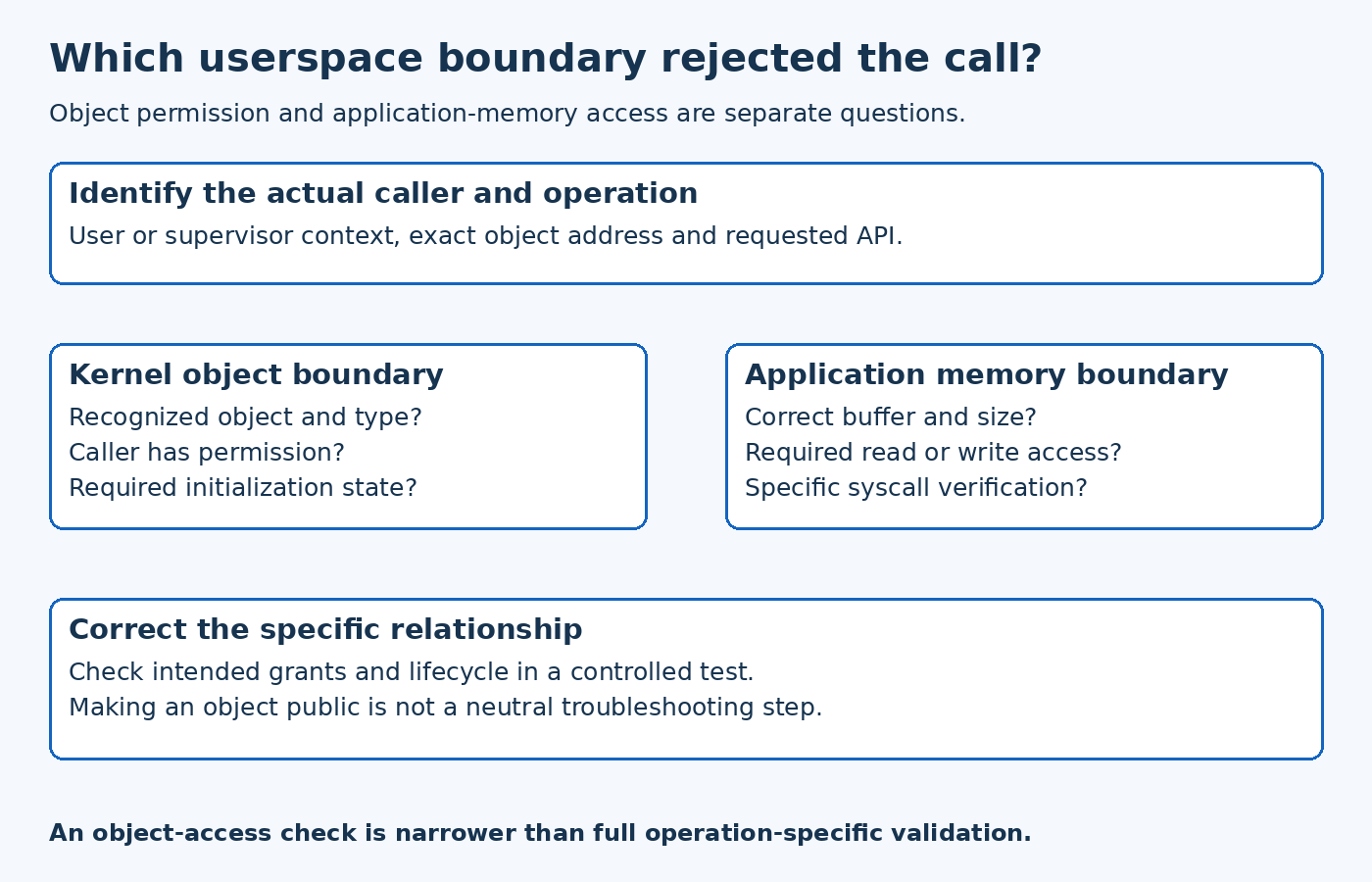
A user thread can hold a pointer to a kernel object without being authorized to operate on it. Conversely, permission to use an object does not automatically make every application buffer passed to a syscall readable or writable. When a Zephyr userspace call fails, identify which boundary rejected it before widening access.
This article examines Zephyr 4.4.0 object permission checks. It is a diagnostic design discussion, not a request to change a running system's security policy. Test changes belong in an appropriate development setup, with the intended isolation requirements preserved.
Start with the actual caller and object
Record which thread makes the call, whether it is executing in user mode, the exact object address, and the operation attempted. A supervisor-side test can succeed while the user-side path fails because the two callers are subject to different checks.
Do not assume two identically initialized structures have the same object identity. Permission is associated with the particular kernel object and thread relationship. A copied structure, stale pointer, or object placed where it is not recognized as a userspace-usable kernel object can fail for reasons unrelated to the intended API's ordinary behavior.
Inspect the object's declaration or allocation method and its lifecycle. “The address is in RAM” is not evidence that the kernel recognizes the address as the required object type.
Separate recognition, permission and initialization
The tagged userspace implementation validates object existence and type, thread permission, and the initialization state required by the operation. Its validation helper distinguishes those failures internally. The application-facing syscall may handle validation failure differently, so do not promise that every API simply returns those internal error codes.
That separation gives a useful investigation order. Confirm the object is recognized as the expected type. Confirm the actual calling thread has the required access. Then confirm initialization state matches the particular operation. Granting access to the wrong address does not repair type recognition or create a valid initialized object.
The object-access-check API can help inspect current-thread access, but it is not proof that every operation-specific condition will pass. In the tagged implementation it uses a generic object type and does not require a particular initialization state. Keep its result within that narrower meaning.
Grant only the intended relationship
The kernel object interface provides a per-thread access grant and a static-thread access declaration. A user-mode grant itself requires appropriate authority over the object and target thread; it is not a mechanism for a thread to give itself arbitrary access.
Review where the intended grant occurs relative to thread startup and the first operation. A startup race can make a correct-looking grant ineffective for an earlier call. For dynamically managed threads, verify that the grant targets the current thread instance rather than assuming an old handle remains the right recipient.
Avoid using the public-object grant as a quick diagnostic fix. That interface grants access to present and future threads and documents that public-object permissions cannot be revoked. A test that succeeds after making everything public reveals little about whether the intended least-access design is correct.
Check application buffers independently
Many syscalls also operate on application-owned memory. A permitted object does not remove the need for valid buffer addresses, sizes, and access direction. Examine the specific syscall verifier and memory-domain arrangement for those parameters.
A hypothetical user thread may be permitted to use a communication object while its receive buffer belongs to memory it cannot write. Expanding object permission would not fix the buffer problem. Conversely, putting a buffer in accessible memory would not authorize use of a different kernel object.
Keep these observations separate in diagnostics. Name the object and operation, then name the memory range and required access direction. This avoids treating all userspace failures as one generic MPU configuration issue.
Test both allowed and denied cases
Use a small development test with the intended user thread and object. Verify the allowed operation, then an intentionally unauthorized relationship under controlled conditions. Because invalid syscalls can trigger fault handling, design the test harness to observe that outcome rather than assuming execution continues normally.
Also test the lifecycle transition the product uses: initialization, thread creation, access assignment, and eventual release or termination. A permission model that only works immediately after boot may fail when components restart.
The conclusion should identify the actual boundary: object recognition, type, permission, initialization, or application-buffer validation. Fixing that specific boundary produces a more maintainable userspace design than disabling isolation until the symptom disappears.