ifm VSE152 Input-Only Monitoring: Resolve the Output Watchdog Requirement
An EtherCAT project may need only vibration values and alarm states
from an ifm VSE152. It is tempting to configure PLC inputs, leave every
PLC output unused, and expect the device to behave like a passive
sensor. The VSE152 manual documents a specific obstacle: its default
SyncManager watchdog can time out when no output module has been
parameterized.
The engineering decision is therefore larger than removing an
unwanted error indication. Decide whether the project can provide an
appropriate output configuration, or whether a documented input-only
arrangement requires a different, explicitly reviewed
communication-monitoring design.
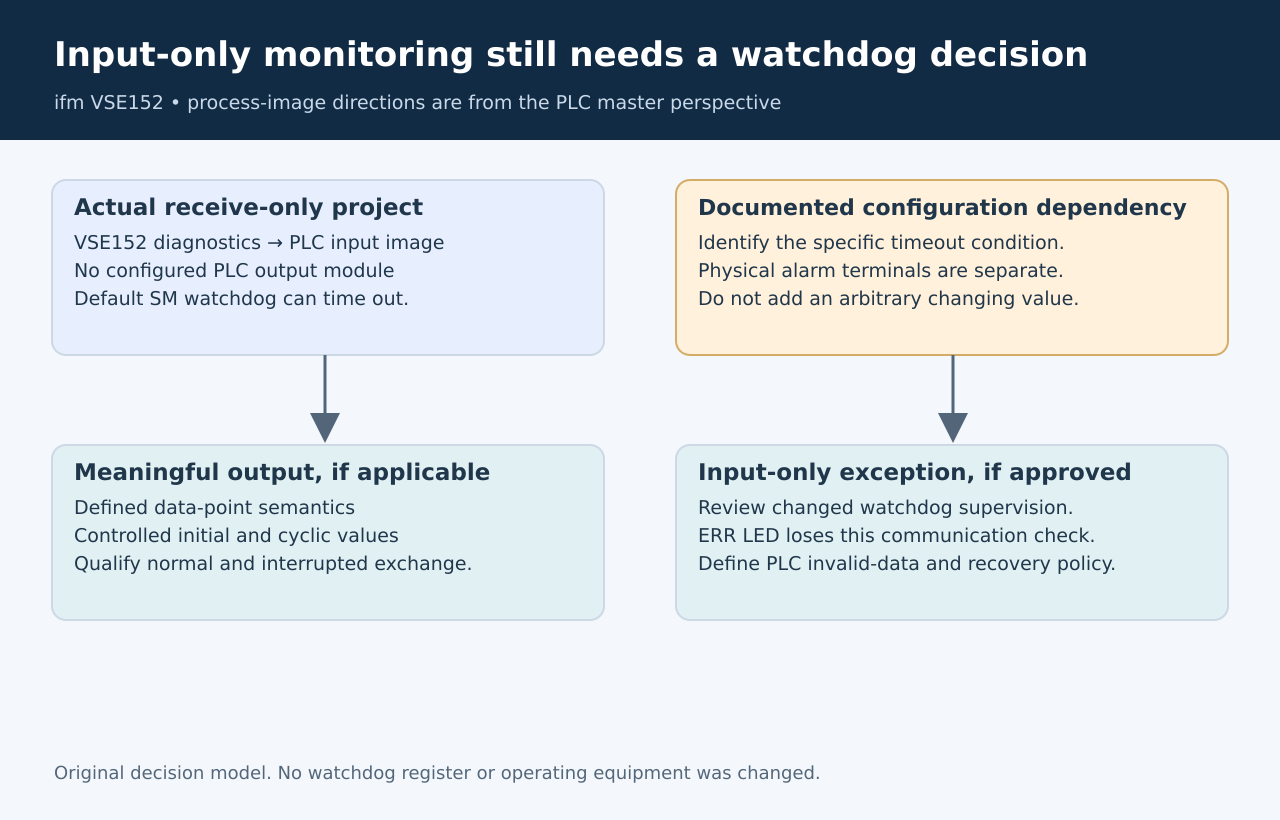
Original configuration decision model. No watchdog, device parameter
or controller setting was changed.
Establish which
direction “output” means
The VES004 software manual defines EtherCAT input and output
directions from the fieldbus master’s perspective. Diagnostic values
received by the PLC belong to its input image; values sent from the PLC
to the VSE152 belong to its output image. The corresponding
configuration views show the selected content and its offsets. VES004
manual, sections 9.3.13.4–9.3.13.6
Those directions are not the same naming scheme as the diagnostic
unit’s physical alarm terminals. Start by inspecting the actual
configured process image. A statement such as “we do not use the alarm
output” does not establish whether the EtherCAT output image is
empty.
This distinction also prevents a misleading repair. Adding an
arbitrary PLC output value can change diagnostic behavior even when no
physical actuator is connected. The chosen data point must have a
defined meaning in the released configuration.
The device-specific
requirement
VSE152 operating instructions 11441755/02, October 2026, state that
the SyncManager watchdog is enabled by default and that an
unparameterized output module causes a timeout. The manufacturer
recommends parameterizing at least one output. It also describes
disabling the watchdog when that is not possible, with an explicit
consequence: the ERR LED no longer reports process-data communication
errors through that mechanism. VSE152
manual, section 13.1.2.3
This is a documented configuration dependency, not evidence that a
receive-only business requirement is invalid. It means that “no commands
needed” and “no cyclic output configuration required” are different
propositions for this device.
Before selecting either supported arrangement, confirm that the
observed error matches the documented condition. A wiring problem,
mismatched configuration or missed cyclic exchange cannot be diagnosed
solely from the application’s intention to read values.
Prefer
a meaningful, controlled output arrangement where applicable
If the design includes a legitimate PLC-to-device value, specify its
owner, initial value, representation and update behavior. Use VES004’s
exported process-image description to reconcile that choice with the
controller project. Do not populate an output slot with a convenient
variable merely to silence the watchdog.
Some available output data points have operational consequences. For
example, the VSE152 data model includes variant selection and a
self-test command. They are not interchangeable filler bytes. The
correct choice depends on the approved monitoring configuration, and an
arbitrary changing value is particularly unsuitable.
Qualify the selected arrangement under normal cyclic exchange and the
application’s defined interruption case. The objective is to establish
that the configuration performs its intended function, including the
response when communication is no longer valid.
An
input-only exception changes the diagnostic contract
If the approved design cannot provide a suitable output, use the
manufacturer’s documented input-only option only after reviewing its
consequences for that installation. This article deliberately does not
supply a register-write shortcut: changing watchdog supervision on
operating equipment requires the responsible control engineer’s approval
and machine-specific assessment.
The acceptance record must explain how the PLC recognizes unavailable
or stale diagnostic data, what the machine does during that condition,
and what evidence permits recovery. A quiet ERR LED after watchdog
deactivation cannot serve as proof of continuing process-data
communication.
Keep the result bounded to VSE152 and the cited manual revision. Do
not copy this arrangement to other EtherCAT devices or infer a
functional-safety rating. The useful outcome is an intentional
receive-only integration whose missing output channel and changed
supervision have both been accounted for.