TinyML Model Storage: Keep Embedded Model Bytes Readable for the Interpreter Lifetime
Tensor allocation succeeds, so the application releases the buffer that held the model file. The next inference reads invalid weights. The mistake is assuming that allocating runtime tensors copies every constant out of the FlatBuffer.
For the examined ordinary TFLM path, model storage remains part of the running system. Plan its address, readability and lifetime independently from the writable tensor arena.
Trace a constant tensor back to the model bytes
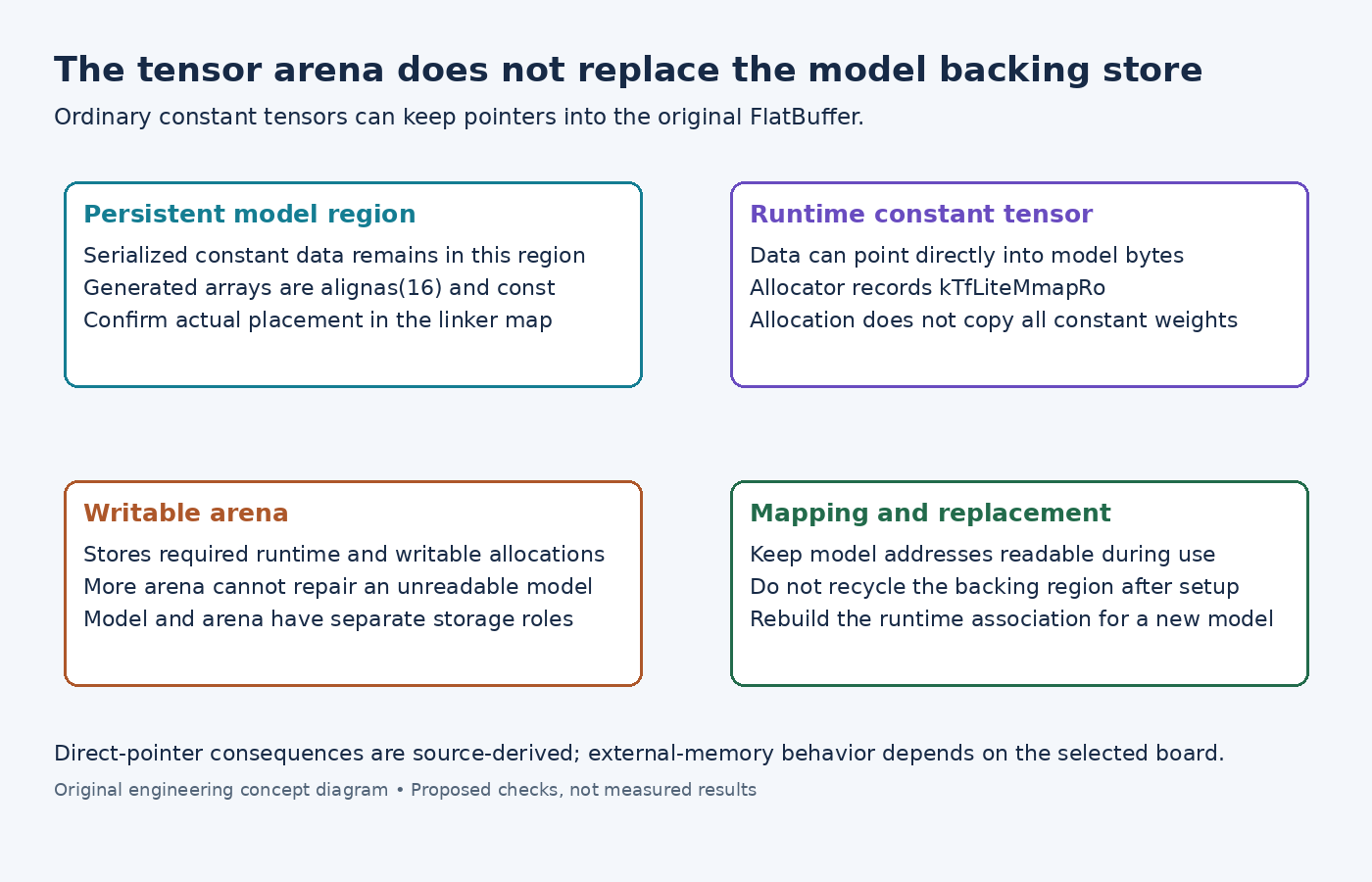
The pinned allocator implementation finds a tensor's serialized buffer and returns a pointer to that buffer's data. When this supplies tensor storage, initialization marks the tensor kTfLiteMmapRo; when no serialized data supplies it, the tensor is marked for writable arena allocation instead.
That distinction explains why a large weight array need not appear as an equally large arena allocation. It also explains why freeing the model buffer after AllocateTensors() is unsafe. The weight pointer can still address the original model representation.
Some dimensions also reference FlatBuffer storage through a vector conversion. Avoid reasoning that retaining only the weight region is sufficient. The interpreter interface requires the model's lifetime, along with the other caller-owned constructor inputs, to cover the interpreter's lifetime.
Read the generated array declaration precisely
The pinned array-generation tool emits a 16-byte-aligned const array for its C++ output and an external const declaration plus size in the header. For .tflite input, that size is the original file's byte length.
Keep the generated declaration consistent when integrating it into a firmware build. Removing const, losing alignment or producing a different declaration in another translation unit changes assumptions at the storage boundary.
However, a const declaration does not by itself prove physical flash placement. Inspect the linker map and startup-copy configuration for the exact firmware. Google's microcontroller conversion guide recommends keeping the converted byte array const for memory efficiency; the board toolchain and linker still decide where the object resides.
External memory must remain usable during inference
A memory-mapped model region can satisfy pointer-based access only while that mapping remains readable at the retained addresses. Disabling its controller after initialization, switching the address window to another bank or overwriting the region for an update can invalidate the running graph even though arena contents are untouched.
These are consequences of the examined direct-pointer mechanism, not claims about a particular flash controller. If a board cannot keep the region accessible, choose a supported persistent storage arrangement before constructing the interpreter. Copying a model into a temporary staging buffer is not enough unless that buffer remains its actual backing store.
For a model replacement, stop use of the old interpreter and rebuild the model/runtime association according to the application lifecycle. Assigning a new value to the application's model pointer does not retarget the constant pointers already created inside the old runtime.
Diagnose storage placement separately from arena capacity
During a controlled integration test, record the embedded array's address range, a representative constant tensor's data address and the arena range. Check whether the constant address lies in the model region as expected. Keep these diagnostics appropriate to the development environment rather than exposing unnecessary addresses in production logs.
Exercise the normal power-management and model-update transitions while preserving the intended memory mapping. An arena-size increase will not fix an unreadable constant-weight address. Conversely, valid permanent model storage does not eliminate writable activation and scratch requirements. No firmware image or hardware execution was performed for this article.