Priority Inversion in RTOS: Trace Mutex Blocking and Priority Inheritance
Priority inversion is a scheduling explanation that must be demonstrated with ownership and timing evidence. A high-priority task missing its deadline, or a watchdog resetting the device, is not sufficient proof. Begin with a correlated task-and-mutex trace, identify the dependency that blocked progress, and then test the smallest relevant change. The examples here are conceptual; the implementation notes are explicitly scoped to Zephyr 3.7.0 and FreeRTOS Kernel V11.1.0.
Distinguish Inversion from Deadlock and Long Execution
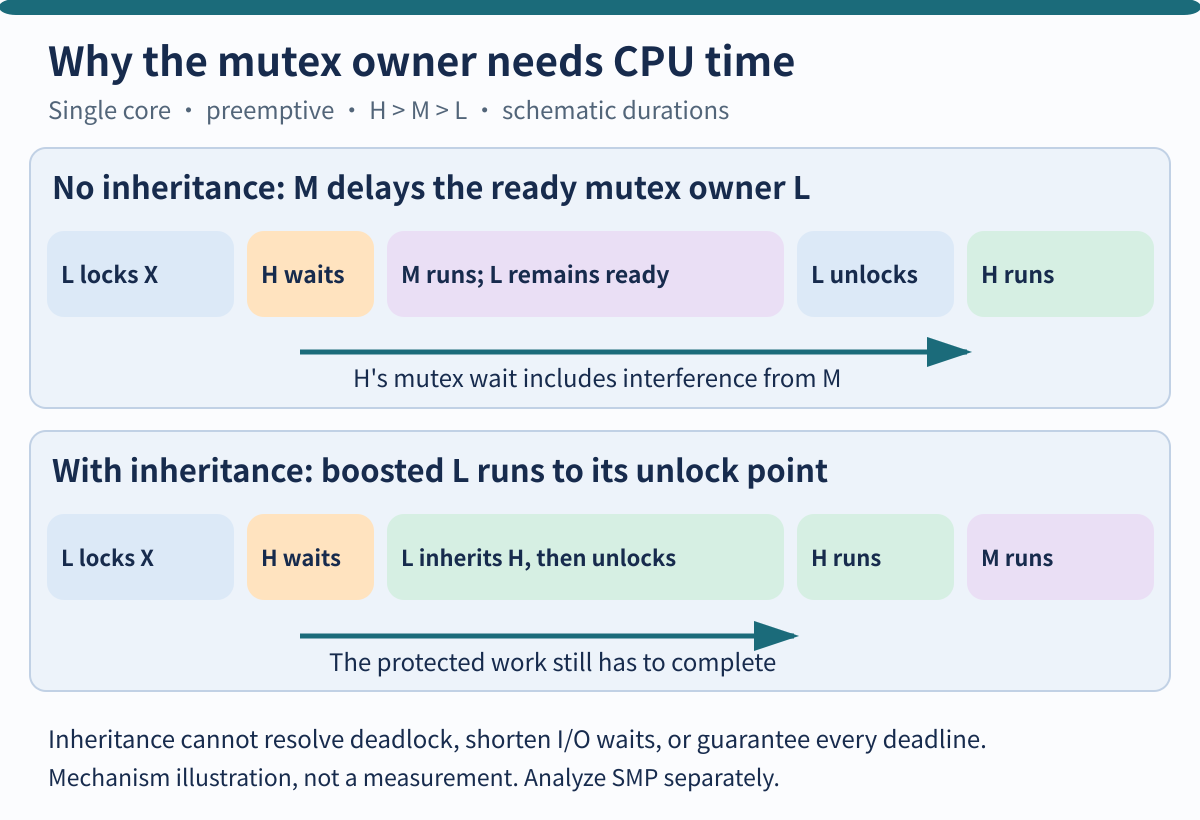
In the basic dependency, low-priority task L holds mutex X and high-priority task H waits for X. H’s progress now depends on L. On a single-core preemptive scheduler, a runnable middle-priority task M can preempt L and extend H’s wait, even though M does not use X. This is the classic prolonged-inversion scenario. Ordinary lock contention and the owner’s necessary execution time still need their own budgets.
Compare that sequence with a deadlock, where dependencies form a cycle and none of the participants can release the required resource. Also consider a long device transaction, CPU overload, interrupt masking, or a missing completion signal. A long wait alone cannot distinguish them. Write the proposed chain explicitly: H waits for X, X belongs to L, L is ready but loses execution to M. If any link is unobserved, retain inversion as a hypothesis.
Capture a Correlated Task and Lock Timeline
Capture task ready, running, and blocked transitions alongside mutex take attempts, successful acquisitions, releases, ownership changes, and timeout returns. Record base and effective priorities separately; inheritance can change the latter while leaving the configured priority unchanged. Include the relevant interrupt activity and the operation that woke H. A mutex address should map to a stable name in the exact firmware build.
Use one monotonic time base, or explain alignment between trace channels. Measure trace overhead and buffer overrun, because synchronous printing inside the contested path can create a new shared lock and change the result. A compact RAM event buffer or supported hardware trace can reduce disturbance, but neither is free. Preserve the build identifier, RTOS configuration, CPU clock, optimization settings, and capture settings with the trace. Without that context, a compelling picture may still be irreproducible.
Check When Priority Inheritance Applies
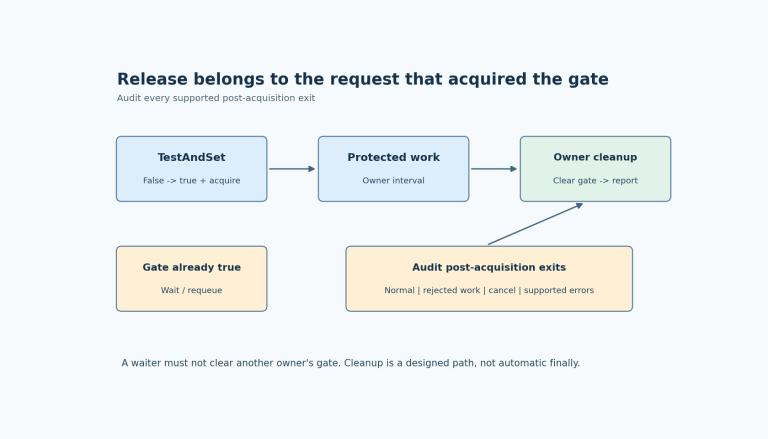
Priority inheritance temporarily raises an eligible mutex owner’s effective priority when a higher-priority task blocks on that mutex. It helps the owner reach its unlock point. It cannot shorten the required protected work, accelerate an unresponsive peripheral, or resolve a lock cycle. Interrupts, non-preemptible execution, and other higher-priority work can still delay the owner.
For Zephyr 3.7.0 mutexes, check the configured inheritance ceiling and thread context restrictions. For FreeRTOS V11.1.0, distinguish a mutex from a binary semaphore: the latter does not provide the same ownership-based inheritance behavior. Verify that the object actually created by the application is the intended type. Renaming a semaphore variable “mutex” changes no kernel semantics.
Audit Nested Locks and Peripheral Waits
Build a lock-order graph from actual call paths, including error handling. A task holding X while waiting for Y may inherit priority yet remain unable to run until Y becomes available. Holding a device mutex while waiting indefinitely for an interrupt or queue item makes the entire dependency dependent on that completion path. Assign bounded waits and recovery ownership, rather than assuming inheritance closes the chain.
Nested-mutex behavior is implementation-specific. Zephyr 3.7.0 documents restoration-order limitations and recommends avoiding multiple simultaneously held mutexes shared across priorities. In the normal give path of FreeRTOS V11.1.0 tasks.c, disinheritance waits until the held-mutex count reaches zero; timeout-related handling has additional conditions. Inspect and test the relevant path in your exact release. Neither statement should be generalized into a promise of fully transitive inheritance for every nested dependency.
Compare Smaller Critical Sections with an Owner Task
First move preparation, formatting, and unrelated logging outside the protected interval where consistency permits. Copy a validated snapshot under the mutex, release it, then process that snapshot. Review lifetime and concurrent-update rules before making this change; a shorter lock that exposes inconsistent state is not an acceptable fix. Do not replace a long mutex-protected operation with a long interrupt-disabled region.
A dedicated owner task can serialize access to a peripheral and make admission control clearer. It also introduces queue delay, cancellation, response ownership, and backpressure. An urgent request behind a long low-urgency operation can still miss its deadline. Define the service task’s priority, queue discipline, maximum operation duration, and handling of abandoned requests. Message passing does not automatically transfer the requester’s priority or eliminate real-time dependencies.
Design a Controlled Scheduling Experiment
On a safe test target, reproduce the same sequence: L acquires X, H requests it, and M becomes runnable under a controlled workload. Compare the original design and one modification at a time. Measure H’s wait, L’s protected execution, effective-priority changes, and total response time. Deliberately test timeout and error exits as well as successful completion.
| Observed trace | Interpretation to test | Evidence required before accepting the fix |
|---|---|---|
| H waits; L owns X; M preempts ready L | Middle-priority interference extends inversion | Owner scheduling changes and H meets its declared deadline |
| L owns X but waits for a peripheral | I/O dependency dominates | Peripheral wait is bounded and recovery releases ownership |
| X-to-Y and Y-to-X wait cycle | Deadlock candidate | Cycle is removed across normal and error paths |
| H is ready while interrupts dominate | CPU availability problem | Interrupt and scheduling budgets are measured |
Keep single-core and SMP experiments separate. For SMP, include core affinity, migration, cross-core synchronization, and the kernel’s locking implementation; the simple three-task drawing is not a complete multicore model.
Validate Against Deadlines and Lock Budgets
Before evaluating the change, declare the task’s end-to-end deadline, allowed blocking budget, workload envelope, and response to a lock timeout. Account for release jitter, other execution, and interrupt interference in addition to mutex waiting. A shorter average lock wait is useful evidence but cannot establish that the deadline is always met.
Report sample count, duration, worst observed blocking, missed deadlines, and uncovered paths. Keep any counterexample and distinguish an observed maximum from a proven bound. If the failure leads to a reset, use reset evidence preservation and watchdog health acceptance rather than merely extending the watchdog period. For a focused investigation, provide Obeita the task priorities, lock map, target build, and correlated trace so the blocking mechanism and repair scope can be reviewed.