Analog Production Limits Near a Threshold: Include Measurement Uncertainty in the Decision
Near an analog acceptance threshold, keep the measured value, applicable uncertainty and approved decision rule together. A rounded display value inside the product limits is not enough to classify the unit. If the required inputs are missing or the rule leaves an overlap region, report an invalid or indeterminate decision instead of forcing a pass.
This article develops an illustrative fixed-limit worksheet using NIST measurement-uncertainty guidance. Ten synthetic classifications were executed with Python 3.12.14 Decimal arithmetic. No analog quantity or uncertainty was measured, no calibration was performed and the example rule is not presented as a universal metrology requirement.
Define the measured quantity before the limit
Write the physical quantity, units, operating condition, acquisition timing and statistic. A supply’s instantaneous minimum, a settled average and a filtered instrument display are different results. The applicable limit must refer to the quantity the test actually observes.
Record the test point and reference node. A voltage at a fixture connector can differ from the voltage at the product pin. Include relevant load, temperature and configuration so a reviewer can determine whether the observation belongs to the specified condition.
Keep the requirement revision separate from the measurement. This procedure assumes one fixed approved criterion; changing customer limits after testing is a separate reassessment problem. Do not silently alter the limit or decision rule after seeing a marginal unit.
Attach uncertainty to the actual result
NIST’s uncertainty approach distinguishes a measurement result’s uncertainty from the general precision of a method. The applicable configuration, repeatability, changes over time and systematic contributions matter. An instrument’s display resolution alone is not an uncertainty budget.
Identify whether the supplied quantity is a standard uncertainty, an expanded uncertainty with stated coverage information, or a separately justified absolute bound. These are not interchangeable. Record the coverage factor or probability interpretation when applicable and the conditions under which the estimate remains valid.
Do not interpret an expanded-uncertainty interval as a guarantee that the true value cannot lie outside it. The acceptance rule must specify how the reported uncertainty is used and what risk interpretation the responsible parties approve.
NIST’s gauge-study discussion also warns that process changes can make an earlier estimate inapplicable. A changed range, fixture path, correction coefficient or environment requires an applicability check before reusing the old number.
Choose the rule before classifying units
For illustration only, assume an approved two-sided product interval from 3.20 V through 3.40 V, with both endpoints included. Let y be the reported value and U a valid nonnegative half-width supplied for this example’s decision interval.
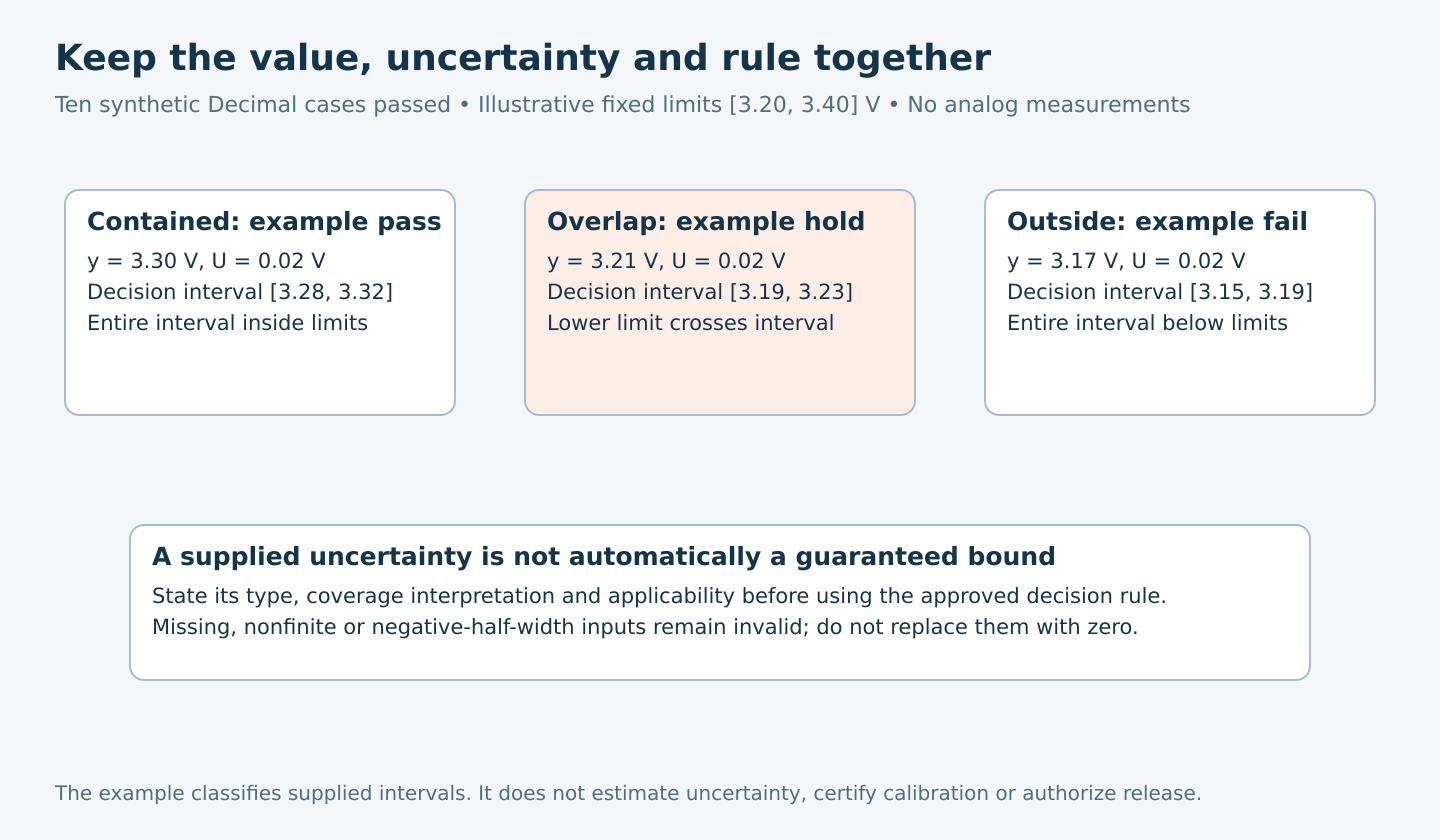
The hypothetical rule is: pass when the entire interval [y − U, y + U] is inside the product interval; fail when it is wholly outside; otherwise hold for further assessment. This is a chosen three-way rule, not a claim that every customer, standard or safety process requires this treatment.
Define endpoint behavior explicitly. Under this rule, a decision interval that touches the lower limit from below overlaps the allowed region and is held. An interval whose lower endpoint equals the lower limit and whose upper endpoint remains inside can pass.
Read the executed decision worksheet
| Synthetic y / U in volts | Decision interval | Outcome under the example rule |
|---|---|---|
| 3.30 / 0.02 | [3.28, 3.32] | Pass: contained. |
| 3.21 / 0.02 | [3.19, 3.23] | Hold: overlaps the lower limit. |
| 3.17 / 0.02 | [3.15, 3.19] | Fail: wholly below the interval. |
| 3.22 / 0.02 | [3.20, 3.24] | Pass: inclusive lower boundary. |
| 3.18 / 0.02 | [3.16, 3.20] | Hold: touches the allowed boundary. |
| 3.42 / 0.01 | [3.41, 3.43] | Fail: wholly above the interval. |
| 3.195 / 0.005 | [3.190, 3.200] | Hold using the retained unrounded input. |
Three additional controls rejected a missing value, NaN and a negative U as invalid inputs. All ten expected classifications passed. The model’s Decimal inputs avoid binary floating-point ambiguity for these decimal examples; that does not create physical accuracy or qualify a general input grammar.
The worksheet does not estimate U. It assumes that the result and half-width were already valid for the test configuration. It also does not authorize shipment: it produces a technical classification under one explicitly supplied rule.
Do not round the evidence into a different decision
Retain the precision needed by the approved rule and apply any required rounding at the specified stage. Display formatting should not silently become the classifier’s input. Near a boundary, rounding y or U separately can change containment or overlap.
If only a rounded value survives, determine whether the lost precision can affect the decision. If it can, preserve that uncertainty in the disposition or obtain a new valid observation. Do not invent extra digits by converting the display text into a wider numeric type.
Keep unit conversion explicit. A millivolt result paired with a volt uncertainty can produce a plausible but meaningless comparison. Validate range, units, acquisition status and finite values before applying the decision rule.
Escalate the overlap rather than averaging it away
An overlap outcome can lead to an approved higher-capability measurement, a controlled repeat campaign or another authorized disposition. Choose the next step from the dominant uncertainty contribution and product process, not from a desire to obtain a passing number.
More repeated readings can reduce some random contributions under the right assumptions, but do not automatically remove systematic error, fixture bias or environmental mismatch. Preserve the initial result and every subsequent intervention.
If the measurement system cannot resolve an important part of the tolerance range, review its suitability before releasing a large population. A wider software limit is a requirement change, not an improvement in measurement capability.
Deliver a reproducible classification record
Store unit and attempt identity, raw/result values, units, method, configuration, applicable uncertainty statement, decision-rule revision and technical outcome. Include invalid and held cases in the report rather than dropping them from the denominator.
The useful result is an explainable decision at the boundary, with the measurement’s limitations intact. A pass under a named uncertainty rule is more informative than a green display, while still remaining conditional on the quality and applicability of the evidence supplied.