Closing a Firmware Investigation: Distinguish Root Cause, Containment and an Unproven Fix
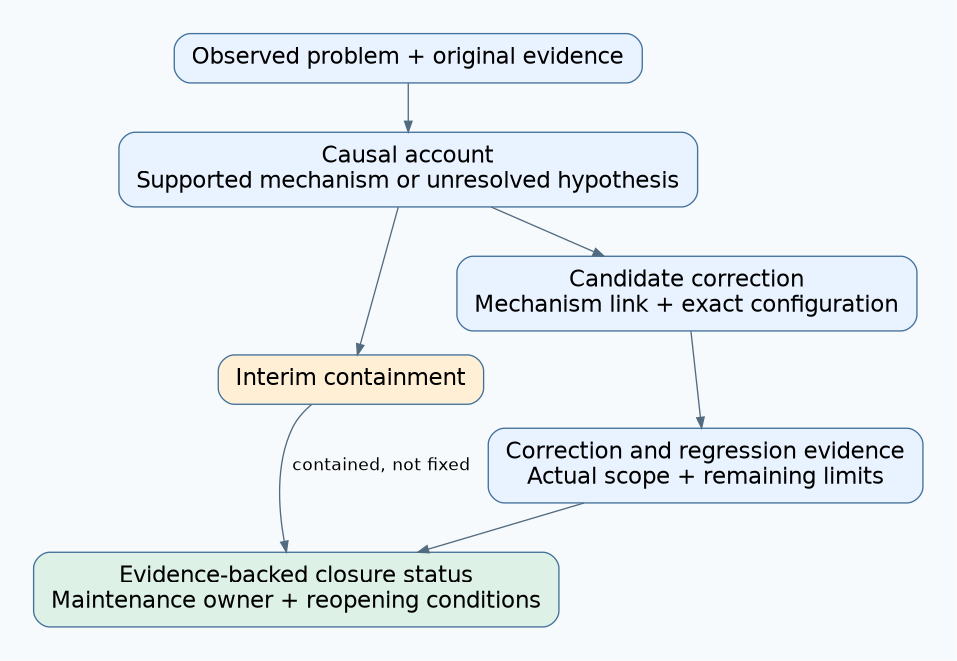
Close a firmware investigation with an evidence-backed status, not simply because the symptom stopped appearing. State what is known about the cause, whether an interim measure exists, which correction was evaluated, what regression evidence supports it and what uncertainty remains for the receiving maintenance team.
This article proposes a closure record and decision method. It does not diagnose a real defect, approve release or promise future support. All cases are hypothetical; no reproducer, patch or regression test was executed.
1. Keep the problem statement separate from the explanation
Begin with the observed symptom, affected configuration, trigger information, impact and original evidence. Then list the current explanation as a hypothesis or supported causal account, according to the actual evidence.
A reset that clears a symptom is evidence about recovery behavior. It is not by itself evidence that memory exhaustion, a race or a particular peripheral caused the symptom. Preserve alternative explanations that remain plausible.
NASA’s verification guidance, section 5.3.1.2.3, calls for discrepancy follow-up and closure records. The classification below is an original way to prevent different investigation outcomes from collapsing into one “resolved” label.
2. Classify the current outcome precisely
| Status | Meaning | What remains unproven |
|---|---|---|
| Unreproduced or unresolved | Available evidence does not establish the mechanism | Cause and correction effectiveness |
| Contained | A qualified interim measure limits the assessed problem | Permanent correction and possibly root cause |
| Cause supported, correction pending | Evidence supports the causal account | Implemented correction and regression behavior |
| Candidate correction | A proposed change addresses the explanation | Required verification of that change |
| Correction verified within scope | Named evidence supports the correction and selected regressions | Unassessed configurations and conditions |
An administratively closed issue can still have an unresolved technical status. If work stops because of an authorized scope decision, record that reason rather than describing the defect as fixed.
3. Evaluate causal evidence at the claimed strength
Look for a chain connecting trigger, internal mechanism and observed consequence. Relevant evidence may include a reliable reproducer, trace, source analysis, controlled experiment or a combination. The appropriate proof depends on the failure mode and available observations.
A causal explanation should account for the observed facts and identify important limits. If it explains only one of several similar symptoms, avoid merging them into one closed issue without evidence.
Where safe and authorized, controlled comparisons can help distinguish explanations. Do not remove protective measures or recreate hazardous behavior on deployed equipment merely to strengthen a closure narrative. Use an appropriate test environment and retain any limits of substitute evidence.
4. Connect the correction to the mechanism
The closure record should explain why the proposed change addresses the supported cause. “Updated the library” or “increased the timeout” identifies a modification but does not establish that connection.
Record the exact corrected configuration and the comparison baseline. A newer build may differ in many ways; if the relevant causal link remains uncertain, label the improvement accordingly rather than attributing it to one convenient commit.
A contained symptom can coexist with an unfixed mechanism. Conversely, a corrected mechanism may require removal of an interim workaround, which needs its own reviewed applicability and transition decision.
5. Separate correction evidence from regression evidence
| Evidence question | Required record |
|---|---|
| Does the original issue still occur? | Relevant trigger/exposure and actual post-change observation |
| Does the test distinguish the correction? | Baseline/control result or justified alternative causal evidence |
| Did affected existing behavior remain valid? | Selected regression scope, identities and actual results |
| What was not assessed? | Explicit configuration, workload and observation limits |
A single quiet run of an intermittent problem may be inconclusive. Define exposure and interpretation before examining the result, and do not invent a universal clean-run count that establishes a fix.
Likewise, passing the original reproducer does not cover every side effect of the patch. Select regression cases from the changed mechanism and its dependencies, rather than relying only on a convenient existing test suite.
6. Use a fictional boundary-condition investigation
Imagine an investigation into an incorrect diagnostic summary when a bounded collection reaches its final entry. A proposed causal account identifies a boundary-selection error, and a candidate patch changes that selection. This is a fictional example, not a finding in any product.
The proposed closure evidence includes cases below, at and beyond the permitted boundary, with defined rejection behavior for invalid input. It also checks the summary’s ordinary empty and nonempty states. No results are supplied here.
If only the formerly failing example is checked, the record can describe that limited observation but should not claim complete correction verification. If the boundary mechanism remains uncertain, retain a candidate-correction status.
7. Transfer remaining responsibility explicitly
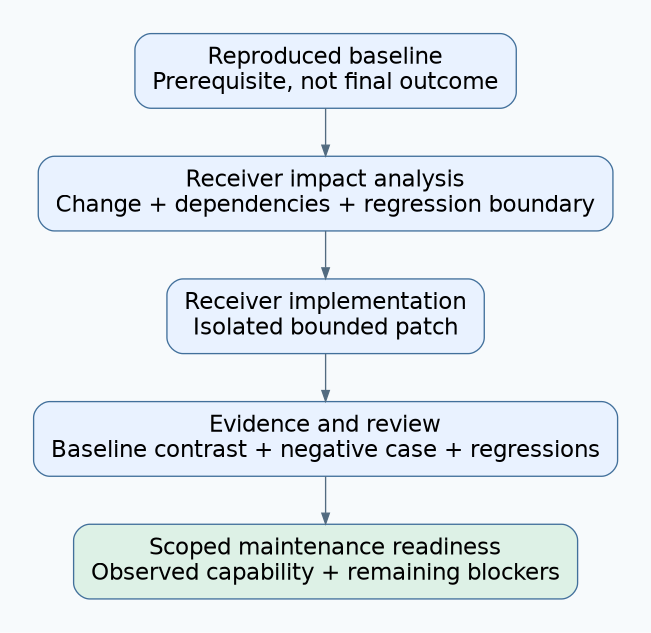
Give maintenance the original symptom record, causal account and confidence limits, corrected release identity, relevant evidence, remaining risks and conditions that reopen the investigation. Identify who owns unresolved questions and the approved escalation route.
NASA’s risk and configuration-management guidance retains residual risk and discrepancy disposition. Use that principle to keep unresolved limitations visible after the issue moves out of active development.
Do not confuse a technical closure recommendation with release authorization or a customer commitment. The final record should make clear whether the investigation is unresolved, contained, awaiting verification or corrected within a named scope. That allows maintenance to act on evidence rather than inheriting an optimistic ticket label.