Customer Acceptance Without the Target Fixture: Separate Demonstration from Final Verification
When the receiving team lacks the required fixture, split the handover into evidenced claims and explicitly deferred claims. Use a demonstration for the behavior it actually shows, a suitable remote target test for claims it can genuinely measure, and a later local test where the receiving site’s physical setup matters.
This is an engineering evidence plan, not a legal acceptance arrangement or a promise to provide equipment. The product owner and authorized parties must decide whether any staged delivery is permitted. No remote session, demonstration or target test was performed for this article.
1. Name the missing capability precisely
“The fixture is unavailable” can mean no target board, no controlled stimulus, no calibrated observation channel, no load equipment or no qualified operator. These gaps affect different claims.
For each requirement, identify the stimulus and observation that the missing resource supplies. A missing signal generator might block a response-time test while leaving configuration-file inspection possible. A missing physical load can leave a command exchange observable while preventing validation of the actual output behavior.
NASA’s verification-preparation guidance, section 5.3.1.2.1, includes the product, enabling resources and environment. The decision table below applies that resource dependency to a staged handover.
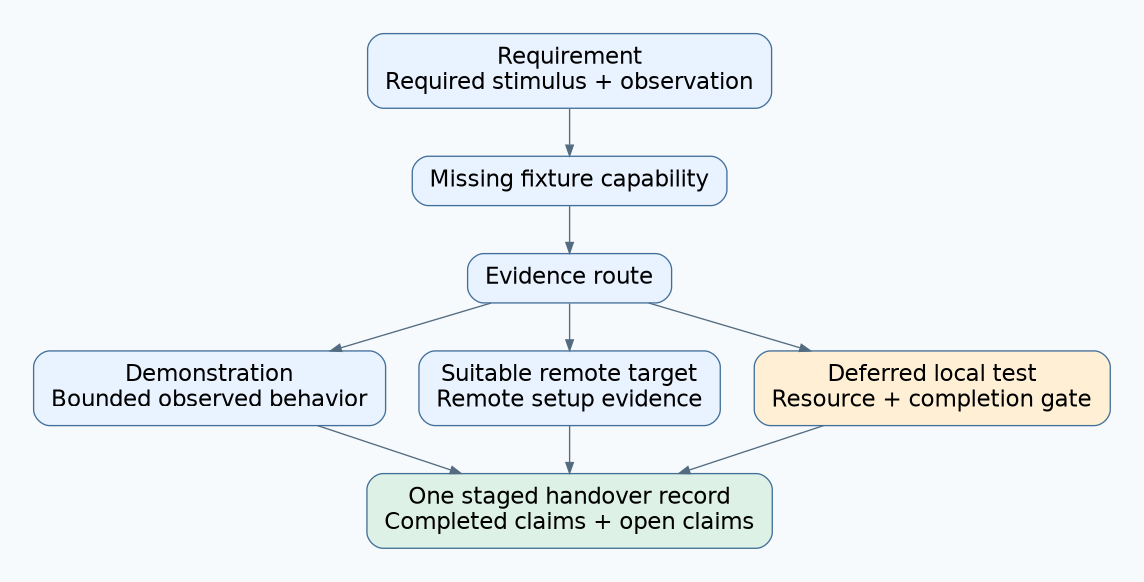
2. Route each requirement to an evidence stage
| Available evidence | Potentially supported claim | Boundary to preserve |
|---|---|---|
| Screen demonstration | Observed navigation or displayed response | Unobserved physical stimulus and timing remain open |
| Recorded earlier target run | The identified historical run’s result | Not a newly witnessed receiving-site execution |
| Live remote target test | Measured behavior of the identified remote setup | Does not prove the receiver’s local wiring or environment |
| Local target test after fixture readiness | Behavior under the specified receiving-site conditions | Credit only the actual procedure and tested configuration |
Demonstration can be an appropriate verification method when the approved requirement and plan call for it. Do not imply that every demonstration is inherently inadequate. The problem is substituting a weaker observation for a different required measurement without an approved rationale.
3. Check whether remote access actually closes the gap
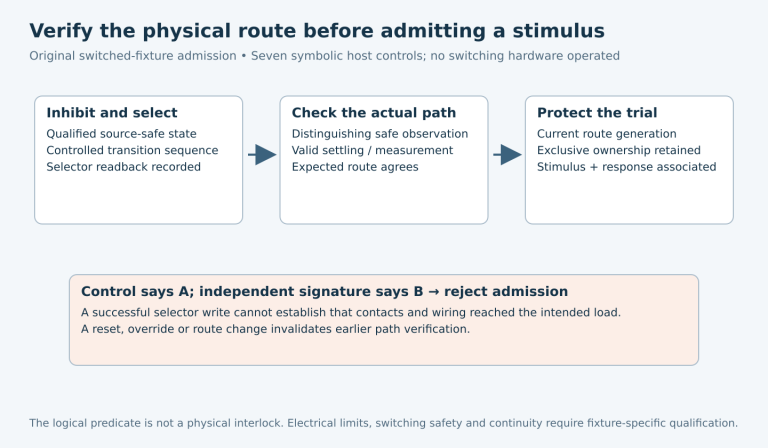
A remotely reachable board is useful only if its relevant configuration, stimulus, measurement path and operating conditions are suitable for the claim. Identify the physical unit and fixture, and retain evidence that the intended channels are connected.
labgrid 25.0.1 provides remote-resource access and groups resources into places. Such infrastructure can help operate an existing bench; it does not manufacture a missing load, establish instrument calibration or certify wiring correctness.
Plan authorized access, resource ownership and the person responsible for physical intervention. Do not expose credentials in the handover packet or assume a remote operator may change the test setup without coordination. A lost observation channel should produce an incomplete result, not a presumed pass.
4. Create an explicit deferred-evidence record
For each deferred requirement, record the missing capability, permitted interim statement, planned evidence, entry conditions, completion criterion and responsible decision owner. If dates or resource commitments are not agreed, label them unresolved rather than inserting optimistic promises.
The entry conditions should include fixture identity, readiness checks, target configuration and approved procedure. The completion criterion should say what actual result and retained evidence will close the row. “Fixture delivered” alone does not demonstrate the product requirement.
Also state what remains restricted while the row is open. Those restrictions must come from the project’s authorized technical and risk decisions. An engineering checklist cannot grant permission to use a partially verified product in a safety-critical role.
5. Use a fictional acquisition-terminal handover
Imagine a receiving team has a terminal and its documentation but lacks the approved stimulus fixture for the external acquisition input. A screen demonstration can show menu navigation and the display of artificial samples. It cannot establish the actual input-to-display measurement path.
A supplier’s remote bench may support the acquisition requirement if the board, firmware, stimulus and observer meet the agreed plan. The receiving site’s cable installation still needs its own applicable check. The two evidence rows have different subjects.
The handover record therefore contains a completed navigation observation, a proposed remote acquisition test and an open local installation check. It does not combine these into a single “customer acceptance passed” statement. All events in this example are hypothetical.
6. Review staged statements for accidental overreach
| Tempting statement | More defensible record |
|---|---|
| Hardware verified by demo | Name the observed function and unexercised hardware path |
| Remote test proves site readiness | Name remote setup evidence and remaining local checks |
| Pending fixture, otherwise complete | List the exact open requirements and permitted interim scope |
| Will pass when equipment arrives | Specify the planned test and leave its result unknown |
Check the release summary, test matrix and handover minutes for consistent wording. A detailed appendix cannot reliably correct an unqualified headline that declares every requirement complete.
7. Close the stage with new evidence
When the fixture becomes available, run the approved readiness and product checks rather than merely changing a status field. Confirm that the delivered product still matches the configuration covered by the plan; intervening changes may require a revised scope.
Preserve the earlier staged record and append the actual result. A failed or incomplete test remains visible, with the next decision assigned. This gives the receiver a clear path from partial evidence to a supported conclusion without converting equipment availability, remote access or a convincing demonstration into proof they do not provide.