FreeRTOS portMAX_DELAY: Verify Whether a Wait Is Truly Indefinite in This Build
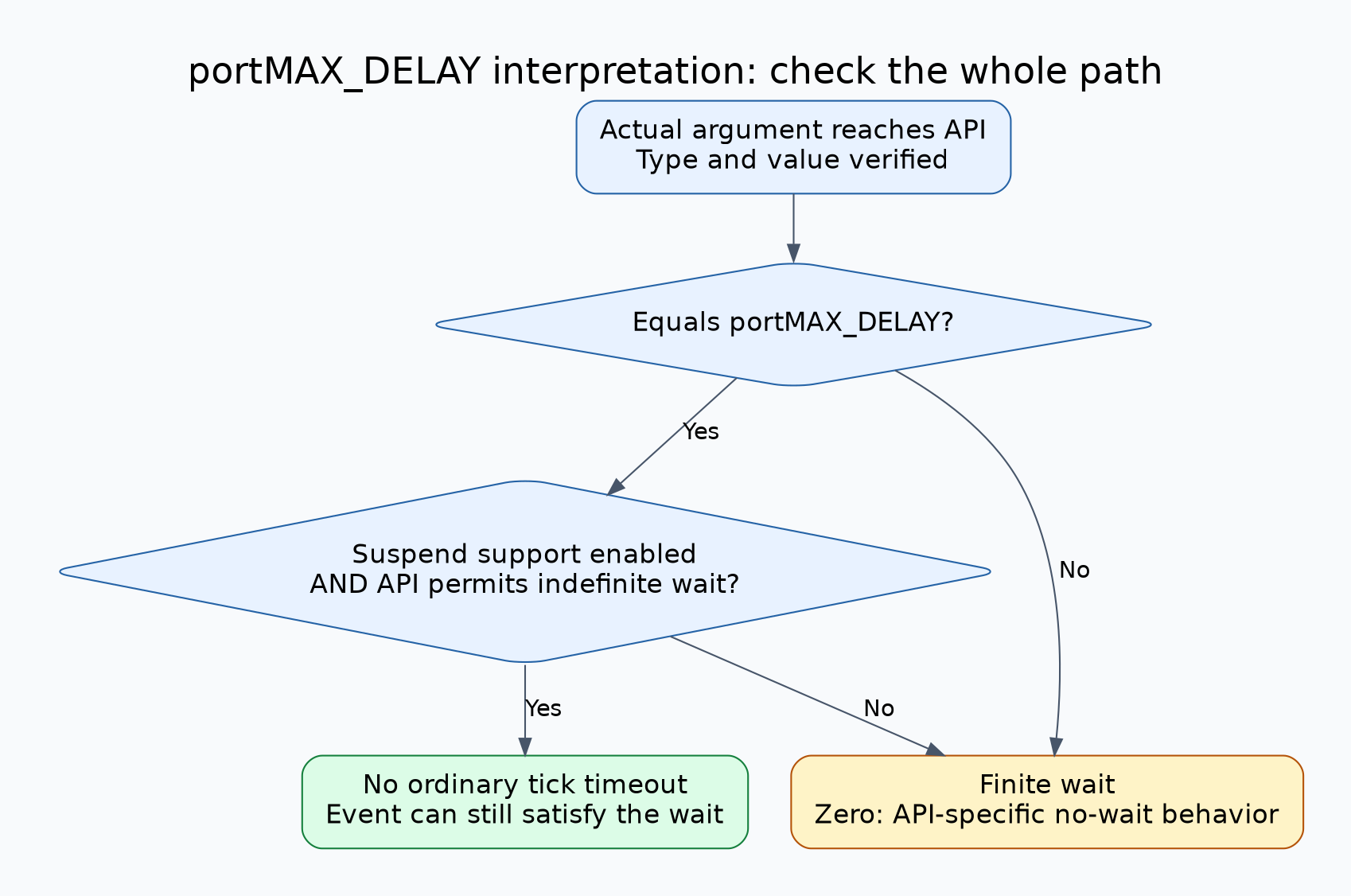
portMAX_DELAY is not a universal “forever” argument. In FreeRTOS Kernel V11.1.0, an ordinary queue wait can treat it as indefinite when INCLUDE_vTaskSuspend is enabled. A delay call does not necessarily use that interpretation. Check the API path, effective configuration and selected port’s tick type together.
This article focuses on that sentinel decision in upstream V11.1.0. It is not a general tick-wrap arithmetic guide or a recipe for preserving a retry loop’s deadline. Vendor wrappers and ports may add conversions or restrictions that need separate verification.
Start with the call, not the constant’s name
Find the actual kernel call reached by the wrapper. A configuration value named “infinite timeout” may pass through milliseconds-to-ticks conversion, a signed intermediate or a narrower storage field before it reaches the API. Record the final argument value and type in a controlled build.
In the V11.1.0 task implementation, the delayed-list helper considers both the maximum tick value and a flag indicating whether that caller permits indefinite blocking. The queue event-list path permits it. vTaskDelay() explicitly passes the other choice, so the maximum argument remains a finite delay there.
The same source’s timeout-check helper contains a configuration-dependent maximum-value special case. These are implementation facts for the pinned release, not a rule that every API accepting TickType_t must obey.
Use an API/configuration truth table
| Call and argument | Suspend support enabled | Suspend support disabled |
|---|---|---|
| Ordinary queue receive, zero wait | Poll; no blocking wait | Poll; no blocking wait |
| Ordinary queue receive, positive value below maximum | Finite timeout | Finite timeout |
| Ordinary queue receive, portMAX_DELAY | No tick-based timeout | Finite maximum tick wait |
| vTaskDelay(portMAX_DELAY) | Finite delay | Finite delay |
The queue rows assume the queue is initially empty and no earlier event satisfies the operation. A queued item can make receive return immediately regardless of its allowed wait. “Indefinite” describes absence of an ordinary tick timeout, not a promise that the task never wakes.
For semaphore use, the versioned semaphore header explicitly documents the suspend-configuration condition for an indefinite take. Still inspect the exact operation rather than extending the table to timers, stream buffers or an SDK’s unrelated timeout type without checking.
Read the tick width from the compiled port
A maximum value expressed in ticks has a duration only after its width and tick rate are known. Do not assume that the host simulator and MCU share the same type. The official V11.1.0 POSIX port header, for example, defines its tick type using unsigned long and its maximum using the corresponding limit.
Record the selected port header, preprocessed configuration, sizeof(TickType_t), maximum value and tick rate. Check the actual type definition and limits rather than inferring semantics from a configuration macro copied from another port.
As a purely arithmetic example, a finite maximum of 65,535 ticks at 1,000 ticks per second represents 65.535 nominal seconds. That is not “forever.” The calculation does not promise the task executes exactly then; tick phase, scheduling and interrupts affect observed return time. A wider finite timeout can merely make an incorrect assumption harder to notice during a short test.
Make the wait observable without changing its meaning
- Create an isolated empty queue with no accidental producer. Record API, argument and effective suspend configuration.
- Use a supported small finite timeout as a positive control. Confirm the timeout path and its return value.
- Test the maximum-valued wait in the build under review. Deliver a deliberate item through a separate controlled producer to prove that the waiting task can still respond.
- For a build where the maximum is finite, use a suitably short supported tick-width configuration or a documented simulation approach to expose expiry. Keep any test-only changes separate from the production configuration.
- Compare a delay call independently. Do not accept a queue test as evidence for the delay API.
A test that waits a few seconds and sees no return establishes only that no return was observed in that interval. It cannot prove indefinite semantics. Source inspection and effective-build evidence close that gap; runtime tests then check integration and expected wake conditions.
Use a short model honestly
An original local Python model checked the classification rule using an illustrative eight-bit maximum of 255. Sixteen combinations covered queue versus delay, suspend support on versus off, and zero, small, near-maximum and maximum arguments. Only the queue/maximum/suspend-enabled combination classified as indefinite. The finite arithmetic example above was also checked.
This was a branch-and-countdown model, not a compiled eight-bit FreeRTOS port and not a kernel timing experiment. No shortened-width target run was performed. Its purpose is to make the truth table executable and easy to review, while preserving the distinction between a model and the actual selected port.
Hypothetical example and the resulting contract
Imagine a hypothetical worker that normally waits indefinitely for commands. A build configuration removes suspend support, while its wrapper continues passing the maximum tick value and treating any empty return as impossible. On a finite-width target, the worker eventually takes an unhandled timeout branch.
The repair is to document whether the service requires indefinite waiting or bounded responsiveness, then make the build and error handling match that requirement. If a shutdown command must wake the worker, keep that command path available; an indefinite queue wait can still be a valid design when its wake and lifetime contracts are explicit.
Deliver the call-site inventory, effective configuration, tick-type evidence, truth table and supported wake tests. Recheck them when changing ports, tick width or wrapper timeout types. Do not replace the sentinel with an arbitrary large millisecond value merely to hide a mismatch. Acceptance means the operation’s wait semantics are intentional and verified, including the finite-timeout branch whenever it can occur.