FreeRTOS Retry Loops: Preserve One Timeout Budget Across Multiple Blocking Calls
Create one timeout state and one remaining-ticks value for the logical operation, then update that pair before each additional wait. Do not restart the original timeout merely because some bytes, replies or resources became available. Partial progress can justify continuing the operation without granting it a new time budget.
This guide pins FreeRTOS Kernel V11.1.0 and finite positive budgets below portMAX_DELAY. The executed fixture used the official single-core POSIX port with INCLUDE_xTaskAbortDelay disabled. It tests remaining-budget behavior, not MCU timing or counter rollover. An operation-level budget is also not a guarantee that the application returns by an exact wall-clock deadline.
Identify the logical operation that owns the budget
Choose the start milestone deliberately: admission of a request, acquisition of its first resource or transmission of its command. The choice determines whether earlier processing counts toward the budget. Record the budget in ticks after checking conversion, range and zero-rounding behavior for the selected port.
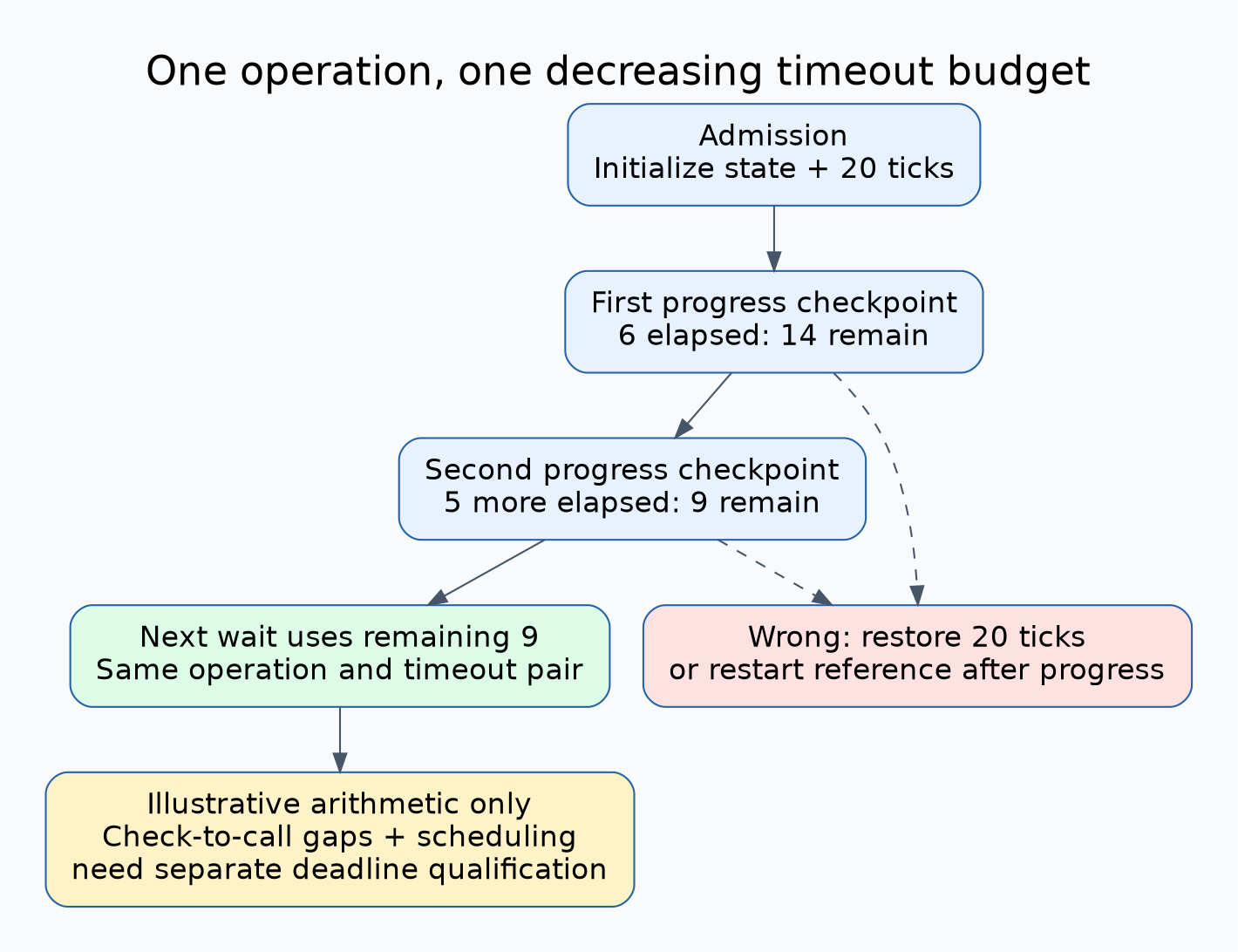
Suppose a hypothetical response requires three fragments and allows twenty ticks from admission. If the first fragment arrives after six ticks, the next wait should use fourteen remaining ticks. If another five ticks pass before the next checkpoint, nine remain. Restarting twenty after each fragment allows a stream of partial progress to postpone failure indefinitely.
Keep the timeout object and remaining value together
The V11.1.0 task header defines vTaskSetTimeOutState and xTaskCheckForTimeOut. The first captures a reference. When the second reports that time remains, it updates both the reference and the remaining-ticks argument. Keep that mutable pair private to one operation owner.
Initialize the pair once. Before another potentially blocking step, call xTaskCheckForTimeOut with the same objects. If it returns pdFALSE, pass the updated remaining value to the next wait. If it returns pdTRUE, follow the operation’s timeout or cancellation policy instead of creating another full-length wait.
The tagged implementation subtracts elapsed ticks when the finite budget remains and sets the remaining value to zero on ordinary expiry. Reinitializing only the reference loses elapsed time; restoring only the original remaining value replenishes the allowance. Reinitialize both only when a genuinely new operation begins.
Do not confuse a queue’s local timeout with your budget
A queue call receives its wait argument by value and maintains its own wait state. It does not update the application’s remaining variable. After a successful partial receive, the caller must still update its operation-level pair before waiting again. The matching queue source shows that local timeout machinery.
Likewise, do not subtract the last wait duration manually and then ask xTaskCheckForTimeOut to subtract the same interval. That double-charges elapsed time. Choose one accounting mechanism and preserve its state consistently across queue waits, semaphore acquisition and other steps whose APIs accept the chosen tick budget.
A useful review worksheet has one row per blocking call: entry milestone, remaining value supplied, API result, progress obtained, elapsed-time checkpoint and disposition on failure. It should reveal any call still receiving the original constant instead of the updated value.
Separate budget expiry from completion semantics
Decide whether success means obtaining all requested fragments, obtaining at least one useful fragment, or committing a complete transaction. On timeout, preserve the count and ownership of partial results. An expired budget does not undo a command already transmitted or automatically return acquired buffers to their original owners.
Also decide how to treat a final successful wait whose processing finishes after the preferred deadline. A tick budget controls permitted blocking at checkpoints; scheduling, interrupts and processing still consume real time. If late results must be rejected, check the application deadline at the relevant acceptance milestone and dispose of the result safely.
There is a check-to-call gap: the task can be preempted after updating the remaining value but before entering the next relative-timeout API. That API can then begin its wait later. Keep the gap short and analyze it, but do not hold an inappropriate critical section across a blocking call to manufacture atomicity. Hard end-to-end timing requires target response-time qualification beyond this bookkeeping pattern.
Respect configuration-dependent branches
When suspend support is enabled, xTaskCheckForTimeOut treats portMAX_DELAY specially rather than as this guide’s finite budget. Keep the finite-only contract explicit. If the application requires an immediate attempt at zero budget, implement that policy deliberately with a nonblocking operation; the fixture’s zero-budget timeout check simply expires.
When xTaskAbortDelay support is enabled, the timeout helper can also report true after consuming an aborted-delay condition. That is not evidence that the elapsed-time deadline was reached. Systems using that facility need a separate synchronized application cancellation reason and result policy. The executed budget fixture excluded it to isolate ordinary finite-time accounting.
What the host fixture actually established
Three successive checks began with 5000 ticks and followed controlled three-tick delays. The observed remaining values were 4997, 4994 and 4991. The fixture compared each subtraction with the actual tick difference inside a short observation critical section; it did not assume a host delay always lasts exactly its requested duration.
A finite expired budget returned true with zero remaining, and an initial zero budget did the same. A separate partial-progress case received two of three expected queue items. Its successive wait allowances were thirty, twenty-six and twenty-two ticks, after which the missing third item timed out. Observed elapsed time was thirty ticks in that run, not a promised return-time bound.
These were compiled kernel/API tests using GCC 14.2.0 and the upstream POSIX port. They did not force rollover, emulate an MCU tick width or measure board latency. A target integration should repeat the partial-progress and delayed-processing cases with its actual port, tick rate and workload.
Release gate
Accept the loop when every additional wait uses the current remaining value, progress never silently replenishes the budget, and each failure leaves partial work with a defined owner. Archive the per-call worksheet and controlled tests with the effective configuration. The result should be one coherent operation budget, with separate evidence for any stricter completion deadline.