OpenMP in a Buildroot Product: Verify libgomp, Thread Limits and Application Responsiveness
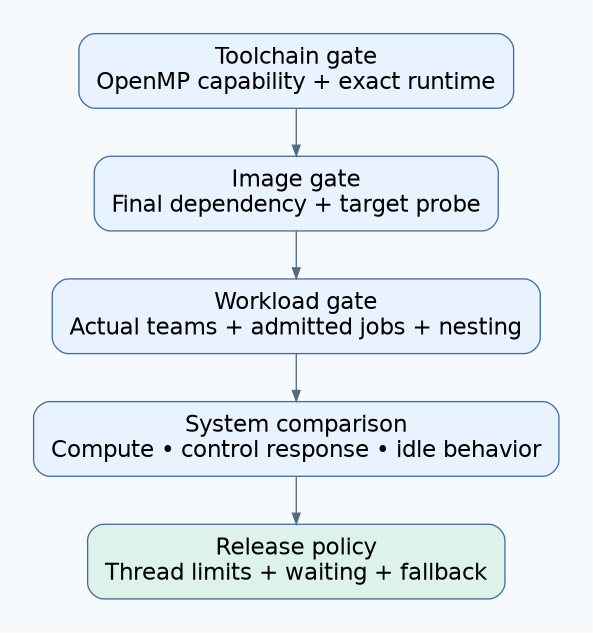
Qualify OpenMP at three separate boundaries: compiler support, runtime deployment, and the effect of parallel work on the whole product. A successful link proves neither that the target image contains the required runtime nor that additional workers improve responsiveness. Start with a small team-size probe, then test representative computation while the product’s other tasks remain active.
The reference baseline is GCC/libgomp 14.2 and Buildroot 2025.02 configuration source. The example was compiled and executed with GCC 14.2.0 on a Linux host, not on a Buildroot target. This article covers CPU OpenMP execution, not accelerator offload. Toolchain features, libc, architecture, vendor patches, and application directives can change the available behavior.
1. Confirm the toolchain capability deliberately
The Buildroot 2025.02 GCC configuration provides BR2_GCC_ENABLE_OPENMP for the internal compiler and selects the OpenMP capability symbol. That revision includes thread-support and architecture dependencies. Do not force an unavailable option through a configuration fragment and assume the resulting toolchain supports it.
For an external toolchain, inspect its actual OpenMP capability and Buildroot’s matching configuration. The internal-compiler switch is not a way to add missing features to an imported compiler. Save the toolchain identity and generated configuration with the image. If the toolchain changes, follow the Buildroot manual’s rebuild guidance rather than trusting stale application objects.
The GCC 14.2 libgomp manual documents -fopenmp as enabling OpenMP directives and arranging runtime linkage. Apply it to the relevant compilation and final-link steps. A successful compilation without the intended directives enabled can produce a misleadingly serial test.
2. Prove runtime deployment with a small probe
Use this minimal C program to report the actual team observed inside one parallel region. It does not measure performance or verify application parallel correctness.
#include <omp.h>
#include <stdio.h>
int main(void)
{
    int observed = 0;
    #pragma omp parallel
    {
        #pragma omp single
        observed = omp_get_num_threads();
    }
    printf("team=%d limit=%d\n", observed, omp_get_thread_limit());
    return observed > 0 ? 0 : 1;
}
For the host-only example, the source file was named team-probe.c and built with:
gcc -O2 -fopenmp team-probe.c -o team-probe
OMP_NUM_THREADS=2 OMP_THREAD_LIMIT=2 OMP_DYNAMIC=FALSE OMP_MAX_ACTIVE_LEVELS=1 OMP_WAIT_POLICY=PASSIVE ./team-probe
Test status: the host run printed team=2 limit=2 and returned zero. Requesting four threads while retaining the two-thread limit also produced a two-thread team in this simple test. Binary inspection showed a dependency on libgomp.so.1. These are local observations, not target results or a guaranteed outcome for every program.
For the product, cross-compile the probe using its maintained build process. Inspect its dependency records with the target toolchain, confirm the corresponding runtime is in the final image, and execute it on a recoverable target. A development sysroot containing libgomp is insufficient evidence about the installed root filesystem. A statically linked build needs its own dependency and runtime checks.
3. Define the parallel-work boundary
The pinned libgomp manual distinguishes requested team sizing, dynamic adjustment, active nesting limits, and thread limits. Set a conservative initial policy and record actual team sizes at relevant regions. Do not treat a requested number as an observation. An application can also use clauses or runtime calls, so review them alongside launch-time settings.
Start qualification with one admitted compute job. Then test the maximum permitted number of simultaneous jobs, including calls through libraries that may create their own parallel regions. Count all product processes that can invoke OpenMP. A per-runtime configuration does not reserve CPU capacity for another service or establish a device-wide thread budget.
Write down who owns concurrency: the request dispatcher, the compute library, or both. If every request may create a worker team, cap admitted requests as well as team size. Confirm that the queue limit is enforced before expensive work begins, and define what a rejected or delayed request looks like to the caller.
4. Treat waiting behavior as a test variable
The official OMP_WAIT_POLICY reference describes active versus passive waiting. GOMP_SPINCOUNT controls libgomp’s busy-wait spin count. These controls influence waiting behavior; they do not supply a real-time scheduling guarantee. Confirm the exact release’s behavior instead of importing tuning values from a desktop benchmark.
Compare active and passive policies under the same burst pattern. Include quiet intervals between compute jobs, because the effect of waiting workers may matter there. Observe control-task latency, idle power behavior, and the time to start the next computation. Do not select a policy only because one isolated compute kernel finishes sooner.
Leave spin-count tuning until a measured problem justifies it. Change one setting per comparison and preserve the previous configuration. If a different policy improves one deadline but worsens another, the product owner needs that tradeoff explicitly.
5. Use a whole-product acceptance matrix
| Test condition | Observe | Decision |
|---|---|---|
| Single-thread baseline | Correct results, compute time, control-response distribution | Establish the comparison before adding workers |
| One parallel job | Observed team size, memory demand, output equivalence | Reject unexplained result changes or missed deadlines |
| Maximum admitted concurrent jobs | Runnable work, queue depth, service responsiveness | Reduce admission or team size if product limits fail |
| Repeated bursts with idle gaps | Waiting behavior, recovery, retained resources | Select a wait policy from measured system behavior |
| Reduced CPU availability and thermal conditions | Deadline compliance and throughput at the intended operating boundary | Define degraded operation rather than assume nominal capacity |
State the acceptable response percentile and maximum timeout using the product’s requirements, not invented universal thresholds. Preserve the input data and completed-job count so two runs are comparable. Also check correctness with the permitted floating-point tolerance where reductions change evaluation order.
6. A hypothetical image-analysis gateway
Suppose a gateway analyzes camera frames while serving a local commissioning interface. Its new build links successfully, but simultaneous frame jobs make the interface unresponsive. First reproduce with one admitted job and a small team. Then vary admission separately from team size and waiting policy.
If a smaller team meets the frame deadline and preserves commissioning responses, it may be the better product setting even without the shortest standalone compute time. If no configuration meets both requirements, reduce workload, change the algorithm, or revisit hardware capacity. The host probe cannot decide that tradeoff.
7. Record a bounded release decision
Ship the compiler/runtime versions, image dependency evidence, launch policy, concurrency limit, and workload acceptance results together. Keep a serial or otherwise qualified fallback if the product design requires one. Requalify after changes to compute libraries, thread directives, CPU availability, or the toolchain. OpenMP is ready when the complete product remains correct and responsive under its approved workload, not merely when the compiler accepts a pragma.