Peripheral Register Access After Reset: Reapply Configuration Without Replaying Side Effects
After reset, restore the intended configuration rather than replaying every byte previously written or read. Registers can contain persistent settings, transient commands, live status, calibration, and results. Some combine settings and actions in one byte. A safe recovery path classifies those fields, rebuilds allowed writes, and starts new work only through an explicit operation.
Applicability: the concrete example is Bosch BME280 over I2C. The official PDF inspected on 14 October 2026 has a revision 1.24/February 2024 cover, BST-BME280-DS001-24, but revision 1.23/January 2022 interior footers. This document-label inconsistency is recorded rather than assigning one revision to all pages. Linux v6.12 regmap is discussed only as a separate cache-design reference.
1. Separate desired settings from the last bus image
A register dump describes observations at one moment. A write log describes operations already requested. Neither is automatically a restart script. Maintain a desired-configuration object whose fields express application intent, then encode that object using the current device’s documented register rules.
For every writable field, record whether repetition is harmless, whether order matters, and whether the field starts an operation. For every readable field, record whether it is live, destructive, device-specific, or merely diagnostic. Keep reserved locations out of both generic replay and speculative readback.
The key review question is: “If this value is written again after reset, what happens now?” A value that was correct during a previous transaction can request a new transaction when replayed. Treat that as a new action requiring ownership and completion tracking.
2. Build a BME280 replay classification
The BME280 memory map and register descriptions support the following recovery classification. It is a proposed software policy derived from those access semantics, not a command to write the entire address range.
| Register or field | Recovery treatment |
|---|---|
| ctrl_hum, 0xF2, oversampling | Rebuild from desired humidity settings. |
| ctrl_meas, 0xF4, oversampling fields | Restore persistent temperature/pressure choices. |
| ctrl_meas mode bits | Choose the recovery phase deliberately; do not replay an old trigger. |
| config, 0xF5 | Restore approved filter, standby and interface fields while sleeping. |
| reset, 0xE0 | Exclude from configuration replay; 0xB6 is a reset command. |
| Status, identity, calibration, measurement data | Read through their appropriate paths; never restore them as settings. |
This table has two useful outputs: an allowlist of restoration writes and a separate list of explicit actions. Review both whenever adding a driver feature. A new diagnostic register should not silently enter the restore allowlist merely because it appears in a saved dump.
3. Work a mixed-field byte example
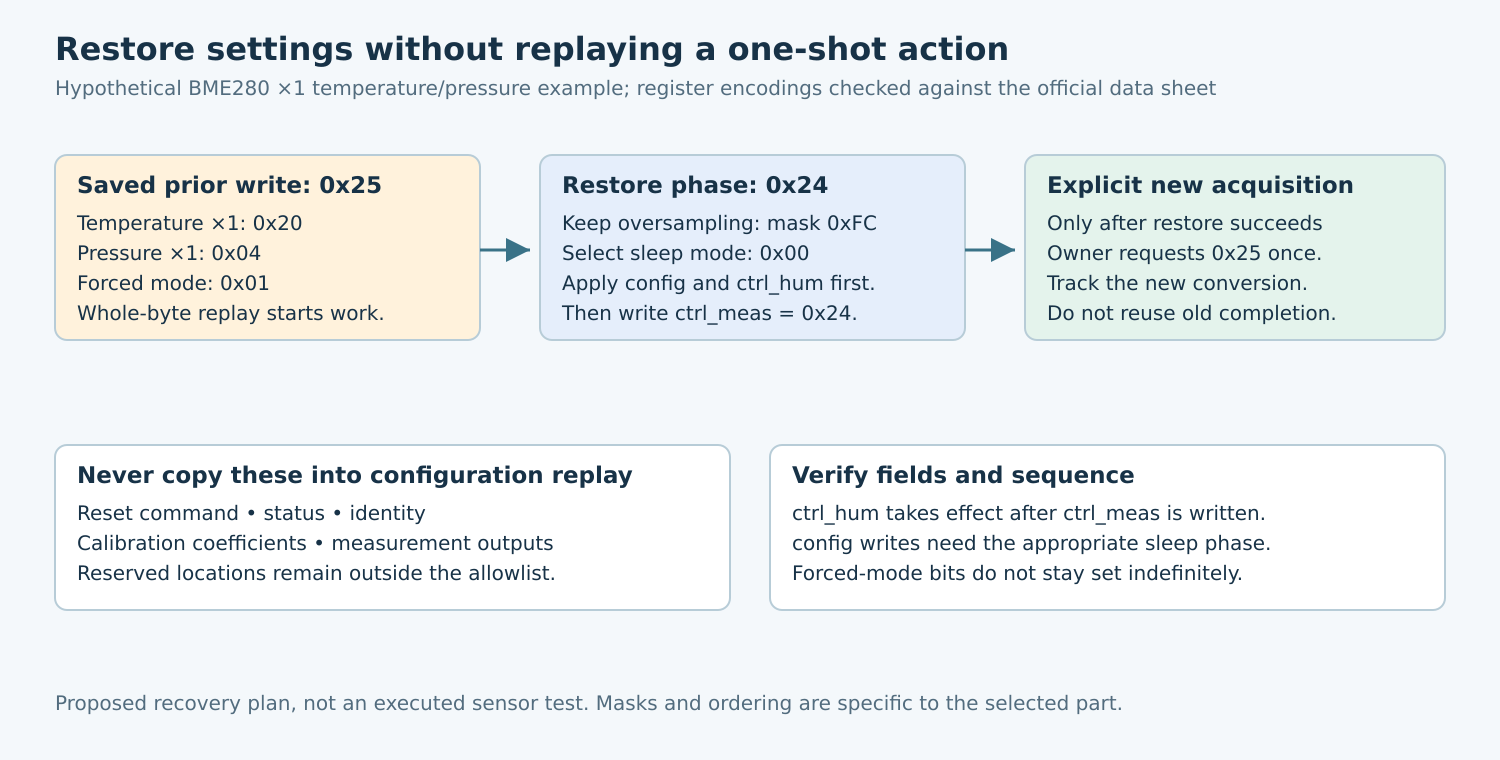
For a hypothetical desired configuration, choose temperature and pressure oversampling ×1. In ctrl_meas, these encode as 0x20 and 0x04. A forced-mode request using mode value one produces 0x25; the same settings with sleep mode produce 0x24. These encodings follow the data sheet’s ctrl_meas tables.
Suppose software saved 0x25 from its previous accepted write. Replaying that complete byte after reset would request another measurement. To restore settings without that action, retain the oversampling bits with mask 0xFC and deliberately select sleep, giving 0x24. Later, the acquisition owner can issue 0x25 once as a new tracked operation.
This arithmetic is illustrative and has not been executed against hardware. It is not a universal “mask off two bits” repair. Other devices place commands elsewhere, use different write semantics, or require reserved bits to retain specified values. Generate masks from the exact register definition.
Also distinguish desired continuous operation from a stale one-shot command. If the application wants normal mode after recovery, make entering that mode a deliberate final transition. The configuration object can preserve the desired operating policy without storing a transient bus byte as the policy itself.
4. Restore in a validated phase and order
Begin only after the device’s reset and internal initialization prerequisites are satisfied. Quiesce acquisition, invalidate current results, and prevent competing configuration writers. This article’s additional outcome is the filtered replay plan, not a replacement for the device’s startup procedure.
BME280 config writes may be ignored in normal mode, while sleep-mode writes are accepted. ctrl_hum changes become effective after a ctrl_meas write. Forced mode returns to sleep after a measurement. These details determine both restoration order and meaningful readback.
For the hypothetical I2C fixture, an explicit plan is: write config 0x00 for the selected filter-off/default standby/interface fields; write ctrl_hum 0x01 for humidity ×1; write ctrl_meas 0x24 to apply oversampling while staying asleep; verify the permitted persistent fields; then let the acquisition owner request 0x25 when a new sample is wanted.
Check each transport result. A failed write leaves the restoration incomplete, even if later reads respond. Do not label the device configured until all required steps and permitted verification succeed. On failure, retain the stage and error, then retry or reset only under a bounded recovery policy.
5. Make cache metadata express access semantics
The Linux v6.12 regmap configuration distinguishes writeability, readability, volatile values that cannot be cached, and precious registers that should not be read outside driver-controlled access. These are different properties, not synonyms for “special register.”
If using a cache framework, audit its configuration against the replay table. A read-only identity register and a destructive status register need different handling. A mixed settings/action register may require driver-managed restoration rather than blind cache synchronization. A library cannot infer those meanings from the register address.
Keep the cache’s software view consistent with the real reset. Otherwise a later update helper can decide that a desired value already exists and skip the hardware write. Review the selected framework’s dirty-state and synchronization protocol; do not add a whole-map replay merely to make the cache look current.
6. Test the write trace, not only the final value
Propose a register-model test that records every restoration write. Require no writes to reset, status, identity, calibration, or data locations; require the sleep-phase settings before any explicit trigger; and require exactly the intended acquisition request afterward. These tests have not been run here.
Inject failure after each allowed write and check that no sample is published under an incomplete configuration. Include a saved 0x25 case, a deliberate normal-mode policy, and an interrupted restore. Verify readback using field semantics: expecting mode one to remain forever after a forced conversion is itself an incorrect test.
The acceptance artifact is a field-class table, generated write plan, failure-stage record, and trace showing that restoration does not accidentally reset or retrigger the device. This makes recovery explainable even when the final register dump happens to look correct.