Unsupported Signature Algorithms in Bootloaders: Fail Before Manufacturing a Batch
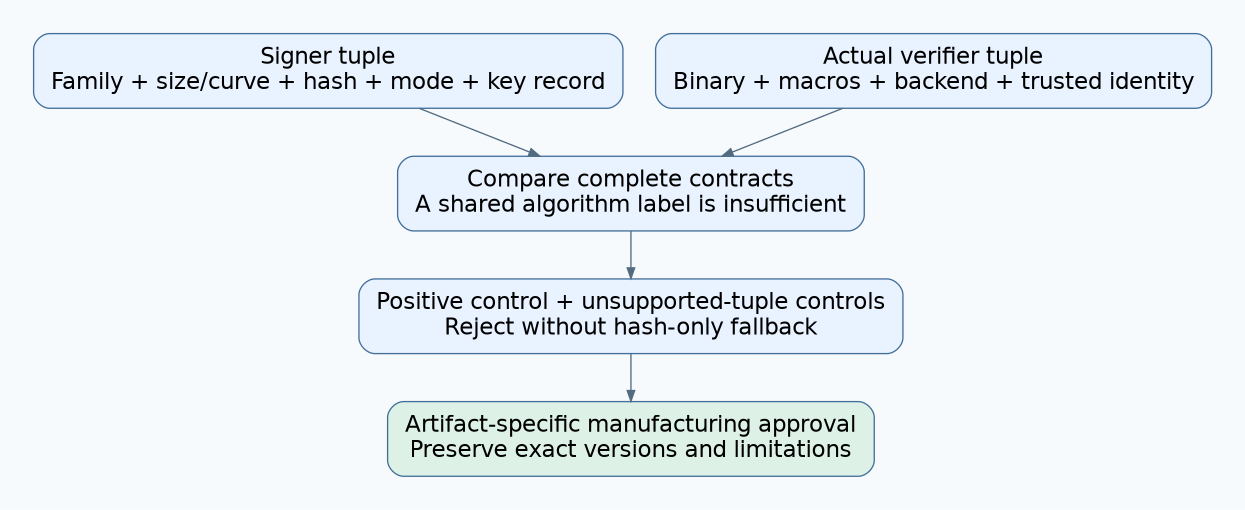
Approve a complete signer/verifier format tuple before programming a manufacturing batch. A signing tool may support several algorithms while the deployed bootloader accepts one compiled signature type, one representation of trusted key identity and a particular signing mode. Successful signing proves none of those target capabilities.
This guide pins MCUboot v2.2.0’s Zephyr integration and image-validation source. It is a compatibility qualification method, not an algorithm recommendation or a key-provisioning procedure. No signing keys were generated or used, and no target verification or manufacturing operation was executed.
1. Record more than an algorithm name
Define the release tuple: image-tool revision, signature family, key size or curve, image hash choice, pure-versus-hash signing mode, key representation, verifier build and cryptographic backend. Include the public trust identifier without exporting private material.
The pinned image-tool guide lists tool capabilities and says the key type must match MCUboot’s configured verification. A host machine accepting a signing option does not establish that an older bootloader contains the corresponding parser or cryptographic implementation.
Keep image signing separate from transport encryption and TLS certificate algorithms. An HTTPS client supporting a curve does not mean MCUboot can verify an image using that curve.
2. Resolve the actual verifier choice
The Zephyr Kconfig selects signature type and its implementation dependencies. Record the resolved configuration from the final build, not a list of menu entries that could have been selected.
The mapping header converts those choices into MCUboot macros and explicitly accepts RSA lengths of 2048 or 3072. Do not interpret the numeric menu range as support for every intervening integer.
The validation implementation selects an expected signature TLV and rejects a build combining multiple signature-type macros. A binary compiled for one family is not a general runtime algorithm-negotiation service.
| Tuple dimension | Example distinction | Required evidence |
|---|---|---|
| Signature family | RSA versus ECDSA versus Ed25519 | Generated verifier macro and expected TLV |
| Size/curve | RSA-2048 versus RSA-3072; selected elliptic curve | Exact compiled size or curve and parser support |
| Signing mode | Hash-then-sign versus pure image signature | Matching tool setting, verifier branch and memory requirements |
| Public-key representation | Key hash versus full public key record | Expected record type and trusted identity lookup |
| Backend | Selected software or platform implementation | Resolved provider, linked implementation and dependencies |
3. Treat pure signing as a separate format contract
In the scoped integration, the Ed25519 pure option signs the image directly rather than the ordinary image digest. Its Kconfig help also requires image bytes to be accessible through memory addresses usable by the cryptographic implementation.
Record that mode explicitly on both sides. Two artifacts labelled “Ed25519” can therefore make different assumptions about the signed input. Do not infer compatibility from the key family alone or substitute a digest where the selected verifier expects direct image access.
Qualify the selected storage and loading arrangement with that branch. This article does not establish pure-mode support for arbitrary external flash, encrypted images or vendor extensions. A compatible host operation can still fail on the target’s access path.
4. Bind key representation to an independent trust source
The ordinary compiled-key path expects a key-hash record that identifies an accepted public key. The hardware-key path instead processes a full public-key record and compares its hash with a value supplied by the platform trust interface in the pinned implementation.
Shipping the full public key does not make it automatically trusted. Verify the source, size and failure behavior of the platform trust lookup. A mismatch or unreadable trusted identity must not be repaired by accepting whatever key the image supplies.
If the product uses a built-in-key interface or downstream customizations, extend the tuple and source review accordingly. Do not assume that changing only the image tool’s public-key-format option is a complete migration.
5. Build a compatibility matrix with controls
Use approved test keys and inert payloads in an isolated qualification environment. Preserve the original images and the exact production-intended verifier binary, without altering its trust policy for convenience.
| Fixture | Required interpretation |
|---|---|
| Approved tuple and expected public identity | Positive control passes the intended verification path |
| Different signature family with otherwise valid structure | Unsupported tuple rejected; no silent hash-only fallback |
| Same family, unsupported size or curve | Format/provider mismatch rejected |
| Pure/hash signing-mode mismatch | Rejected under the fixed verifier contract |
| Wrong key representation | Missing or incompatible trusted-key lookup fails |
| Supported tuple, unrelated public identity | Authorization control rejects even though the algorithm is supported |
| Correct identity, altered protected bytes | Integrity/authentication check rejects |
Record the exact rejection stage. A malformed container that never reaches signature dispatch does not establish unsupported-algorithm handling. Likewise, failure of the positive control makes the comparison inconclusive.
Hypothetical RSA-size mismatch
A production signing job begins producing RSA-3072 artifacts while the deployed verifier was built for RSA-2048. Both formats are supported somewhere in the project, and the signing job completes. The frozen tuple comparison still fails because the specific verifier expects the other signature record and size.
Stop the affected release before manufacturing. Determine whether the signer configuration drifted or the approved verifier capability needs a separately qualified transition. Do not repair the mismatch by disabling signature verification or trying whichever setting makes the sample boot.
6. Gate manufacturing on artifact-specific evidence
Bind approval to the actual bootloader binary, generated configuration, cryptographic provider identity, public trust identifier and representative signed artifact. Retain negative results that demonstrate unsupported tuples cannot degrade into integrity-only acceptance.
Repeat the matrix after changing the image tool, backend, compiler configuration, signing mode or trusted-key representation. A provider upgrade may require renewed compatibility evidence even when the human-readable algorithm label stays the same.
The deliverable is a supported-tuple ledger with exact limits and test results, not a broad claim that the product “supports RSA” or “supports secure boot.” Algorithm compatibility is necessary for an accepted image; it is not a complete product-security assessment.