FreeRTOS on Raspberry Pi Pico: Check Target Definitions Before Editing FreeRTOSConfig.h
Two Pico executables can include the same FreeRTOS configuration header and still compile with different kernel settings. Target-level definitions and fallback values can make a header edit appear ineffective or affect a different executable than expected.
Before changing scheduler or allocation options, inspect the configuration seen by the actual compilation unit. This article follows Raspberry Pi's official FreeRTOS example files as inspected on October 19, 2026. The repository branch can change, so the same checks must be applied to the project's recorded revision.
Follow the example's target-specific choices
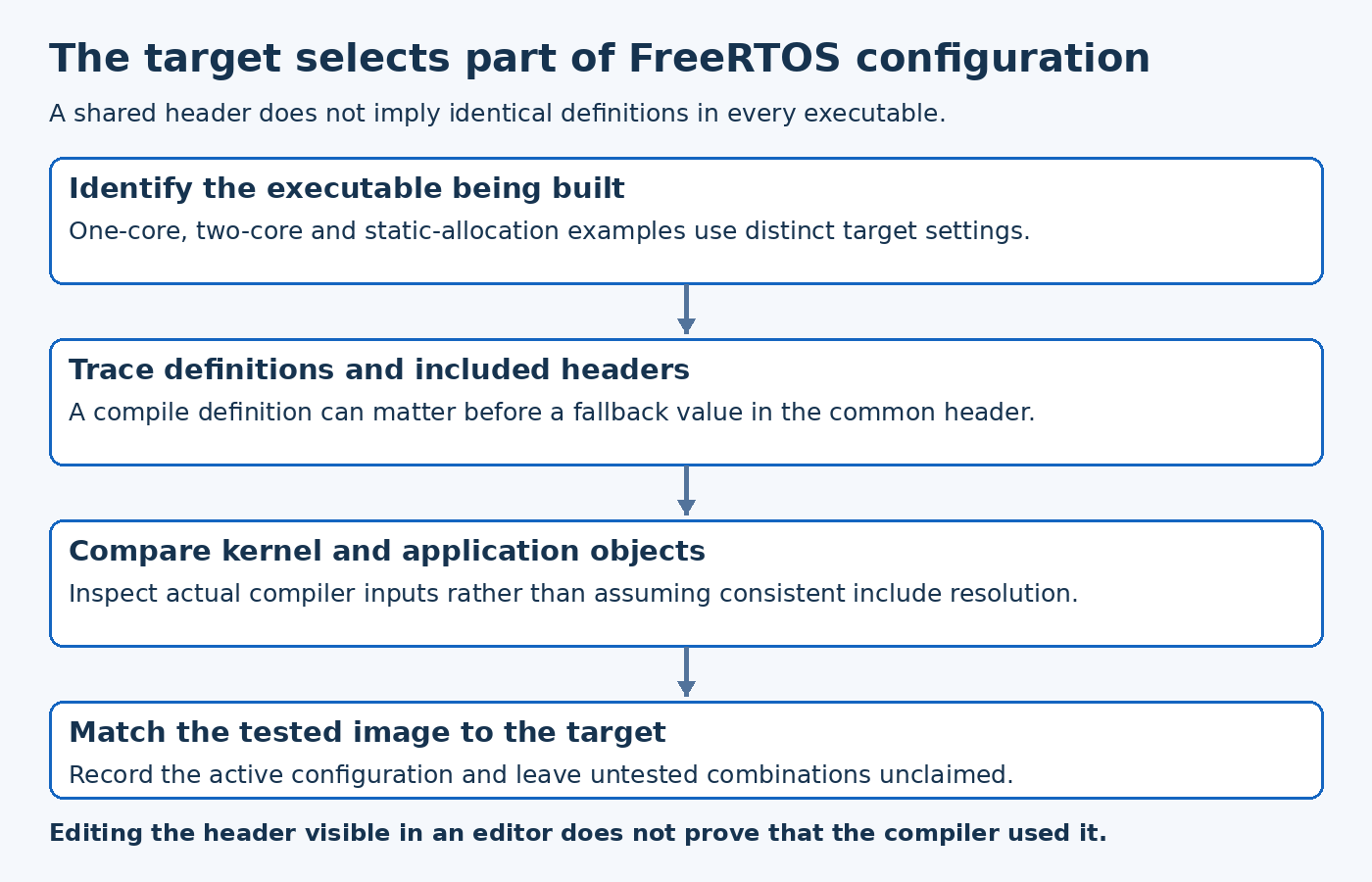
The official hello_freertos CMake file builds separate one-core, two-core and static-allocation executables from the same application source. It gives the one-core target an explicit core-count definition. The static target links the static kernel target and explicitly selects static allocation while disabling dynamic allocation.
That structure explains why editing a shared source file is not enough to understand the resulting firmware. The executable target determines part of the compilation environment. Building one target and flashing another output can produce observations that seem to contradict the edited configuration.
For a hypothetical application derived from the examples, first identify the exact target used to create the flashed image. Keep its build directory and output path unambiguous. Do not use the names “debug build” or “Pico firmware” as substitutes for the actual target identity.
Follow the include chain, including fallback definitions
The example's FreeRTOSConfig.h includes a shared configuration header. The common file contains application defaults and conditional definitions. A value supplied earlier by the build can therefore be relevant even when the developer is reading a different value's fallback in the header.
Inspect the preprocessed result for the translation unit that matters. The question is not merely which file your editor opened, but which configuration file and definitions the compiler actually consumed for the kernel, port and application objects.
If multiple copies of FreeRTOSConfig.h exist in the project and dependencies, trace the include search order. Renaming or deleting random copies is a poor diagnostic method because it changes the build while obscuring which copy was responsible. Establish the selected path first.
Compare compilation units rather than assuming consistency
A custom CMake integration can accidentally compile application and kernel objects with different configuration inputs. Compare their compiler invocations and relevant preprocessed definitions. Use the build system's supported verbose or compilation-database output rather than reconstructing flags from memory.
Pay particular attention to configuration that changes interfaces, structures or selected implementation paths. A successful link does not establish that every object was compiled under the intended assumptions. Conversely, a compile-time error can be useful evidence that inconsistent settings have reached a boundary.
When correcting target wiring, preserve the failing configuration for comparison and create a fresh build directory for the changed setup. This separates input changes from stale generated files without discarding the evidence needed to explain the original problem.
Validate the intended variant, not every possible combination
After identifying the effective settings, test the smallest variant the application actually needs. A project requiring static allocation should validate that variant deliberately; it should not accidentally inherit a dynamic example's target linkage and then interpret the resulting behavior as a kernel defect.
Record which configuration choices were exercised and which remain untested. Avoid presenting a matrix of combinations as supported merely because CMake can generate them. Target selection, successful compilation and runtime behavior are separate evidence.
The useful result is a reproducible configuration chain: executable target, compile definitions, selected header and final image. Once those agree, changes to FreeRTOS settings become controlled experiments rather than guesses about a file whose contents may not be the active configuration.