Zephyr OS Shell and Binary UART Traffic: Assign Ownership Before Sharing a Port
A UART that successfully prints a shell prompt is not automatically available for an independent binary protocol. If the shell and application both consume received bytes or install callbacks on the same device, a framing problem may actually be an ownership conflict. Resolve who controls the transport before changing protocol checksums or increasing buffers.
This article examines Zephyr 4.4.0's serial shell backend. It describes an integration review, not a tested multiplexing implementation. A deliberately designed shared transport can work, but two unrelated consumers do not become a multiplexer simply because they reference the same UART.
Find the device the shell actually uses
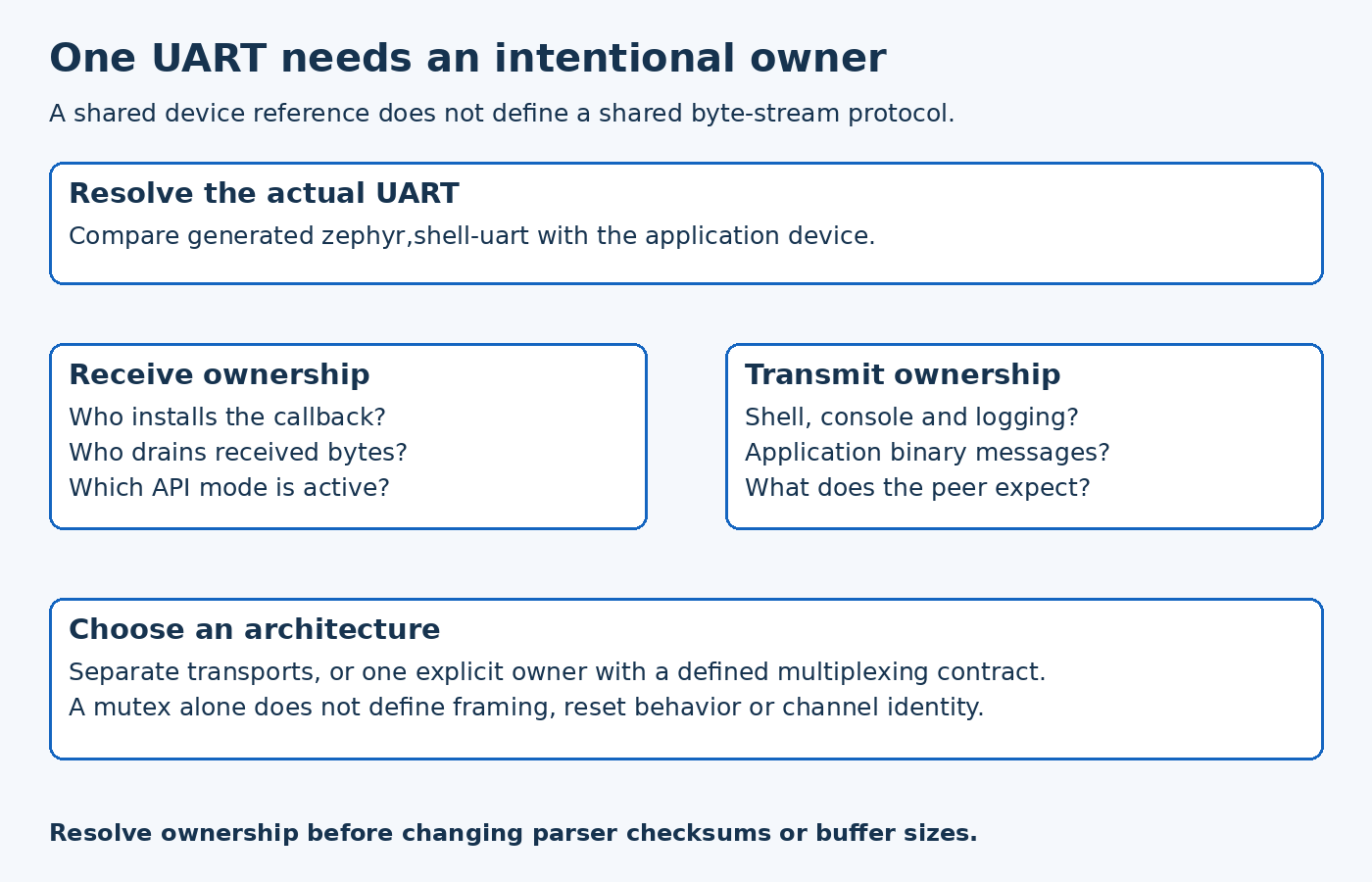
The tagged serial shell implementation obtains its device from the zephyr,shell-uart chosen entry. Resolve that entry in the generated devicetree, then compare it with the device used by the application protocol. Board names and connector labels are insufficient: aliases, overlays, and chosen entries can resolve differently from expectations.
Also identify console and logging destinations. They are separate configuration concerns, even when a board routes several of them through the same physical connector. Moving the shell alone does not establish that no other subsystem can insert bytes into the protocol stream.
Draw a small ownership map with physical UART, receive consumer, transmit producers, and enabled API mode. Include boot-time output if the peer begins parsing immediately after reset. A parser that sees a valid frame after initialization may still encounter a prompt or banner earlier.
Check the receive path before the decoder
The shell backend has interrupt-driven, asynchronous, and polling receive paths. Its interrupt-driven initialization installs a UART interrupt callback and enables reception. Its asynchronous path installs its callback and provides receive storage. The polling path reads bytes into the shell's ring buffer.
These details matter because an application may also try to install a callback or drain the same UART. Do not assume callback registration automatically fans bytes out to both clients. Inspect the selected driver and API contract, including return values from registration and enable operations. A successful compilation proves neither shared ownership nor delivery to the intended parser.
A useful hypothetical symptom is a binary receiver that works until the shell initializes. Rather than assuming a baud-rate change, compare initialization order and ownership changes. If one subsystem replaces or competes with the other's receive mechanism, a larger application buffer cannot repair the lost ownership relationship.
Separate byte ownership from message framing
Even if writes are serialized, that only prevents concurrent access at a particular implementation boundary. It does not define which complete messages the peer should interpret as shell text and which as binary data. A prompt can be syntactically harmless to a person and destructive to a protocol expecting a fixed header.
The shell backend configuration includes prompt and mode settings, along with a shell logging level. Disabling one visible prompt should not be treated as proof that all shell output, echo, or log traffic is absent. Inspect the actual paths enabled by the build.
Prefer a separate transport when the hardware and product requirements allow it. If sharing is required, define an explicit ownership layer and framing contract for both endpoints. That design needs to specify escaping or channel identification, parser resynchronization, flow control, and how reset returns both sides to an agreed state. Merely wrapping application writes with a mutex is not the whole design.
Distinguish supported integration from arbitrary sharing
The upstream shell backend contains integration for management traffic when the corresponding configuration is enabled. That is evidence of a specific coordinated path, not permission to inject an unrelated binary protocol into any shell session. Review the actual integration and peer expectations before adopting it.
Likewise, switching from interrupt-driven to polling mode changes how bytes are obtained; it does not by itself establish who owns them. Avoid using API-mode changes as a substitute for an ownership decision.
Test the boundary that can fail
For a proposed separated-port design, observe both physical outputs across reset and during active commands. For a proposed multiplexed design, exercise binary payloads containing control characters, simultaneous diagnostic output, truncated frames, and a reset of either endpoint. Expected results must come from the chosen framing contract, not from what happened to look readable in a terminal.
The decision is complete when every byte producer and receive consumer has an intentional route. At that point, protocol debugging can focus on framing and payload interpretation without a hidden shell consumer competing for the same stream.