Ignition Leased Tag Groups: Keep Closing a View from Quietly Changing Acquisition
A tag can update quickly while a view is open and slow down when the last view showing it closes, even though the Ignition gateway remains healthy. With a Leased Tag Group, that change can be the configured acquisition behavior. The lease belongs to the displayed tag, not automatically to every tag sharing its group.
For Ignition 8.3, qualify the unattended state as deliberately as the attended screen. A working demonstration with a dashboard open cannot establish the data available overnight, when every client and Designer view has closed.
Write down both rates and each displayed tag
The 8.3 Tag Groups reference says that displayed tags use the Leased/Driven Rate while undisplayed tags in the same group use the base Rate. Merely viewing a tag in the Tag Browser does not lease it. The base Rate is in milliseconds, and zero means no group execution at that base rate.
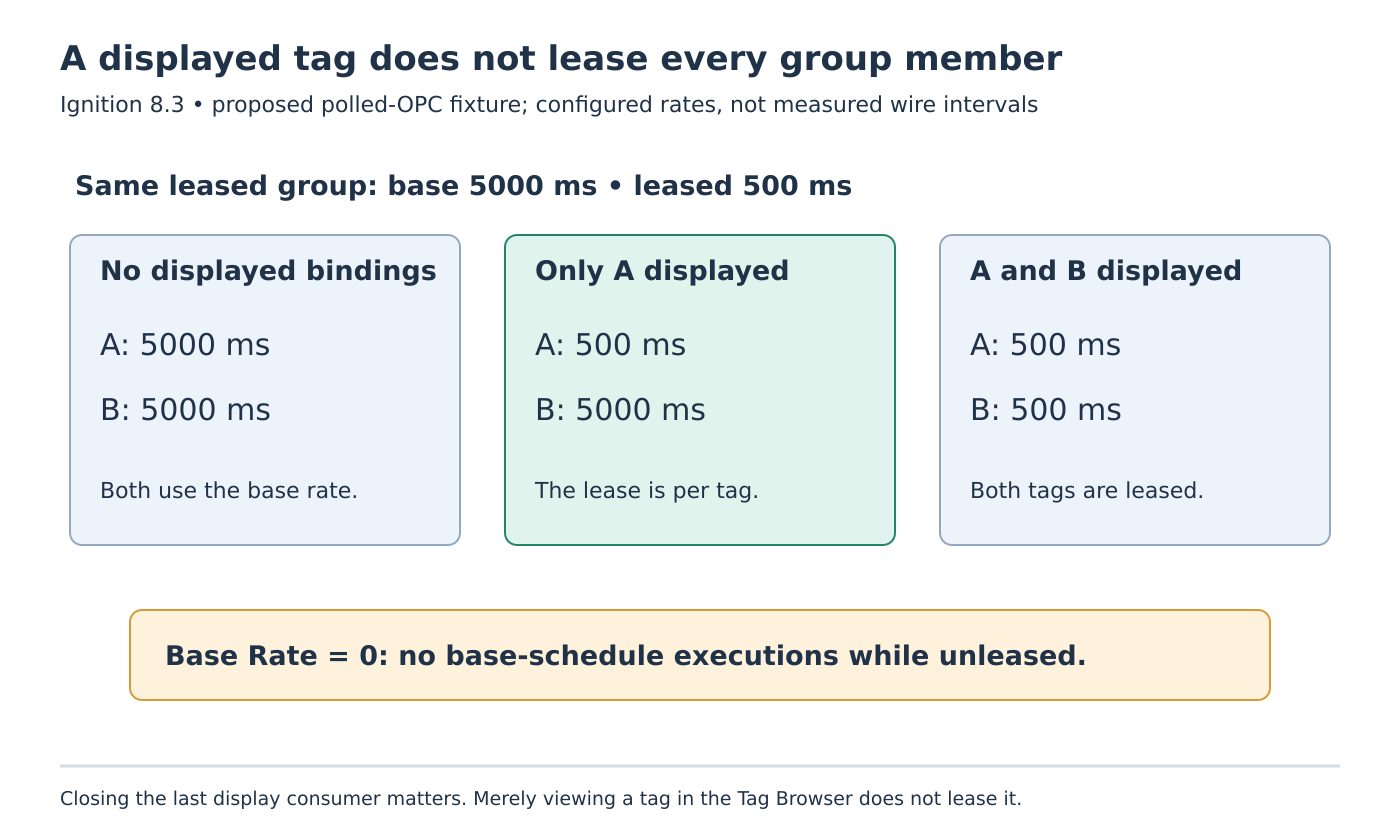
For a synthetic polled-OPC fixture, assign tags A and B to one leased group. Choose a base Rate of 5,000 milliseconds and a Leased/Driven Rate of 500 milliseconds. These are illustrative settings, not recommended production intervals or measured network timings.
Describe the intended states explicitly:
No view displays A or B:     A uses 5000 ms; B uses 5000 ms
One view displays only A:    A uses  500 ms; B uses 5000 ms
Views display both tags:     A uses  500 ms; B uses  500 ms
Last view of A closes:       A returns to its base rate
The last row assumes no other open view still displays A. Closing one browser tab is not proof that every client or Designer binding has released the tag. Inventory the actual display consumers before interpreting the result.
Keep group membership separate from the lease
A common diagnostic mistake is to observe A speeding up and conclude that B must also be acquired at the leased rate because both share a group. Leased mode specifically permits different rates within that group. Use an A-only view to expose that distinction.
Do not use a new screen showing B as the sole way to inspect B’s unattended behavior. Opening that screen changes the condition under investigation. Prefer gateway-side execution evidence or an appropriate diagnostic record that does not add another displayed binding.
Keep OPC data mode and server timing in the record. This example fixes the mode to Polled to make the requested acquisition schedule clear. Actual request grouping, processing delay and source sampling still require their own observation; a 500-millisecond group setting is not a guarantee of one wire request every 500 milliseconds.
Treat a zero base rate as a separate design choice
Repeat the state review with base Rate zero. Once unleased, a tag has no executions from that base schedule. This is materially different from merely taking fewer measurements. A final displayed value can remain plausible while no new observations are acquired through the intended scheduled path.
The official Leased Tag Group example warns that a zero slow rate supplies no updated tag data for history. Asking a historian to record more frequently cannot create measurements the acquisition path did not obtain.
That warning does not mean every history mode, query result or external alarm source universally stops. Qualify the configured consumers individually. A stored row containing a repeated old value is also different from a newly acquired measurement, so record sample context rather than counting database rows alone.
If the requirement is continuous unattended evidence, review whether a nonzero base schedule or another deliberately configured acquisition arrangement is needed. Do not keep a maintenance dashboard open as an undocumented substitute for that requirement.
Test the last-consumer transition
Prepare two harmless simulator signals with distinguishable changes. Establish the no-view baseline, open an A-only view, add a separate B view, then close them one at a time. Finally, close all relevant clients and Designer views. Preserve which consumers were open at each stage.
Repeat with the reviewed zero-base configuration only in the isolated fixture. Inspect scheduled execution and source observations alongside any history or alarm behavior the project actually requires. Reopening a view should be a new test phase, not retroactive evidence that the closed interval was adequately observed.
No gateway or simulator was operated for this article. The acceptance record should state what acquisition continues without an audience, how each tag obtains a lease, and which observation demonstrates the last lease ended. That keeps a screen-lifecycle choice from silently becoming the site’s data-collection policy.