ifm AL1432 Sensor Replacement: Choose Who Owns the Restored Parameters
Replacing an IO-Link sensor is not simply a matter of fitting the
same connector. The replacement can receive a stored parameter set from
its master, and the chosen storage mode determines whether later sensor
changes become the next stored set. Decide that ownership before a spare
enters the machine.
This article uses ifm AL1432 manual 11489157/02, February 2024.
IO-Link Interface and System Specification v1.1.4, June 2024, provides
protocol-level background for backup policies; citing that later
specification does not claim that a particular AL1432 firmware was
certified against it.
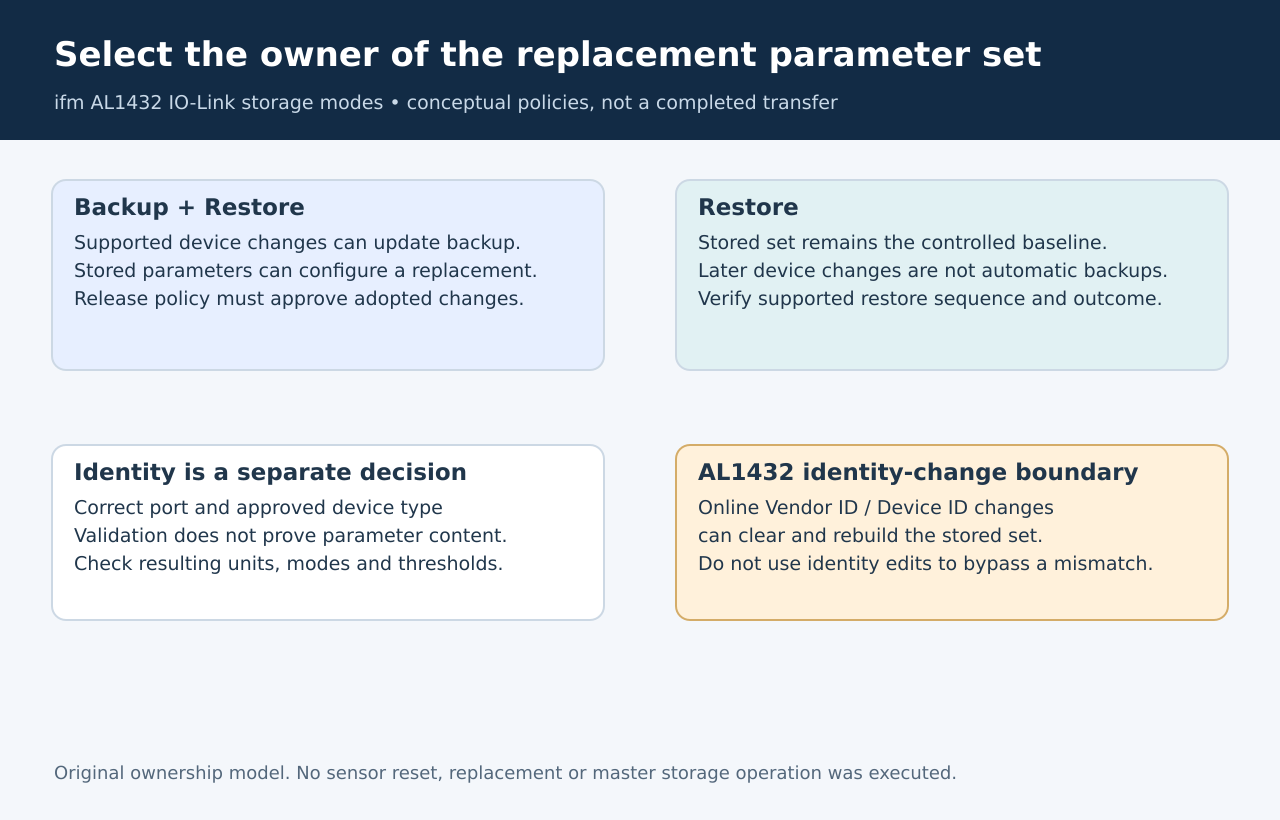
Original parameter-ownership model. No sensor replacement, reset or
parameter transfer was executed.
Separate
identity checking from parameter storage
The AL1432 offers validation modes without data storage as well as
V1.1 Backup + Restore and Restore modes. These features require the
port’s IO-Link operating mode. Its backup/restore selections check the
configured vendor and device identity and describe restoration to an
identical device with factory settings. AL1432
manual, sections 9.1.3.8 and 11.1.3.5
Accordingly, “the replacement passed validation” and “the approved
parameter set was restored” should be separate acceptance statements.
The first concerns what device is connected. The second concerns what
configuration it will use.
Keep the expected sensor identity, port and approved configuration
together in the maintenance record. A technician should not need to
infer the correct configuration from a live process value that happens
to look plausible.
Choose a moving
backup or a controlled baseline
Backup + Restore allows supported parameter changes to become the
stored backup. Restore retains a controlled stored set rather than
automatically adopting such changes. The IO-Link specification describes
upload-enabled versus upload-disabled policies and the associated
download behavior. Its sections 12.4 and 12.5 also distinguish device
replacement from replacing the master itself. IO-Link
specification v1.1.4
Consider a hypothetical pressure sensor whose approved threshold is
changed during commissioning. If the new threshold is intended to become
the machine’s maintained setting, the release procedure must establish
that the stored set reflects it. If production policy instead requires a
fixed approved set, automatically adopting every later adjustment would
undermine that policy.
Neither choice is universally better. The decision depends on who may
approve a parameter change and whether that change should survive a
sensor exchange. Document the intended direction of authority: accepted
device changes updating the backup, or the established backup governing
the replacement.
Do not treat the mode name as proof that a transfer has finished.
Verify the relevant configuration after the supported storage or
replacement sequence, including meaningful parameters rather than only
communication status.
Protect the
stored set during identity maintenance
There is a consequential AL1432-specific boundary: changing Vendor ID
or Device ID online in either backup/restore mode clears the data memory
and backs up the connected device’s parameters again. Therefore,
adjusting an identity field is not a harmless way to make a replacement
pass a check. It can change what will be restored later.
Before such a change, resolve whether the installed sensor is the
approved type and preserve the authoritative parameter record. If the
device type intentionally changes, treat that as a configuration
migration with new acceptance criteria, not routine like-for-like
replacement.
Qualify
the replacement procedure, not just the spare
An isolated qualification should distinguish an approved
factory-state spare, a previously configured spare and an identity
mismatch. Follow the applicable device instructions for preparing each
case; do not factory-reset production equipment merely to create a
convenient test condition.
For each permitted replacement, compare the expected identity and
selected parameters after restoration. Also confirm the resulting
application meaning: a correct numeric threshold in the wrong
engineering unit or operating mode is not an accepted configuration.
Finally, keep the master’s storage in the recovery plan. A spare
sensor procedure does not establish that a replacement master contains
the same backup. The maintainable outcome is an explicit parameter owner
and a checked recovery path for the equipment actually being
replaced.